Our readings for Palm Sunday are here. (https://bible.usccb.org/bible/readings/032424.cfm).
These are my notes and interpretations of Fr Dennis Dillon SJ’s homilies from the March 25, 2018 Mass at Noon and March 29, 2015 at St Mary Student Parish, Ann Arbor, MI.
______
The poem and reading Fr Dennis references are:
On Turning Ten by Billy Collins (25 Mar 2018 Noon)
Excerpt from I Know Why the Caged Bird Sings by Maya Angelou, pp 29 (“When I was around ten years old, …”) – 34 “… and hummed ‘ Glory, glory, hallelujah, when I lay my burden down.'”) (29 Mar 2015)
In 2018, D2 reflected —
While it is Palm Sunday and the entrance starts so promising, it feels Good Friday-ish because of the reading of the Passion. We hear this reading of the Passion again on Good Friday. But it seems a short time of celebration, even as we must admit Jesus probably knew the entrance was not an enduring celebration of his ministry or himself.
In the Spiritual Exercises of St Ignatius of Loyola, the spiritual movements of our soul towards God are captured by “Weeks.”
- The First Week is God’s Love for us and only then do we consider the sinful quality of ourselves and the world, the system of sin. These reflections inevitably, at some point, lead us to the conclusion: We need a Savior!
- The Second Week is when our spiritual reflection focuses on the Savior, and we walk with Jesus in his public ministry.
- The Third Week of the Spiritual Exercises is the Passion and Death of our Savior. We don’t focus so much on our guilt and shame (or even our own grief) because then we are not focused on Jesus. We do so because the details of his death and ongoing throes leading up to the Passion demonstrate he is human and we feel emotional attachment to him.
He seems mostly human in his Passion despite being able to have done something about it as God, but he consciously and conscientiously goes through this for Love.
He is bloody, he is human. There are two times we read of Jesus bleeding.
- The first is his ritual circumcision, and the bleeding is implied. This blood alone would have been enough for the sacrifice.
- The second is the Crucifixion, in which he pours out his blood. He suffers emotionally, socially, and physically in such a way that individuals suffering in all ways might know they are not alone. We are never alone in our sorrows or our joys.
Billy Collins’ poem touches on, perhaps, what Jesus as human might have had to face (as his time neared), and we certainly do. It seems only yesterday I used to believe there was nothing under my skin but light. // If you cut me I could shine. // But now … I bleed.
In the Jesuit mother ship in Rome, The Church of the Gesù, the apse generally has a painting of the Circumcision, and then a statue of the Sacred Heart is rolled out around that day’s observance. And, of course, the Altar Crucifix is present.
In 2015, D2 read and reflected on the excerpt from Maya Angelou’s I Know Why the Caged Bird Sings autobiography. The excerpt is when Maya Angelou’s Momma endures in Christ the mockery and attempted dehumanization of some poor white children of the area through violations of basic decency, manners to our elders, and more — all unbound from morality because of the children’s concept of race and God.
It remains one of my favorite Palm Sunday observances to this day — to have such a vivid reminder that the Passion and Crucifixion is all too alive in this time, still, for some of us. Our parish does a shared reading of the Passion — the Celebrant and two lay readers. The two lay readers that 2015 Palm Sunday happened to be student-parishioners, vibrant young women, and richly graced in their African-American identities. I can’t remember the particulars anymore, but my heart is singing, “Glory, glory, hallelujah, when I laid my burden down …”
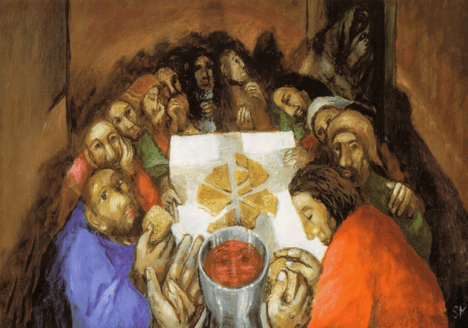
Our image is a repeat, The Last Supper by Sieger Koder. Which face are you drawn to?
 The Surest Sign