These are the poem, my notes, and interpretations of Fr Dennis’ homilies from the Masses of
Feb 2, 2020 Noon, Feast of the Presentation of the Lord (no homily notes)
January 30, 2011 (no poem)
_______
The poem Fr Dennis references is:
2020 homily — A Marriage Song by Wendell Berry
An introductory comment that these two entries (the Fourth and Fifth Sundays of Ordinary Time) are brief. These are my early note-taking efforts back in 2011 — as I was coming ’round the corner of one year returned to the Church. And, I was beginning to realize how precious — like salt! — Dennis’ homilies were, and all the more so set in a Mass of loving fellowship. Most of the Masses he celebrated left me square in the experience of God’s Love, and these two entries reflect the first stirrings (fifteen years ago) of my desire to leave trail markers in notes should I ever need guideposts to help me find my way to kind love through scripture and prayer.
In 2020, I listened this Sunday but did not capture any homily notes. Likewise, the poem is in Wendell Berry’s New Collected Poems (2012) and is well-worth finding, though I had no luck getting a link from the web. In recollection and without notes, my thought is that the repetition of “Our Mary in her day of days” in the poem is like a refrain in a hymn and would have struck D2 akin to the repetition of the “Blessed are …” introduction of each beatitude. However, I went back to the original spreadsheet and saw this Sunday was the Feast of the Presentation of the Lord.
In 2011, we reflected from D2’s homily that —
The Beatitudes
are beyond commandments
they are affirmative qualities rather than probabilities or conditionals
They are God-like qualities.
How can we do this or be these qualities, so extraordinary in sum total or individually?
It’s a cliffhanger! 🙂 Tune in to the Fifth Sunday in Ordinary Time, Cycle A!
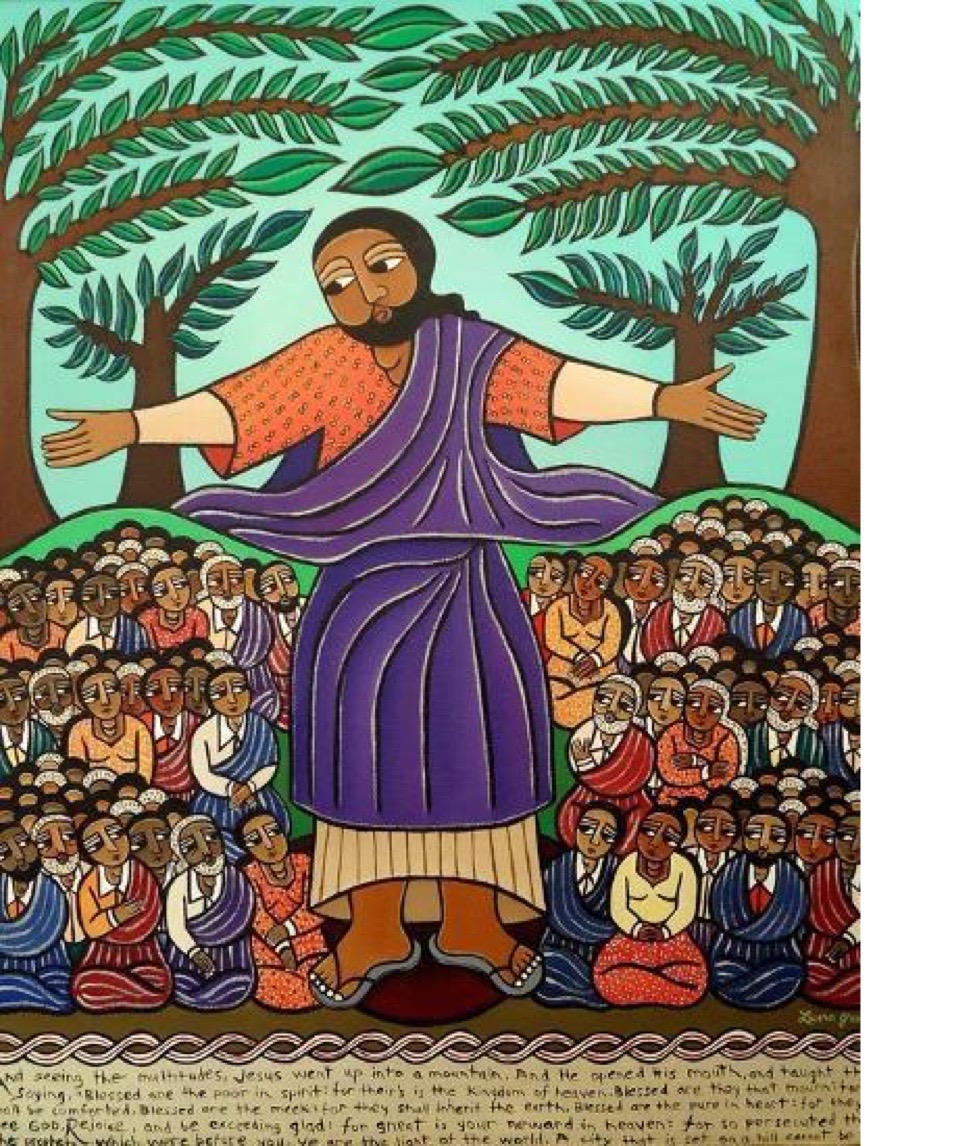
I hadn’t realized the Book of Gospels we used at St Mary’s when I first returned to the Church in 2010 was the one of her design and art! It was long and lovingly used before it was retired, but this fortuitous connection with her work this morning is just in time for me to return it to use tomorrow for our Black and Blessed Celebratory Mass (and also discover that a new edition was published in 2020!).
May we be the Light of the World today, particularly for those experiencing darkness and oppression … and for those parts of ourselves needing that Light. Pass the salt! 🙂
In 2020, I just listened and did not capture any homily notes (how jazzy of me!) —
However, the Margaret Hasse poem, Jazz You’ll Never Know, captures the feel and rhythm of all the Light themes in the readings, the repetition but just slightly different with each use, like jazz.
In 2017, we reflected from D2’s homily that —
The theme of Light is strong in all these readings, again, it seems like the celebration of Epiphany just keeps shining on
Is 9:1 The people who walked in darkness have seen a great light; Upon those who dwelt in the land of gloom a light has shown […more and great rejoicing]
Ps 27:1 The Lord is my light and my salvation; whom should I fear?
Mt 4:16 The people who sit in darkness have seen a great light, on the dwelling in a land overshadowed by death, light has arisen.
Note that Matthew misquotes Isaiah, in this the people are sitting (emphasis added) in darkness rather than walking (as in Isaiah). And this begs the question: Why was the gospel according to Matthew never “fixed”?
Because of the “eyes on the prize” principle. Scripture, particularly in the Catholic tradition is not literal nor incantational, it is one of the pillars that leads us to God, who is most definitely not literal!
In other words, the message is important, not the details. Light is important.
Our expression of our faith is important; are we sincere even if we don’t get all the words and details correct? The writer of the gospel of Matthew is.
How randomly Jesus seems to call the disciples! We don’t get any sense of Jesus
knowing them before their call
somehow attracted to them
“come along” seems the ultimate in low key invitation for what is going to be a life-changing event and, ultimately, a relationship with a world-changing person.
there doesn’t seem to be any logic in it — scriptural, organizational, geographical, social … anything!
Instead, the wonderful randomness of Jesus’ calling of the disciples is
like the wandering evangelists
establishing Jesus as an inspiration of the wanderer
and, rl would chip in, that everyone can receive a call to be a disciple.
Anne Porter’s poem, Music, describes music so beautiful it reminds us of absolute beauty … the very beauty who came to wander with us (“wanders where we wander”).
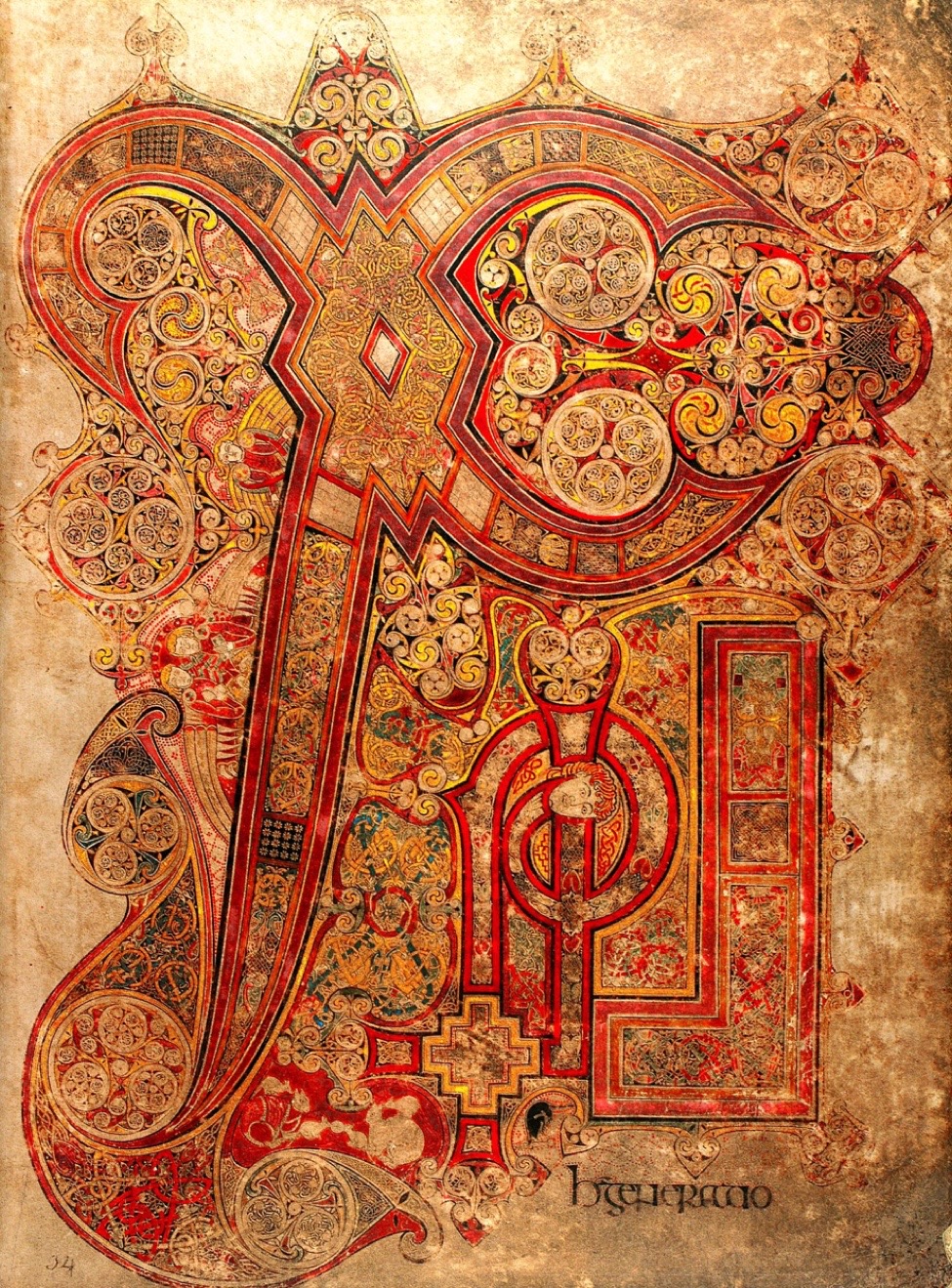
Our featured image is the famous Chi Rho page from the Book of Kells, now housed in Trinity College in Dublin, Ireland. Nature-based inks on cowhide vellum. Amazing.
In Isaiah (49:6), we hear that the Lord made Isaiah, Israel, the prophets, and, of course, Christ himself to be a “light to all the nations” (emphasis added), to the magi, the Jewish people, the Gentiles (that’s us!). It feels like an echo of the Epiphany.
In the gospel, John the Baptist said, “I did not know him,” in the sense that he did not recognize Jesus for who he truly is.
It feels consoling, in a way, that someone like John the Baptist could be wrong.
He saw Jesus but did not understand Jesus was the “Son of God”; he had been wrong.
Also, the earlier Spirit and Fire messages about the Messiah (from spirited and fiery John the Baptist) sound threatening, but Jesus generally isn’t like that or that sort of threatening, particularly to the anawim (the poor and marginalized).
Patricia Fargnoli’s poem Winter Grace is about not seeing and then, eventually, seeing (like John the Baptist) that “which is otherwise always eluding you.”
In 2014, we reflected on —
In the gospel, John the Baptist said that “I did not know him [as the Son of God]” until the Spirit / Dove descended on Jesus — that’s us!! —
As it is often the reflection on past events that helps us recognize Jesus. We hope and aspire to recognizing Him a little sooner in the course of our events.
The persistent aspiration to holiness and the humility regarding our limitations are aspects of our holiness, but being recognized as holy by others after-the-fact seems also to be an aspect of being Holy.
In the second reading (1 Cor 1:2 “to you who have been … called to be holy”) addresses the saints and all of us hoping to see what’s right in front of us. E.g., Rev. Dr. Martin Luther King, Jr. recognized the presence of God in our lives, and in community, and that he might very well have to die for living so.
Eavan Boland, an Irish poet (1944-2020) captures the after-the-fact epiphanies in her poem, the Necessity for Irony, with her final lines of
that I was in those rooms, with my child, with my back turned to her, searching — oh irony!– for beautiful things.
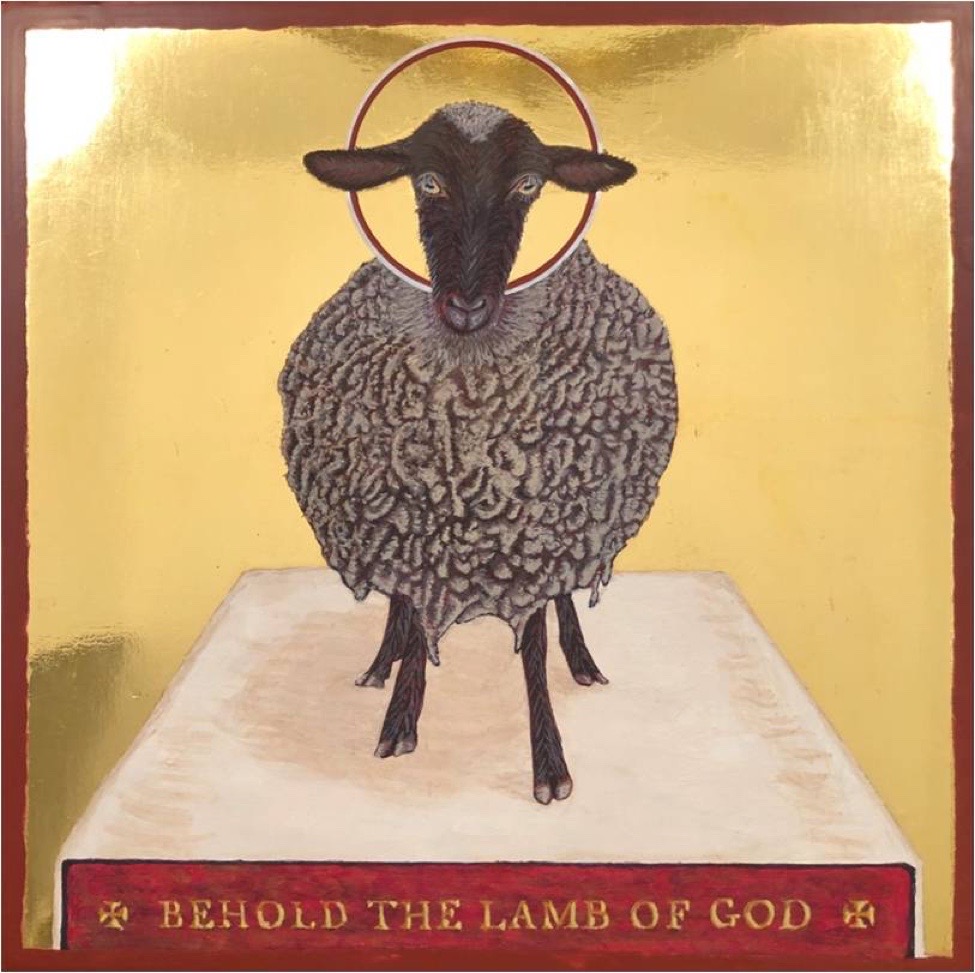
Our featured image today is a jewel (8″ x 8″), and as with all jewels it was pure internet chance that I found it: the Behold the Lamb of God Icon by Ed Narvaez. The notion of the “black sheep” captures that sense D2 was going for with the after-the-fact recognition of the holiness and value of someone who, at the current moment, doesn’t seem to fit. Like the saying that Jesus came not only to comfort the afflicted, but to afflict the comfortable. 🙂
Mr. Narvaez is quite gifted and accomplished in a variety of art forms; he resides in Boulder, CO. His description of his icon capture of the restored icon in St Bavo’s Cathedral in Ghent, Belgium is well-worth the visit to his site. I have received Mr. Narvaez’ permission to display the image; please respect his artistic rights. The actual icon is still available for sale, if you are captivated by it.
14 January 2011, Cycle A homily — Diagnosis by Sharon Olds
For the Feast of the Baptism of the Lord, the first and second readings are the same for all three liturgical years A, B, and C. However, there is a different gospel option for each year, which we’ll discuss below (from notes of Fr Dennis Dillon SJ’s homilies).
In 2015 (albeit Cycle B but supplemented with notes from the 2020 Cycle A homily), to better set the context of D2’s discussion, we reflected that —
In the first reading, Isaiah 42:1-4, 6-7, Israel is commissioned as a chosen leader despite its insignificance at that time in the world order, per the New Jerome Biblical Commentary, 2nd Edition).
The gospel reading for each cycle (A, B, or C) has a different emphasis and consequence in the telling of Jesus’ baptism in the River Jordan by John the Baptist:
Cycle A, the gospel according to Matthew (3:13-17) (emphases added): “After Jesus was baptized, he came up from the water and behold the heavens were opened for him, and he saw the Spirit of God descending like a dove and coming upon him. // And a voice from the heavens saying “This is my beloved Son, with whom I am well pleased.”
Cycle B, the gospel according to Mark (1:7-11) is even more personal than Matthew in that only Jesus hears God’s blessing (emphasis added): “And a voice came from the heavens, ‘You are my Beloved Son; with you I am well pleased.'” In other words, it is easy to believe that only Jesus hears the blessing.
Cycle C, the gospel according to Luke (3:15-16, 21-22) takes a more universal, or at least public, approach. Compare the gospel of John which acclaims Jesus, though not by name, to “The people.” In Luke, “[a]fter all the people had been baptized and Jesus also had been baptized and was praying … ,” the dove descended.” And a voice came from heaven, “You are my beloved Son; with you I am well pleased.” The context lends support to the interpretation that “the people” heard this.
Why does this nuance matter? Because if everyone in the crowd (a là Luke and John) hears “my beloved Son,” the crowd is, essentially, being told to follow this guy. But if only Jesus hears this blessing (a là Mark and to a lesser extent Matthew, this year’s gospel), then it more fits the model of Baptism and its blessing as a personal call, more like we would each experience and determine how to respond (e.g., going to the wilderness and figuring out “What now, God?!?!?”).
In 2020 and 2011 Cycle A homilies, we reflected that —
Themes of Light pervade this season:
Advent: We are awaiting the Light in the darkness.
Christmas / Nativity: Light into the world.
Baptism: Light from Light.
Luke’s Baptism — to all
Matthew’s Baptism – a Father-Son moment, a blessing for the journey. It is a moment of obvious union in this world. God the Creator cannot do what the Son is sent to do / be.
The Perlberg poem offering “the season’s perfect oxymoron” of the signs of “United” and “Departures” right next to each other at the airport, as her the poet’s daughter and her husband are leaving after the Christmas holiday. The poem captures the complexity of parent-offspring relationship (particularly as adults) that in a way is resonant with the complexity of the Baptism. So many meanings all at once. The Sharon Olds poem, used in 2011, also captures this complexity but between a mother and child. The Perlberg poem perhaps captures more of the richness of the Baptism emotions we can imagine for God and Son in this moment.
In the 2015 Cycle B homily, we reflected that —
Much of the Cycle B homily (and a daily Mass homily) that laid out this comparison of the Baptism in the four gospels discussed above.
In this homily he also described how the gospel of Mark uses John the Baptist, in what he says and does, to reveal who Jesus is.
He also introduced us to John Shea’s poem (a very, very long one!) about John the Baptist. The poem covers all we know of John the Baptist!
In somewhere around the tenth stanza and a couple following ones, John Shea captures the “Are you the One Who Is to Come?” question with “This arrow of a question was sent from prison” by way of John the Baptist sending his disciples to ask, “Are you the Messiah or not [because you ain’t acting like the Messiah I was expecting!]?”
Recall that John the Baptist was going around saying [paraphrased], “You think I’m something? He’s gonna baptize you with fire, not just water!” The implicit meaning is that the Messiah is going to be like us … but only more so, with exclamation points. As John Shea writes, “The more is arriving ….”
So John the Baptist gets his Messiah, just not the who and how that John the Baptist expected.
John the Baptist’s role was to point to Jesus; to gather people and then give way
John Shea’s poem offers “I can denounce a king / but I cannot enthrone one.”
So, as being fully human, like John the Baptist, we can point to what God is doing in our lives and receive the bread to follow Jesus in this journey.
This is not unlike Recovery Spirituality in that there are many tools in this century to help address addictive behavior and choices, but the other 1/2 or more of the effort is leaving the result to our Higher Power, to Grace, or, as so many of us might say, to God. There is a letting go that has to happen, and so John the Baptist did.
I (rl) managed to get the poems but did not take notes, apparently enjoying the homily — though now, oh how I wish I had jotted them down. This was one of his last three months of homilies and Mass celebrations with us. Each of the three poems by Sutphen, Nye, and Staub shares a moment of epiphany, as per usual with D2, a sharing of the Light in the ordinary.
In 2018, we reflected that —
We associate the magi and its root word with astronomers and magicians, of which D2 was one in his youth (and continued to share in his Nativity Pageant Mass aka The Mass of Chaos homily) in the model of __________ __________ of the 1940s. Fr Dennis was more of a sleight of hand magician, and used scarves when he was at St Mary’s, and it looks like cards at other times in his life.
An epiphany and the magi of the Epiphany evoke awe and mystery.
It’s hard for us to imagine how foreign the astrologers and magicians were to the Jewish temperament at that time. The Magi of the gospel had three strong prescriptions against them in Jewish culture of that day:
First, they were magicians/astrologers; these groups were generally looked down upon by both Jewish culture and its offshoot Christians. Second, they were Gentiles (and how). Lastly, gentile magicians using a star to proclaim a Jewish King to the Jewish people themselves.
Yet, in the story of The Epiphany, 1) the Magi are the witnesses, 2) very much outsiders, and 3) there’s no closure to their story — they just disappear without conversion.
But in having such a story, God, through the Magi, demonstrates God is not bound by our way of thinking and how God is present in different cultures …
… which leads to an understanding of missionaries that is more Jesuit-like: a missionary doesn’t bring God to other cultures, so much as finds out how God is already at work there, i.e., God’s Glory .. and God’s Glory is not confined by us, least of all.
“Epiphany” means “shining forth” — like the stars, gifts, the James Joyce insight into epiphanies.
Mary Oliver’s poem Ice is a beautiful description of living on with the absence of a parent or parents and how we come to our understandings and insights later. It captures the light, joy, and suffering of those times of our lives, or the story of the Magi: light, Herod, The Epiphany, their departure, and the ensuing slaughter of the innocents.
In 2016, we reflected that —
There are so many themes of Light! — Isaiah reading, second revelation of mystery, Israel, star, God’s Glory, Jesus Himself.
D2 tells the joke about a big day in Heaven. God is feeling even more generous than usual, especially for religious communities. So God sends Francis of Assisi, Dominic, and Ignatius of Loyola back into The Nativity, >poof<. They’re there. Francis raptures “Oh! The simplicity! The poverty!” and goes off and joins the shepherds or something. Dominic begins philosophizing about the infinite God manifesting in this finite child, and so on and so on. He walks off deep in his thoughts. Ignatius leans in to the Holy Family and asks, “Have you given any thought to the boy’s education?” [laughter in the congregation]
All jokes have an epiphany — the moment where we “get it.”
Jesus is an epiphany, a shining to all the nations.
James Joyce noted that all his stories have an epiphany for the reader or for one of the characters.
An epiphany is how things fit together better; we see things better or more wholly [or more “holy”?] and grow as a result.
Poems are like epiphanies, the “aah” moment of seeing the light.
In today’s poems —
Five Wishes by Anne Porter express the epiphanies of who Ms. Porter is — a wild bird, radiance, …, and being with her daughter..
In William Carlos Williams’ Pastoral he describes the beauty of weathered, poor houses, the patina. He now prefers the patina to the untarnished new. His doctoral ministry has led him to the beauty of their neighborhoods; his poem is the sharing of his epiphany which is “not of importance to the nation.”
In 2015, we reflected that —
James Joyce spoke of epiphanies as a literary device, a recognition of what the character/story is all about without the character knowing it. Much of this can be found in Richard Ellmann’s classic James Joyce, a biography.
Epiphanies are a kind of inadvertent revelation of things the characters are most careful to conceal, e.g., Mary and Joseph were simply busy taking care of their kid and these magi (and shepherds) show up.
Epiphany is a moment when the souls of the commonest object shines like a radiant star; an epiphany is both arrogant and humble. Epiphany merely happens and in its happening it merely happens; the author does not focus the text on the epiphany itself.
It is remarkable that God comes as a child / one lowly and common but who shines like a radiant star, not a as a huge warrior king. He is attended by magi whose astrology told them they were visiting a newborn “king of the Jews.”
Ron Koertge’s Negative Space poem holds an epiphany, unveiled after decades of life together.
In 2017, we reflected: • How the New Year is also a new hope, a starting over again. • D2 mentioned Ann Lamott’s new novel All New People in which failure and forgiveness are prominent themes among its characters. • And, today’s baptism (at Mass) is a reminder of yet more life and hope going on amid daily challenges that might make us think otherwise. • The May Sarton poem, New Year Resolve, offers “come back to still water” in our minds, and the key to finding clarity is silence. • Jesus, as an act of salvation, finds the clear water in our everyday experience, as if to say “everything’s okay.”
In 2016, we reflected that • Historically, a number of celebrations are wrapped up in this day — Mary, the historical titular Feast of the Society of Jesus (aka the Jesuits), the Feast of the Circumcision, New Year’s Day, and more. • The Feast of the Circumcision was observed because only humans bleed, and Jesus’ circumcision would have marked the Lord Jesus as truly human. In The Church of the Gesù in Rome in the rear of its sanctuary/apse, there is the image (below) of the circumcision, and during and around its June-ish observance, an image of The Sacred Heart. In part the display of the circumcision is done, as theoretically, any bloodletting would have satisfied the letter of sacrifice law, but the crucifixion marks the entirety of his sacrifice and our resurrection (fully divine, he also fully suffered and died and resurrected completely). • Today’s Mary, Mother of God celebration is one of the major Marian observances, as the reading is clear how she was reflecting on all this — the shepherds, the temple and circumcision, the magi, and later Jesus getting lost in the temple. Just as Jesus had to grow in wisdom and grace before God and his community, so, too, did Mary. “What’s going to happen to this child?” “How is he going to save?” These were normal and expected questions because, for all appearances, Jesus was just one infant like any human infant. • So Mary (and all of us) learn how to understand from the experience of a child. Sharon Olds poem Diagnosis is evocative, perhaps, of the challenge Mary might have had to interpret and understand Jesus. • The Bilgere poem evokes this time of year, the winter solstice, the Christmas season, and the sense of reverence and extraordinariness in the ordinary, like how the Lord of the Universe erupts into our world as a human infant!
Some rl notes: today’s readings are beautiful — blessings, loving salvation, and shepherds — all in celebration of Mary, the Mother of God. For those who aren’t Catholic, the Marian devotion ranges from proxy mother to mother watching over the community to Jesus’ first and best disciple. Spiritually and emotionally the range of devotions create a flowing, mystical, and rich person.
The first reading, Aaron’s blessing (the Aaronic blessing), is when God instructs Moses to teach his brother, Aaron:
The LORD bless you and keep you! The LORD let his face shine upon you, and be gracious to you! The LORD look upon you kindly and give you peace!
I really enjoyed the Irish Blessing, an all-Ireland video released during the pandemic, and one that contains the Aaronic blessing at the end.
I had the gift of reading the Aaronic blessing passage at Mass in 2017. I love reading (or lectoring, if you wish) as when I am prayerful, what is spoken is beyond me. It is one of the joys of the mystical tradition of the Catholic Church. As I was reading: Whoosh! All the errant ways in which I (and many of us) use God’s name or claim to be God’s people or “righteous” flooded in simultaneously with the true voice of God (like in 1 Kings 19:11-13 — a whisper, not a roar; gentleness, not dictatorship), and I found myself emphasizing in the reading the words “my name.” I realized God was not just marking the Jewish people, but God was creating and explaining God’s identity to us humans who worship idols or create false proxies of Love Loving.
But the peace of understanding who God is and how we share God was a rich consolation, making the inheritance of the second reading even closer. It’s easy to imagine the desire to be close to Abba, Father, especially if you feel close to your human father; but experiencing God’s voice of loving call directly draws us each and all to our best self.
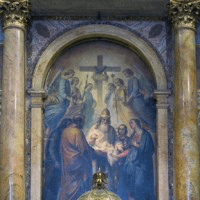
The Circumcision by Alessandro Capalti in the apse/sanctuary of the Church of the Gesù in Rome shows this moment,
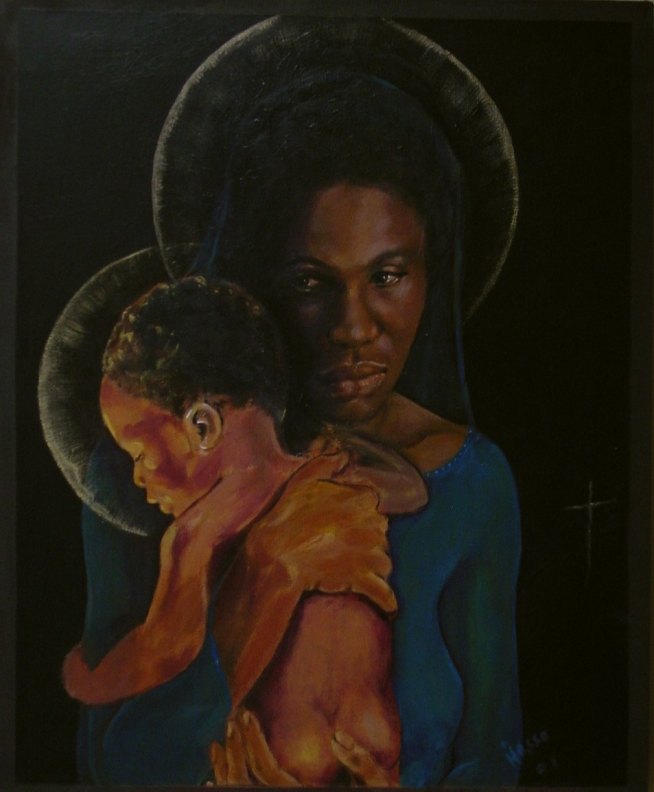
but then Jim Hasse, SJ catches the thoughtfulness, concern, and puzzlement Mary might have carried in his Sorrowful Madonna, our featured image.
Our readings for this Sunday, the Feast of the Holy Family of Jesus, Mary, and Joseph are here. The readings are again ABC, so I have used the notes from 2017 (Cycle A).
These are the poems, my notes, and interpretations of Fr Dennis’ homily from the 10AM Mass on December 31, 2017. And a couple tip-ins on the nature of what a Holy Family is!
and Fr Tom McClain, SJ in 2014 offered a homily that has stuck with me,
and, likewise, Fr Peter Fennessy, SJ contributed a visual image.
In 2017 with Fr Dennis, we reflected on —
Simeon and Anna are the symbolic grandparents in the story of the Nativity. In the apocrypha, stories are told of Mary’s parents, Anne and Joachim. Over time we have come to celebrate them on July 26th. However, Simeon and Anna represent Jesus’ grandparents in this early story in Jesus’ life. Both the symbolic and the actual grandparents are our reminders that Emanuel, God-with-us, came to “pitch tent” with us, that his humanity fully encompasses ours. And so eventually through the resurrection, our humanity is resurrected with his fully shared humanity into the divinity of God. In short, humans have grandparents, so our savior had grandparents as part of his fully human experience.
All the readings encompass the themes of
looking back, reflectively, as Simeon recalls the prophecy from earlier in his life; of beginning leanings, such as both Simeon and Anna offer about Jesus,
and of families, as all of the readings offer — with concessions to the culture and language of their times.
In Mary Jo Salter’s poem, Advent, she captures the sense that Advent = Coming and how a mother and daughter inhabit Advent, the coming, and the becoming of their space and relationship together. The poem shares the holiness of the interweaving and recognition of our lives with each other and with the physical world.
Linda Pastan’s Course of Treatment has 40 visits of (probably) a spouse, but an unnamed relation, being released from treatment for a new year, with hope.
In Carrie Shipers’ Vocational Training she presents the wisdom internalized and practiced by her mother, a doctor. You get the sense of the Anna type wisdom and the details of advice, the practice we need so we “know what to do” in the moments of need.
So we pray for our families — biological (through birth), adopted (our functional families), social (varied), and global (all of humanity) — that we may create more loving and giving, inwardly and outwardly, families.
In 2014, Tom McClain offered that Holy Families are our communities that offer
the gift of intimacy;
safety in our physical, emotional, intellectual, and spiritual beings; and
apostolic mission/service for others, as in I love you but I’ll let you go to do what you must for Christ. In other words, the absence of an authentic sense of service for others eventually leads to interior rot.
Holy Family Imagined
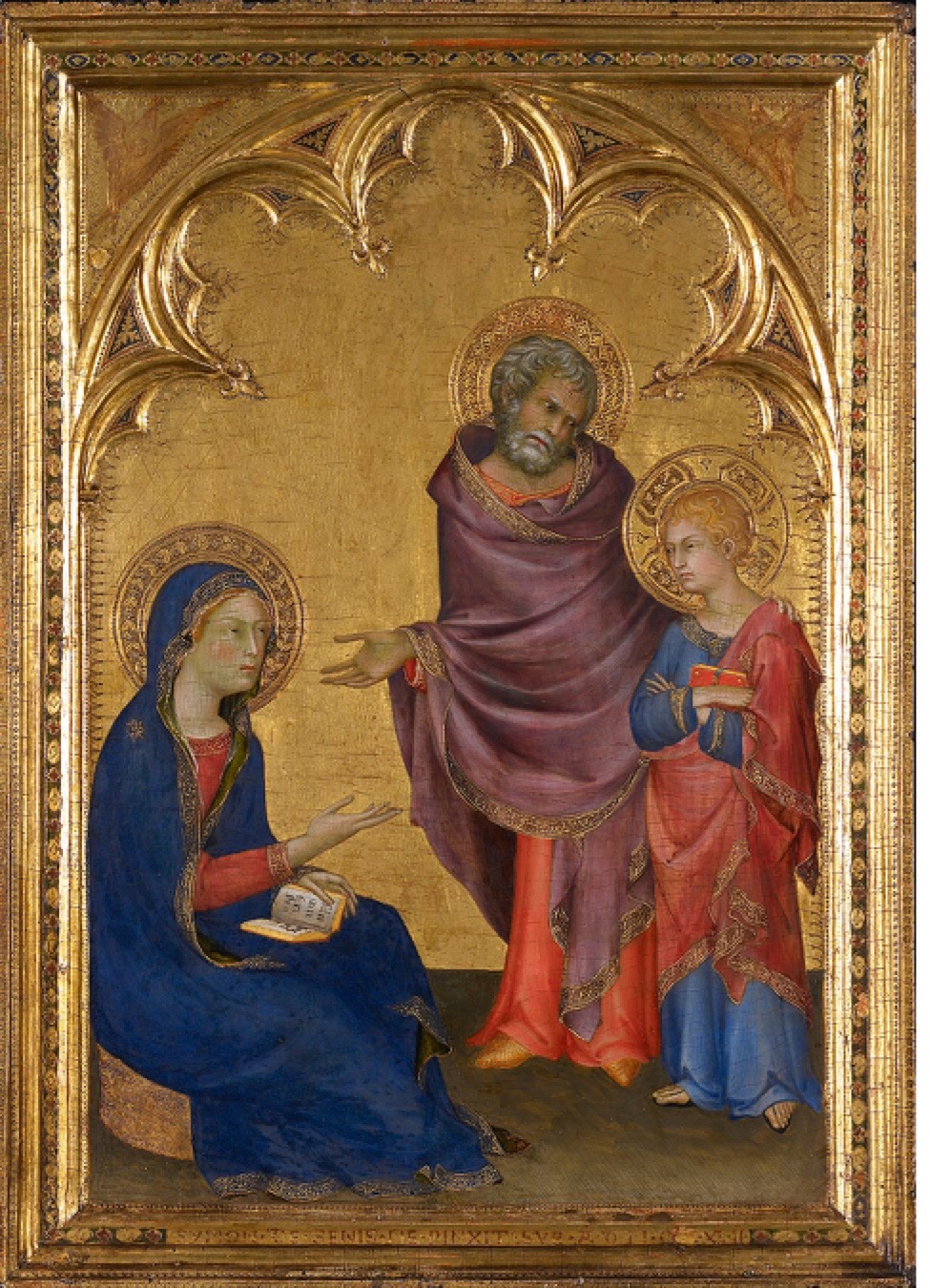
On one of my (rl’s) retreats at Manresa Jesuit Retreat House, Fr Peter Fennessy, SJ shared our featured image of “Christ Discovered in the Temple” by Simone Martini (1342). It is from a scene in scripture (Luke 2:41-50) just before “the hidden years” of Jesus (Luke 2:51-52). (Correct! — it is not an image matched to today’s gospel reading, but it captured the flavor of Fr Dennis’ homily message better.)
Jesus has, in essence, ditched his parents and family caravan to return to the Holy Temple in Jerusalem to be “in my Father’s house,” and the Holy Family is having a conversation after his human parents found 12-year-old Jesus three days later. Can you imagine?!
This image reminded me of D2’s main theme that Jesus lived all of our family experiences, including adolescent challenges. Martini’s image of the expressions on Mary’s, Joseph’s, and Jesus’ faces are those of human families past, present, and future. Exasperation, anguish, frustration … all these are part of Holy Families, as are patience, tenderness, and love.
I found myself so relieved on sitting with this imagining — for contrition of some of my adolescent behavior, for renewed compassion toward my parents’ human frailties, and redoubled gratitude for their many, many gifts of love they gave beyond our human limitations.
These are some of the poems, my notes, and interpretations of Fr Dennis’ homilies from the Christmas Masses in 2017. For about ten years prior to the pandemic, Fr Dennis Dillon SJ celebrated the Nativity Pageant Mass (you know … Charlie Brown and the Christmas pageant?). 🙂 His spoken homily was very brief, then he invited the children close near at the sanctuary. He then performed and amiably chatted his way through a couple magic tricks sharing the wonder and awe of Christmas. You could see the kiddos have excitement, joy, and wonder — see those emotions being bundled with their pageant experience and the coming of Jesus Christ. Pretty cool.
The children themselves create the Living Word in ways our adult imagination fails, or has forgotten. One year at the pageant, after the Annunciation, Gabriel threw her hands up in joy and bounced herself up and out of the choir loft after getting Mary’s “yes.” It’s easy to forget the joy of heaven of sharing the good news, let alone someone accepting it!
This year, when the narrator read that ” … Gabriel departed,” Gabriel dropped like a rock (whump!!), slunk up the stairs until the focus was on the Visitation occurring on the other side of the choir loft. It’s easy to forget, holy or not, Mary said “yes” amidst some pretty challenging irruptions of God in her life.
***
The gospel readings for Christmas are tied to the Mass, e.g., Vigil, Night, Dawn, or Day, and come from the gospels of Matthew, Luke, and John. The Christmas readings are listed for ABC, rather than a single cycle, like we read during Advent, e.g., Matthew’s gospel is the dominant gospel account in Cycle A this liturgical year. It and the Gospel of Luke are the only two of the four which discuss the birth of Jesus. Luke has the shepherds and angels, Matthew has the magi and more about Joseph’s interactions with the angels.
For clarification, both the gospels according to Luke and Matthew have plenty of angels! However, one would expect the angels to interact with the key people in the story, like Mary and Joseph. The messengers of God interact with key people. What is unusual about our God and the account in Luke, is the angels proclaimed “glad tidings of great joy” to shepherds, at that time some of the lowliest members and most on the fringes of Jewish society. This is God’s very different take on who the key players are in God’s eyes and heart! This is one more exclamation point by God that salvation is for everybody! St Gregory of Nazianzus wrote that we are most made in the image of God when we love humans, preferentially the poor. This is one more example of God doing so!
Fr Jim offered the reminder in the homily today that Jesus was born poor so the lowly shepherds AND magi could visit him. Birth in a palace would have left the shepherds out in the cold.
So the following is from a 2017 10AM Christmas Day Mass, I believe, celebrated by D2.
Some of the poems Fr Dennis references over the years:
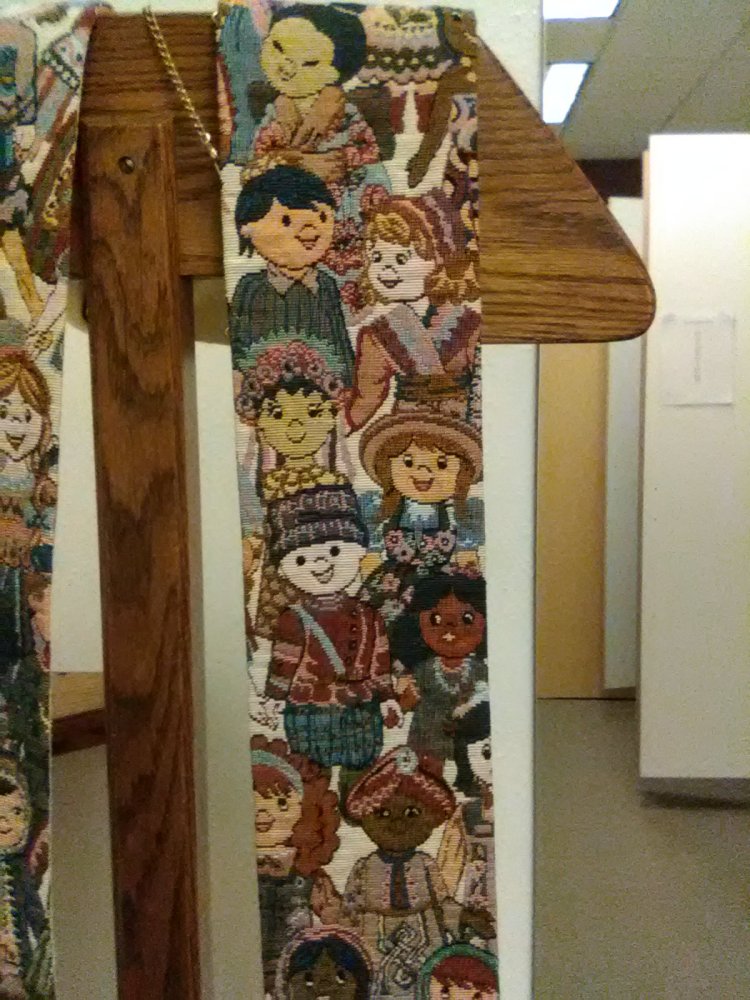
The Nativity Pageant and Mass are a celebration of the children of the world. The pageant and its fresh interpretation of the story by each year’s cast of children renews our faith. Fr Dennis wore the stole of children to honor all the children — those who are children by age, and those who are children at heart. Most importantly, he wore it to honor the One who came to be with us … as a babe!
Why would the Trinity do this, this mystical incredible idea of the Incarnation? What was Jesus hoping to say with the Incarnation? Solidarity. Jesus of the Trinity became incarnate to share the vulnerability of a fertilized cell on to his last breath on the cross to be in total solidarity with us humans, God’s Created. This form of solidarity means:
His mercy comes from within, from his full humanity and divinity
He felt himself at home with us in a very simple meal of bread and wine, and being divine could leave this expression with us in the Eucharist, so we can always be together in the Sacrament
He became helpless, like we are helpless and vulnerable
Because of Jesus’ mercy of Incarnation, we aren’t so helpless, and no one of us is ever alone. Our facades of independence become a barrier to our divinity and acceptance of salvation.
In today’s Collect Prayer for the Vigil Mass for the Nativity of the Lord (Christmas!), we pray that because of God we “share[e] in the divinity of Christ.” In other words, through the Incarnation, we are called to be divine, and the call itself as well as its manifestation is Grace, God’s Life within us, now.
May Sarton’s poem, Christmas Light, feels extra resonant tonight … as it feels like the joys and the busy-ness of creating space for reflection or giving or service this autumn and Advent having finally ceded before the coming of the Babe, and his Peace. I sit with my “small silent tree” bedecked with ornaments glittering with family memories and
I [feel] reborn again, I kn[o]w love’s presence near … [Is] with me in the night When everyone ha[s] gone And the garland of pure light Stay[s] on, stay[s] on. .
Our featured image (seeking permission) is John Swanson’s Nativity. He passed in September 2021. From his website: Mr. Swanson’s art reflects the strong heritage of storytelling he inherited from his Mexican mother and Swedish father. John Swanson’s narrative is direct and easily understood. He addressed human values, cultural roots, and the quest for self-discovery through visual images. These include Bible stories and social celebrations such as attending the circus, the concert, and the opera. He also depicted everyday life, city and country walks, visits to the library, the train station or the schoolroom. His parables optimistically embrace life and spiritual transformation.
the Nativity is only in Luke and Matthew, but all the gospels have his death and resurrection because that is central to his life and message.
However, culturally, Christmas has moved to a more central part of the story
The birth of Jesus isn’t “all happy” because of the Death of the Innocents, as well as the pain and danger of birth to mother and child.
There is cultural fun, too, in that there are different stories about the birth of Jesus (e.g., the Huron Carol) and that every child, each of us!, is a reaffirmation of the birth of Jesus.
In December by Gary Johnson
He alludes to many Christmas carols (see some below). The allusions suggest our hopes of greater holiness and wisdom
the dark of night : the dark of the future
In Going to Bed by George Bilgere
It is not just a poem about every day matters; like Johnson’s, he ties the ordinary modern things to reverence
In the sum of it all, there is simple excitement in knowing Jesus is our Savior, and that is something to celebrate in and of itself.
In 2013, we reflected that —
Joseph is a righteous man, meaning that he follows the law, but doesn’t want Mary to face public shame.
This sense we get of Joseph being faithful to the law and conscious of the people involved is like Pope Francis, about placing the person first then the law, i.e., being pastoral.
Gary Johnson’s December poem utilizes snippets and words evocative of specific Christmas carols, resulting in a poem with smiles but also the richness of a realistic faith:
Adeste Fideles — “singing for the faithful to come ye”
Twelve Days of Christmas — “partridge in a pear tree // And the golden rings and the turtle doves.”
O Little Town of Bethlehem — “In the dark streets [lights shining]”
Adeste Fideles — “Not much triumph going on here.”
O Little Town of Bethlehem — “And my hopes and fears are met // “
Hark! The Herald Angels Sing — “And are there angels hovering overhead? Hark.”



 The Surest Sign