Slough Creek / Junction Butte Pack

We arrive near Junction Butte at the pullout with restroom … the Junction Butte pack’s den is on a slope north of the road facing south (steep hill, former coyote den, squared by four sets of evergreens) and a kill on the south side of the road where we saw two blacks and maybe one gray last night.  The south side of the road is where the pack has been feeding on a kill/carcass below Specimen Ridge about 1 ½ mile(?) away.  When ravens had fun with them, that’s when the wolves would poke their heads up either for a break or taking a snap at the ravens.  I could see them with Bob’s good glasses and could really see them with the Swarovski scope he rented / was lent.  Whoa … just checked out the tag price at $2500!  (I think these were members of the Junction Butte pack.)

Glad there are black and white wolves, grey wolves are almost impossible to see!  They are like ghosts against the landscape this time of year.  We also saw their den via Bob’s knowledge of where it was and the Swarovski scope.  The mom poked her gray head out a few times, but nobody was really coming out.

Bob was telling me about the folks who have changed their lives to include a month or more of wolves.  (Bob, for one! But Wendy, Rick McIntyre obviously, a couple from San Diego, and so many more.)  This was also the first time Bob had a scope and thus had more time to share the scope and what he knows with those around him.  Filming and the photography equipment doesn’t lend itself to the same dynamic with people.

Phantom Lake

Further down the northern road on the April 22 evening visit, lotsa bison and people on either side!  People parked and waited for a two year old bear in either Phantom Lake or the next one (the next one, I think) to come out.  It had been denning under the road somehow … can’t remember if it was using a culvert.  Apparently the bears have their clan of observers, too, like the wolf clan!

Phantom Lake fills with run off and looks like a spring fed lake, but it isn’t, so no fish.  It looks so convincingly like a natural lake that people regularly fish in it.  Sorry, Charlie!  It’s one of those ethical moments for the locals when they see folks fishing — the truth? or let the moment of enjoyment stand on its own? Usually the latter.

Somewhere along here we saw mule deer (no surprise) and then whitetail … not quite an invasive species, but it tends to out compete the mule deer.  Yellowstone National Park is considered the Serengeti of the northern hemisphere, as there is no other larger concentration of large mammals.  It has an incredible array of what otherwise can be top predators in their own right – wolves, grizzly bear, American black bears, cougars, coyotes, red fox, Canada lynx, bobcats, wolverines, and badgers, river otters, and weasels.  Someone thought they saw a young cougar in a chase/road crossing.  There are also major ungulates:  bison, moose, bighorn sheep, mountain goats, mule deer, pronghorn antelope, and whitetail deer.  In ten hours in the park, we saw all but the mountain goats of the ungulates.

First Visit: Black Wolf Running

After an early dinner on April 22, we started from Gardiner/Roosevelt Arch then on to Mammoth Hot Springs and then along the northern route, which is comprised of the Grand Loop Road until Tower Junction and the Northeast Entrance Road further east. We saw lotsa elk and bison (one calf), a few bighorn sheep, and ground squirrels.

Up around the Blacktail Lakes ridge I saw a black wolf!! 

This video has nothing to do with what I saw, but you can see the range of colors of wolves, and is probably the Wapiti pack. The first video captures very unusual pack behavior (taking on a griz) and a plethora of “ya’ll”s on the audio. Grizzly Bear will kill and eat wolf pups, so the pack will defend the den and the pups. That’s a bit of behavioral background not audible in the video.

So! I saw two running elk and a lone black wolf chasing them, maybe 30 seconds or less behind.  We drove further on but never saw them emerge from the other side.  I did see a few ground squirrels and a yellow ground flower – five petal radial, puffy center … maybe a sagebrush buttercup?

Even this first encounter introduced me to the notion of how much waiting and patience and respect goes into the photography and filming of wildlife. 400 hours of wait time may yield minutes of relevant wildlife behavior captured on film (let alone if the film survives all the technical difficulties and processing).

Further down the road, the Blacktail Lakes is this swampy, pondy area attracting everyone – mammals, water fowl, and thus humans.  Last week (okay … that would have been around April 15th) the National Park Service had to pull out seven bison who got stuck because otherwise the road fills up with people watching, and if the bison die .. then carcasses attract predators and more stopped traffic! 

The bison have to swim hard to stay upright … once they lose the vertical line of balance through unbalanced swimming or sheer exhaustion they tip to one side and begin to drown.  (They can’t do the side stroke.)  There are all kinds of birds in this area – sandhill cranes and every kind of water fowl.  On Friday, Bob called out mallard, pintail (pretty rare), teal, mergansers, and more.

Math to Mountains, Functions to Film

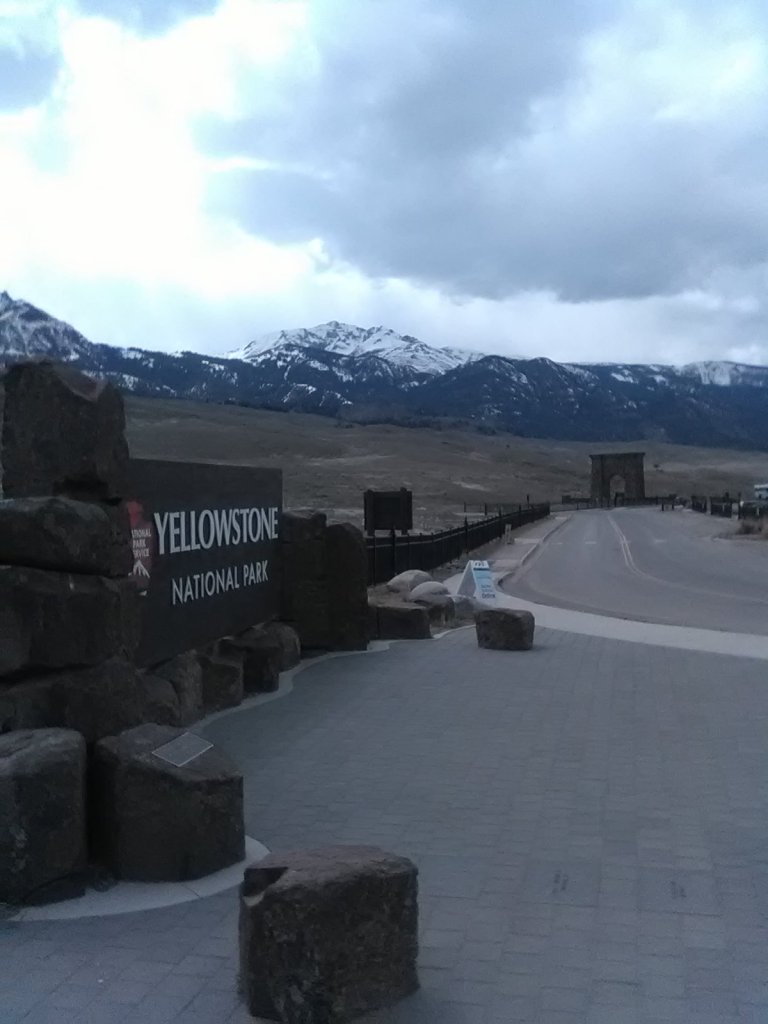
So I managed to get in part of a zoom meeting in Wonderland Cafe and Restaurant.  Then I went out and took a photo of the Yellowstone National Park sign and Roosevelt Arch while it was daylight.

Good to see Bob … after almost 40 years.  Been a long time since either of us derived or integrated functions, an excellent calculus teacher back in the day. But now, he was having to get a bunch of trees cut, as were other neighbors because of an infestation by some kind of coating pest or fungus. It’s clear but hardens over the bark.  Over time, he now owns three adjacent houses adjacent near the Yellowstone River. The River flows out of the Park through Gardiner.  He started with a duplex which he rebuilt one summer with a nephew and nephew’s friend.  Then he and Connie bought another, then they built the one he lives in. Connie worked with the architect for a very open design, e.g., no hallways. 

His front yard displays a life-size replica to a fraction of an inch of the actual measurements of Wolf 21, the adopted son of Wolf 8. It is a cast metal very similar to this image Doug Dance used in this article. Wolf 21 was alpha-male of the Druid Pack of the Lamar Valley for around 6 ½ years and lived to be 9 years old, like his long-time mate, Wolf 42.  Most wolves live about three years, not every wolf becomes an alpha (female or male), and Wolf 21 and 42 were unique for the duration of their relationship and tenure as the alpha pair of a pack. Bob captured a LOT of film of Wolf 21 and the Druid pack.  A really big wolf when you are 5 feet away and certainly caused me a number of double takes!!  Coyotes must look dinky through the field glasses and viewing scope.

His at home “wolves” are a mixed breed and one whose species I couldn’t identify (big with wolfy long fine/outdoor white fur, both rescues – Raven (the smaller) and Agate (the larger, with her left eye missing).  They liked Organix, too.  Very sweet doggies!

Scott is another filmer/photographer/scientist and also staying at the house. 

Bob shares his housing to support Yellowstone Forever, a non-profit organization which supports all kinds of programs, particularly scientists and artists in Yellowstone ecosystem-related research and the Yellowstone Forever Institute (education and more). The Wolves Project represents a 25 year study, the only one of its kind in the world. It has documented and studied the wolves from their mid-90s reintroduction, as well as historical research prior to and inclusive of the extirpation era.

We had dinner at Wonderland Restaurant and Café (“Wonderland” is what YNP was originally called).  Bob had mac’n’cheese with elk, and I had quinoa wild rice and substituted sautéed mushrooms.

Bob ticked off the tiers of experience to try for / hope for with wolving.  

Find a wolf on your own. 

See a wolf. 

See a wolf doing something. 

See/hear a pack.

Trains and Automobiles

I headed out from Dad & Jo’s at 11:15-ish on Thursday, April 22nd, just as Jo was getting her baggage at the Billings airport. 

Handel’s Messiah by the Monteverdi Choir (1982) the Glory of the Lord from Part I was filling the Element as a 150 car, four engine train went by. Incredible, as a train that large is around 1 1/2 miles long. I futilely pumped my arm for the whistle. It was unlikely the conductor could see me and not very likely I could hear the whistle or horn, even if it was sounded.

Back in the 1960s and 70s in Montana, the two-lane highways ran closer to the train tracks than the Interstate (divided highway) does now.  As our family station wagon pulled abreast of the engine(s), the conductors could see us and us them.  The three of us kids in the back of the station wagon would pump our arms furiously, mimicking the conductor’s motion of pulling the rope for the train whistle, in hopes of hearing the whistle blow.  Of course, even for our generation, it was more often horn than whistle. But so often the conductors did blow the horn!  I wonder if the train engineers / conductors do that anymore? 

(They do!  On US87S, a fair bit after leaving Great Falls on April 28th, a wonderful cobbled together train of an engine and six unique cars drove opposite the two lane highway. I (stupidly, I confess) rolled down the window, pumped my arm furiously, with a hopeful smile the conductor couldn’t have missed. In return, I heard a double horn blast off the north bound small train. Tears of joy ensued for renewal of a cherished memory and way of life.)

Now, back to the westbound trip to Yellowstone on the 22nd! Smooth sailing down I-90.  Got gas in Livingston but didn’t stop in hopes of mostly making a Zoom meeting.  Livingston to Gardiner is a great road (two lane, mostly good shoulders, bottom of the valley, and mostly flat with good lines of sight). Light auto traffic at this time of year with elk abundant in the valley, increasing as we approached Yellowstone National Park. 

Two osprey nests were slammed atop tall poles (one wooden utility pole) with osprey pairs active in their home.  Nestled in Paradise valley with the mountains close and very loud Handel’s Messiah Allelujah chorus had a soundtrack to match the view.  The closer I came to Gardiner, the closer the Elk are to the road — here, there, and everywhere. By the time I reach the outskirts of Gardiner and the airfield, another six elk are comically nestled against the “control tower” house like cats waiting to get inside.  A 500 pound cat. The landing strip is designed for Cubs and Pipers, but … still … oops! … miss by a little, crash down 50’ into the Yellowstone River!

But … I made it … and now to find Bob’s house.

Ebb and Flow

by Lorraine Lamey (c) 2021

A brief poem capturing the unexpectedness and richness of these times with my parents. These moments have a preciousness and richness well beyond their brevity. In looking into the poem, I found that tidepools vary tremendously in size, duration, consistency, but most are vibrantly rich in life.

When did yours become the weaker body?

On the shore of memory, your hug catches me

in its undertow of love, leaving

the abrasive grains of childhood tumbling behind.

Eventually I am released, reborn.

A river unable to fill your emptying estuary,

I embrace you now, unaccustomed

to the soft flesh and frailing frame

leaning into me.

We abide in the ripples

of our teeming tide pool.

Moments of Resurrection

As a child, Easter Sunday was a blur of Mass, breakfast, Easter Egg hunting, and Easter basket rummaging. We might revel in the warmth or shiver in the late winter snow of Montana. The Resurrection itself was lost on me in the early years, but Jesus was in the Easter chocolate, too. Our childhood theologies can be true yet insufficiently robust as life’s challenges accrue.

Visiting my parents and Smom this past Easter season (six weeks long in the Catholic and much of Christian tradition) led to different moments of joyful resurrection. The folks are 90+ years young and/or feeling their days, and my seventh decade is rounding the corner. This is all new to us, and the newness creates a symphony of life music. Some themes are anticipated but were still unimagined. When did making my bed start to take so long?!? Of course I only imagined my parents’ bodies aging, not my own — which leads to funny and wistful “helping” at times.

But amidst it all, Joy rises up in just being together. In green faithfully forcing its way through ground and bud to shout Hallelujah again! Harmonies of blossoms join in. The deeper truth among my childhood memories is the joy of being together and witnessing God’s Creation around us and in our relationships.

In the Ignatian spiritual tradition, St. Ignatius’ The Spiritual Exercises includes reflections on passages, a spiritual imagining and placing of yourself in the scene while engaging all of your senses and being. In that space, we let Jesus engage with us. There are some notable gospel scenes that Ignatius did not incorporate directly (though you could), e.g., Pentecost.

But there is only one scene-setting Spiritual Exercise that is not in the gospels. St. Ignatius, perhaps reflective of the longing he had for his own mother who died in childbirth, imagined Jesus in the Resurrection first visiting Mary (SE 218, 299).

The Resurrection is the font of these wellsprings of joy, making clear Who is the source.

Of course, e e cummings in his poem [i thank you God for most this amazing] gives us a source of ready Easter renewal in any moment, as shared by SALT Lectionary. (Their Sixth Week of Easter scripture highlights Jesus’ exhortations for “works of love for the sake of joy.” In our world in which we move through accretions of sin and darkness from over the ages, it can be easy to forget that this is good news, joyful news we are sharing!

The Montana and Yellowstone National Park adventures that follow, amidst unlikely gray skies and cloud cover, are well-sprung by Easter Joy.

A Dancing Compass

So today’s first reading, Dn 3:14-20, 91-92, 95, the story of Nebuchadnezzar’s conversion on seeing “one like a Son of God” dancing in the flames with the now miraculously unbound Shadrach, Meschach, and Abednego is one of my favorites.

First, it’s a great story — drama, faith, repetition and rhythm of sound, and joyful witness by God. It was also the first, if not one of the first, mass readings I was ever asked to offer in our parish, St. Mary’s in Ann Arbor. As I stared at the names realizing exactly why nobody had been interested in reading this one, the Jesuit (yes, D2) murmured in response to my humorous attempts with rhythm to get a flow to their names, “Yes, I believe there were songs to that effect.”

When I got home, the magic box enlightened me with Louis Armstrong’s version in the 1951 film THE STRIP (with Mickey Rooney): SHAD-rack, ME-shack-n-uh-BED-neh-go. Love Louis Armstrong’s seamless interweaving of devotion, dance, story, voice, and performance! For fun socio-historical comparison, look at the 1939 capture by “Ford Leary and the boys” version. MA RAINEY’S BLACK BOTTOM (2020), starring the recently deceased Chadwick Boseman, depicts an example of the deceit by white-owned and -managed music labels of paying on the cheap for jazz song and lyrics and cutting out the African-American composer of the arrangement, performance, recognition, and subsequent career growth in favor of white recording artists.

The Michigan Theater reopened (again) a little over a month ago on February 14, 2021 with a HERO FOR A NIGHT (1927, December 18), a romantic comedy and satire of the many Lindbergh wannabes. For a historical grounding prior to the viewing, Russ Collins, the Executive Director, shared commentary on a series of shorts showing the disastrous trans-Atlantic flight attempts (4 deaths, 3 serious injuries) prior to Lindbergh’s triumph in May 1927. (Someone was taking their elementary school age children?!?!) We also saw a clip of Lindbergh’s takeoff, barely making it off the ground with the extra fuel (no radio nor navigation equipment) and barely clearing the electrical wires at the end of the runway. Noting that the film was made in 1927: people of color are absent (which may be a blessing given the social and cinematic norms of the day) save for five minutes or less of African-Americans incidentally captured in servile roles in the background, e.g., pushing carts and vehicles with white people in them.

After all these months, our sold-out pandemic-sized crowd (100 in an auditorium of 1500) watched a near-century old film in an historically appropriate theater with live organ accompaniment. Such joy! Laughing out loud together as a group, marveling at the sheer goofiness of the film and the amazement of sharing much of a century old experience.

At the end of the film, the hero and heroine land somewhere in Europe. But without radio, navigation maps, or navigating ability — How to identify where you’re at without any shared words / language?  Who and what can connect us?

Dance. 

Our scrappy hero, Hiram Hastings, assures his wife-to-be, Mary Sloan, and future father-in-law, Samuel Sloan, not to worry as they stand in the midst of the town square surrounded by the silent and staring town folk. All things considered, the townfolk are remarkably stoic after having a plane (something never seen before) crash into the end of one of their streets!

Hiram offers a brief dance of the Highland Fling (Scotland) and meets blank stares.  Turkish Dance? Blank stares.  Play acted tip of the bottle and Russian / Cossack dance?  The crowd onscreen bursts into smiles, laughter, shouting, clapping, and dancing … silently .. until we clap to the unheard beat of the film in unison to the newly created live organ accompaniment, awash in our communal laughter and (masked) smiles.  We’re in Russia with our hero and heroine (who have saved the day) … and to prove it, around the hidden corner the Eastern Orthodox priest steps out of the church and welcomes them into be married. 

God is with us in our moments of joyful sacred dance, whether liberating us in the fiery furnace or making us strangers no longer, to God or to each other.

(Probably also with us in that scrumptious TeaHaus dark choco-dipped strawberry macarón the MT handed out as we exited. mmmmmm. Thank you, MT!)

‘Cuz I Didn’t Mean All the Misery I Caused

In today’s Gospel reading (Luke 16:19-31), Jesus shares a parable featuring an unnamed rich man and Lazarus (not the raised from the dead Lazarus), a man so poor “[d]ogs even used to come and lick his sores” (NASB, USCCB Internet on 4 March 2021). Suffice it to say, the unnamed rich man in the parable couldn’t quit digging a spiritual hole for himself!

Mary Lou Williams, a brilliant American pianist, arranger, and composer included the selection below, “Lazarus,” in what came to be known as “Mary Lou’s Mass,” but formally known as “Music for Peace,” a religious jazz Catholic Mass setting. In addition to her sheer brilliance in the field, she also blazed trails as a woman and African-American.

I first heard the song, you guessed it, in a Dennis Dillon, SJ, homily.

A Jesuit, Peter O’Brien, SJ, served as manager and archivist for Ms. Williams as she reclaimed her musical, spiritual, and inspirational strength after a debilitating period in her life. Her legacy influenced diverse artists such as the late Professor Geri Allen, a jazz pianist with Detroit roots, a UM PhD and professor, and too early death while Director of Jazz Studies at Pitt, and the late Jim Dapogny, another UM Professor of Music Theory, Chicago jazz artist and compositional researcher & re-creator extraordinaire. In a private conversation and in response to my (clueless) prompt, Dapogny once shared that he looked for inspiration to Williams’ hands for balance and lyricism on the keyboard.

Remembering Joy

One of the Midwest Jesuits, Fr Dennis Dillon, SJ, was sent for his “mandatory semi-retirement” at age 70-ish to our parish, St. Mary Student Parish in Ann Arbor. We hardly let him semi-retire amidst his spiritual companioning, weddings, funerals, masses, staff sponsor for Into the Light reflection group, a summer film series, and more.

But even on the street in Ann Arbor, you would hear … “Hmmmm. Which one read poetry during his homily?” He had begun renewing a lifelong interest of poetry and interweaving it with 40 years or so of celebrating Mass. After a time, the expectation in the congregation waited for his right hand to artfully divide the front and back of the chasuble, then through the open gap in the alb to reach his pocket and the folded poem. Hand and sheets of paper were removed in reverse. Each reading invited us to open our own hearts to how the poem and the Word of God was speaking to us that Sunday.

One of my favorites was “Ode to the Joyful Ones” by Thomas Lux. I’ve linked to the Writer’s Almanac website, who have obtained permission to use the full text (unlike me). 🙂 Lux opens it with an exhortation from an Anglican prayer to “Shield your joyful ones.”

“Because they bring laughter’s / brief amnesia. …”

“Because you don’t have to tell them to walk towards the light.”

If ministry had a desk I could clunk my head on, yesterday would have been one of those head clunking days. But in the midst of my comedy of errors and frailties, I laughed harder with a friend than I have laughed in months. That “brief amnesia” from the darkness of our world right now was so wonderful.

Smiles and laughing memories lit up the rest of the day.