Second Sunday of Advent, Cycle B

Our readings for Sunday are here. 

These are the poem, my notes, and interpretations of Fr Dennis Dillon SJ’s homilies from the Masses of

  • December 10, 2017 Noon
  • December 7, 2014 8:30

The poems Fr Dennis references this cycle are:

  • December by Gary Johnson on December 10, 2017 Noon
  • Winter Grace by Patricia Fargnoli on December 10, 2017 Noon
  • A Prayer At a Baptism by John Shea on December 7, 2014 8:30 (Sorry, I can no longer find a version on the web; I only have it in hard copy in my notes.)

In 2017, we reflected that β€”

  • In the first reading (Isaiah 40:1-5, 9-11)
    • the text is the libretto for Handel’s Messiah (“Comfort, give comfort ye my people”), i.e., don’t worry.  “Com” “fort” is with-strength from Latin derivations
    • just being with one another, with God, is a comfort and strength
    • presence is not about changing things, necessarily, but about being.  When we wait upon the Lord, when God comes, the very presence of God changes things.  The ground is leveled and we can then walk on the level –> πŸ™‚  so preach the Good News, shout it out!  πŸ™‚ 
    • Mark is the first gospel written and the first to use the term “Good News,” i.e., I’m writing Good News, Good News that Jesus proclaimed.
  • In Gary Johnson’s poem December
    • we pass time with singing or humming, e.g., Handel’s “Messiah,” perhaps πŸ™‚
    • a poem is a form of hymn
    • the everyday-ness of Jesus and Christmas, his coming, now, into our untriumphant lives
    • going forward into the dark, we don’t understand — it’s our going forward without head knowledge or certainty is what marks our faithfulness of heart to walk with Jesus.
  • In Patricia Fargnoli’s poem Winter Grace
    • it is about asking for comfort without asking (“truth is found in silence”)
    • the passage of time, preparing for God, and how if we go out & turn to God, God is right there
    • bread — “piled up like a white beaver hat”
    • feast — “on the picnic table”
    • wine — “to be swallowed by water”
    • The Presence — “then you have seen beauty”
    • Transubstantiation — “and know it for its transience”

In 2014, we reflected that β€”

  • In the Gospel according to Mark
    • there are no infant stories
    • it is the shortest gospel
    • the most used word in this gospel is “suddenly.”  It gives this gospel a very edgy feel relative to the other gospels. “Suddenly” Jesus went here; “suddenly” Jesus went there …
    • in Mark, John the Baptist points the way to Jesus
  • The Isaiah reading
    • has excerpts used as the libretto for Handel’s Messiah, which happened to be being performed at Hill Auditorium that same weekend.
    • and, it is always a good reminder that Handel’s Messiah was originally composed and at first performed at Easter time.
  • John Shea wrote a very long poem about John the Baptist, “The Man Who Was a Lamb,” (which rl couldn’t rummage up on the web at this point) and plays with almost every gospel passage about John πŸ™‚ but, since it’s so long, D2 shared a shorter John Shea poem about baptism, “A Prayer At a Baptism” (which rl also can no longer find on the web, only hard copy in her notes).
    • We recognize and respond to the prayer to be God’s people and recognize each other as our own in the verses “We made you [wee baptized Johnny] our own // by making you God’s [through the Sacrament of baptism]”

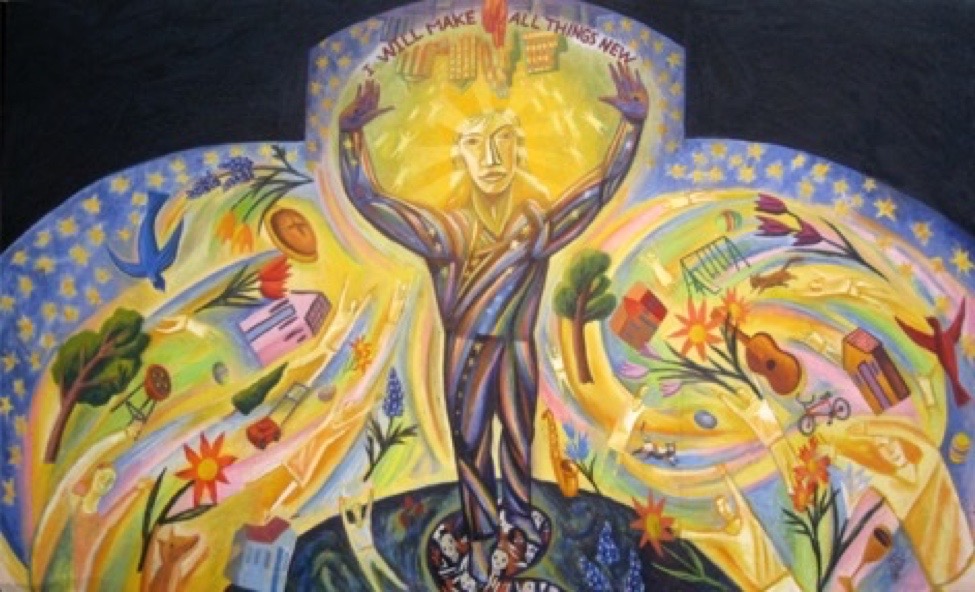
Our featured image is one of the works of Professor Bill Burgard‘s. It is the lamb of Isaiah and the Messiah, and the image for one year’s production of Handel’s Messiah by the University Musical Society. Hill Auditorium (acoustically perfect) usually sells out all 3300 or so seats; the stage is filled with orchestra, the UMS Choral Union, and more.

Bill Burgard is on the faculty of The University of Michigan Stamps School of Art & Design. I always loved this design and am realizing he also did one of a holy king for the production in another year. I use both as part of my nativity scene at home, a Peruvian ceramic set (Mary, Joseph, the three wise guys, a couple llamas, no shepherds, and one baby Jesus — not added until Christmas morning, of course!). I use a Tibetan silk fabric of the richest blue as background and set all in one of my book shelves (I guess that makes me go with the theological option of Jesus born in a cave rather than a stable). I add stars (lights) and angels, but the two Burgard images add the lamb, king, and prophecy of sacrifice and divinity.

I use this image of Bill Burgard’s with his written permission; do not copy or otherwise use or separate it from this site, please. Here is the link to Bill Burgard’s personal website in which you can peruse more of his (secular) art, if you wish!
First Sunday of Advent, Cycle B

Our readings for Sunday are here. 

These are the poems, my notes, and interpretations of Fr Dennis Dillon SJ’s homilies from the Masses of

  • December 3, 2017 Noon
  • November 30, 2014

The poems Fr Dennis references this cycle are:

In 2017, we reflected that β€”

  • In this liturgical season, we celebrate three comings, the three “Advents” of Christ:
    • The second coming
    • his birth
    • right now, in this very moment today
  • We are beginning the Gospel of Mark, called Cycle B, of
    • Cycle A focusing on the Gospel according to Matthew,
    • Cycle B focusing on the Gospel according to Mark
    • Cycle C focusing on the Gospel according to Luke

with the Gospel of John scattered throughout the three Cycles, but predominating during the Triduum gospel readings for all three cycles.

  • The Gospel of Mark is
    • the earliest recorded, canonical gospel with a ~70 CE date
    • the approximate date is determined in large part because it references the destruction of the Temple in Jerusalem by the Romans in ~70 CE (and was never re-built)
    • the final loss of the Temple was a major blow to Jewish identity and a major event in their history, as Yahweh (God) was in the Temple and was defeated.  Of course, this was exactly what Jesus was offering, is that God abides in us, too, and indestructible.
  • The event inevitably created what we would call PTSD in individuals and in cultural identity.
  • So, in that context, the “Watch!  Be on the lookout!!” (Mark 13:33-37) is about the “how” of the second coming and reflects this contemporary cultural trauma for 70 CE listeners: Where is that God (with the Temple now destroyed)? How can we be more alert?
  • The Dan Gerber poem Only This Morning reflects on the end of all time, being orphaned, a filly (indicating a relatively new birth) on the only day that matters — now.
    • We go ahead with our lives knowing all things will die
    • And, yet, the gesture of helping, support leading us in the right way is the “Advent” of thanksgiving, and ultimately the Eucharist.

In 2014, we reflected that β€”

  • the themes of light and dark, watchful waiting
  • In the Mark Strand poem For Jessica, My Daughter
    • He writes austerely, a bit darkly about that mystery of making connection when we aren’t certain when and how it will occur.

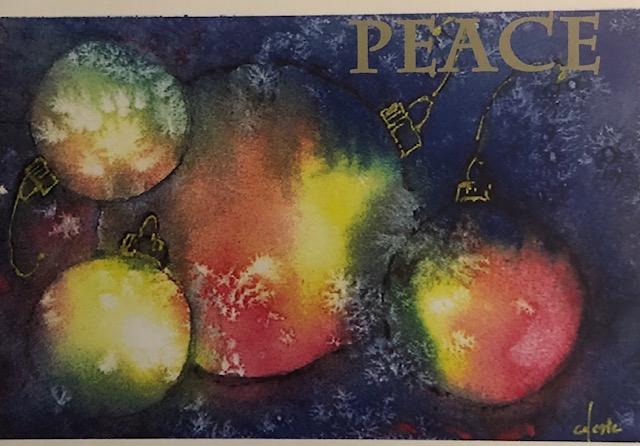
And, of course, we’re starting the season with Celeste’s beautiful design — which should actually be for the second week of Advent (Peace), but here we are!

Thirty-Fourth and Final Sunday of Ordinary Time,

The Solemnity of Christ the King Cycle C

Our readings for Sunday are here. 

These are the poem, my notes, and interpretations of Fr Dennis’ homily from the Masses of

  • November 24, 2019
  • November 20, 2016 5PM
  • November 24, 2013 8:30AM

_______

The songs Fr Dennis Dillon, SJ references these years are:

In 2019 notes, we reflected that β€”

  • The end time themes, like the traditional When the Stars Begin to Fall, embed new hopes (“what a morning”) with the endings.Β  This is what we know from Christ’s life and death; it all brings newness and salvation.Β  There are no promises about the Way, just that it is the Way to and with Love Loving.

In 2013, we reflected that β€”

  • The Solemnity of Our Lord Jesus Christ, King of the Universe, is an observance originated in the 1920s by the Church as a statement against the totalitarianism of Russia, Germany, and Spain, which were persecuting and murdering those who weren’t syncophants to the state.Β  No personal dignity or sacredness.
  • With Christ as King, each of us has dignity.
  • The United States can feel different, but we had sanctioned and institutionalized slavery (no personal dignity or sacredness) which has simply changed form in our culture over the centuries; it has not been eradicated.Β  Racism remains a great weight.Β  Yet Christ was a huge call to Africans for freedom from exile, from slavery (Moses), for the Good News, for Christ’s Kingdom, and thus they could not be kept down in spirit because of Christ the King. Or perhaps more accurately, Black spirituality and abiding faith in Jesus raised up in dignity and love and forgiveness those who believe.
  • D2 played one of Jessye Norman’s versions of “Give Me Jesus.”Β 
  • The simplicity but power of the message, particularly arising out of the African-American … or any marginalized or oppressed people’s experience.Β  Jesus is enough.
  • The featured image is the original art, “Glimpses from the New Creation,” created by W David O Taylor.

Happy Halloween!

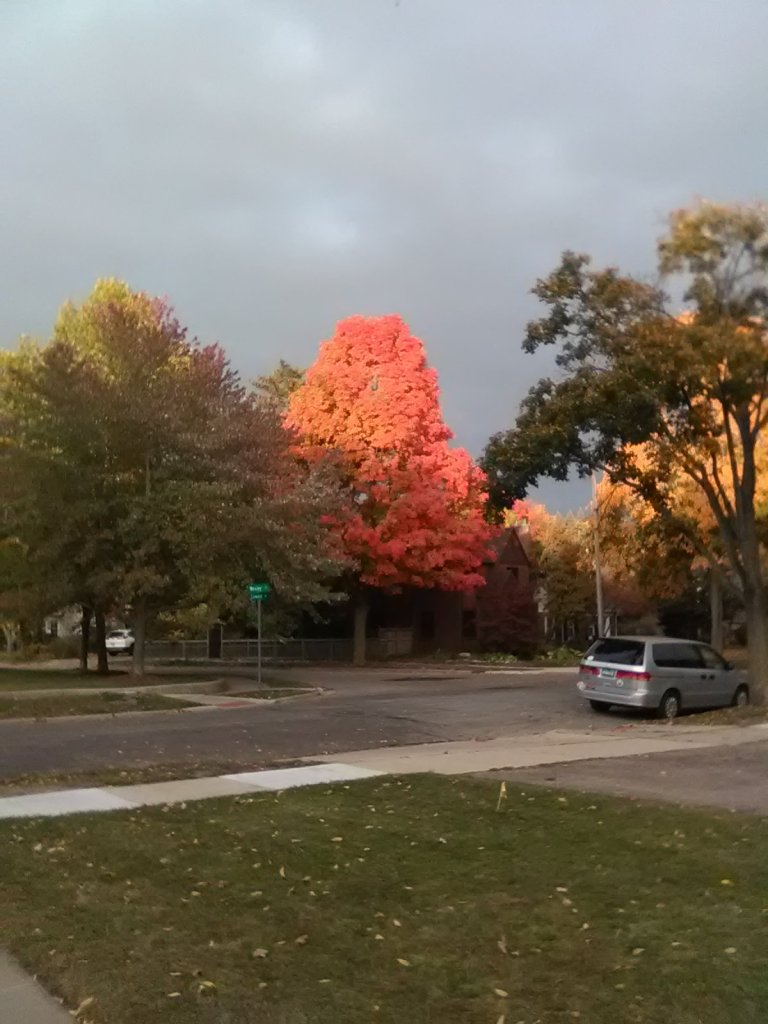
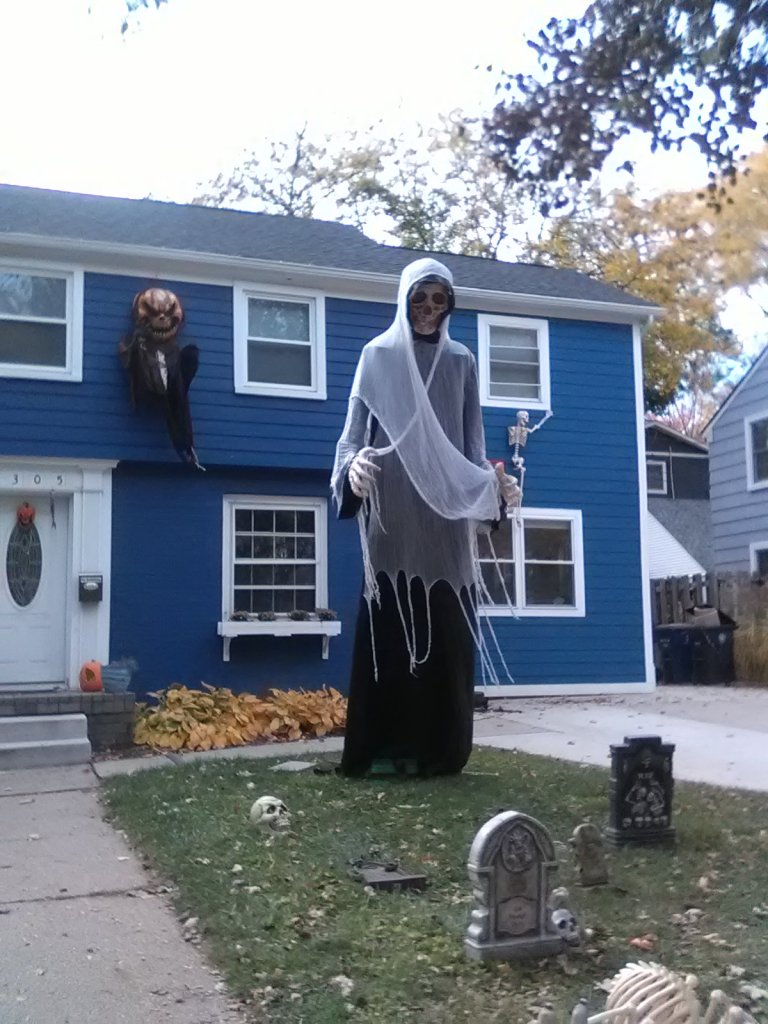
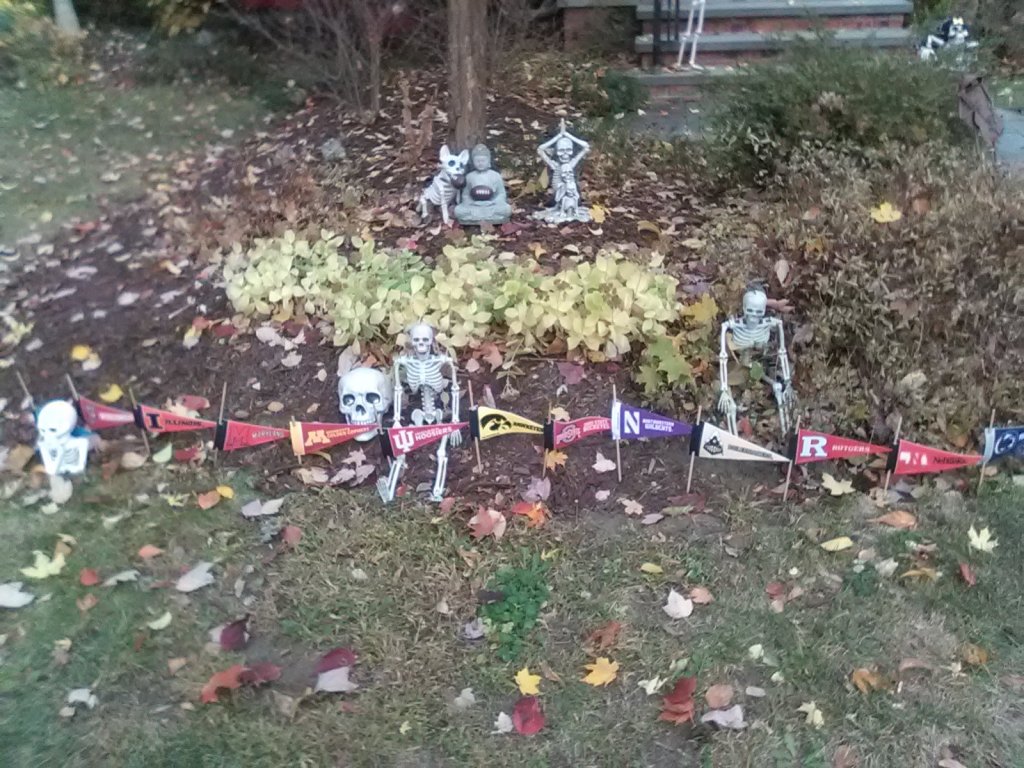
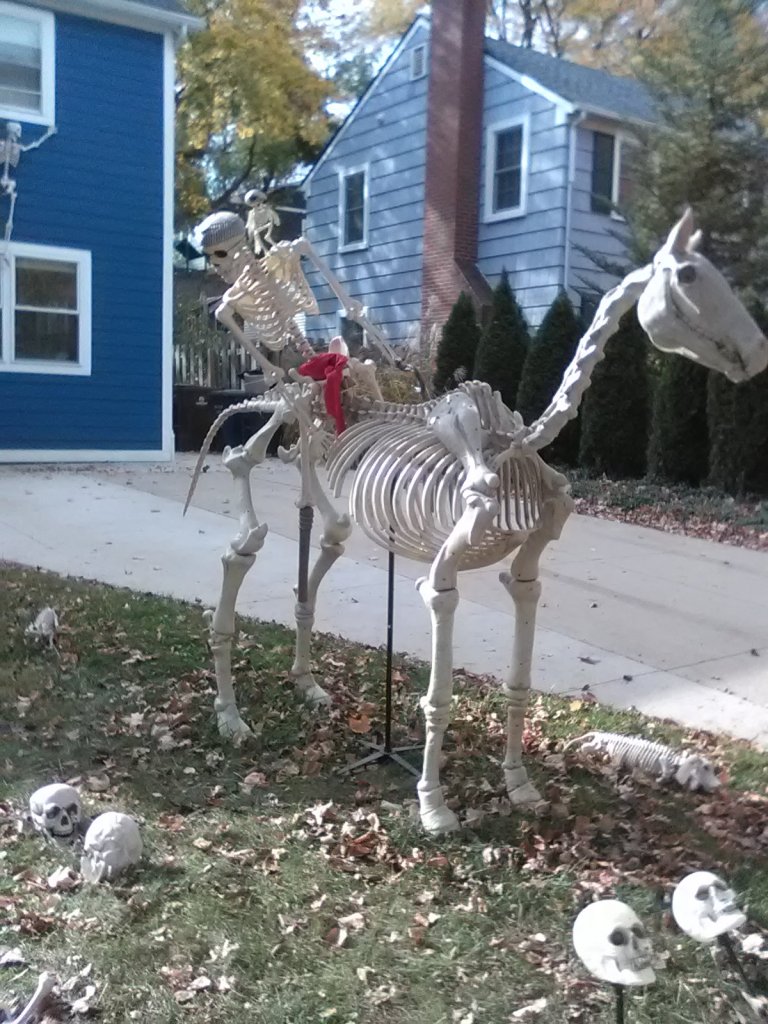
Just sharing a bit of the beauty of Midwest autumn in the United States, replayed throughout the Great Lakes region and more. The grandeur of God in the trees and their colors, the joys of Halloween decorating for the little goblin & ghostie in all of us, the backyard brawl fun of the University of Michigan v Michigan State University annual (American) football game for the Paul Bunyan trophy.

Mass (2021)

Our secon film of this year’s 2022 series, Fractured Fairy Tales, at St Mary’s is MASS, a Fran Kanz film. The AADL has both a regular single disc DVD and Blu-Ray edition. We watched the former.

We had a few more people but were still able to discuss in a circle (no microphone needed!) our thoughts on the film. Generally, the attendees thought it very engaging, particularly as we are watching two sets of parents talking and listening to each other in a single room for the majority of the film. We discussed both the emotional movement and cinematic techniques to make the setting seem larger than it was.

Without jumping in too far in description here … let’s see what people have to say about it and use the comments for discussion.

The Magnificent Ambersons (1942)

Our first film of this year’s 2022 series, Fractured Fairy Tales, at St Mary’s is THE MAGNIFICENT AMBERSONS, an Orson Welles film released by RKO. The AADL has both a regular single disc release and the Criterion Collection’s restored quality version and double-disc release. We watched the latter.

With the shorter notice and communication challenges, we had fewer people, but it was nice to have discussion face-to-face, without having to run the microphone around so we could hear each other.

Without jumping in too far in description here … let’s see what people have to say about it and use the comments for discussion.

Fungi and Fox

A lovely day and evening greeted us all in Ann Arbor. There are fewer but still hungry skeeters.

I enjoyed a quiet dinner overlooking the quiet ravine. The chippies make so much noise for being so tiny!

One meandering gaze takes in the ferociously large fungi on the wi-fi tree. a foot or more in diameter.

After an hour and a full stomach, I give up on the undercurrent of hope of seeing a fox. It’s too early and too light for them to be visible in observable areas.

I turn the corner and burnish copper with black stockings is in motion, from the northwest corner of Jan’s garden to the southwest corner then on to the ravine, confirmed by silent swift fox trot and the white-tipped tail.

Joy burned all the brighter and fuller for hope having just been set aside to residue embers for the evening, a full three seconds of unfettered joy with the fox in motion.

Where Foxes Play

After a six week hiatus, I saw one of “our” foxes Monday night!

The day had been a joy anyway, as the hummingbirds were busy at the feeder. There are at least two, as two had their territory war briefly. Good grief! There are two big bowls of sugar water that they never finish! Sharesies, hummies, sharesies!!

At perhaps 15 minutes away from full dark, I reflexively looked at the birdfeeder. Sometimes a beautiful cardinal is cheep-chomping on the seed. This time, nobody. But at the base, burnished copper catches my eye. One of the foxes is cleaning up the peanuts and seed. Sleek, red, black-stockinged, and just-so white-tipped tail. Gorgeous.

I stare and ooh and ahh to myself. I even manage one picture … but through the window with the screen, and then forget to save the second picture through the clear window because I am so excited.

A street noise startles the fox, and it dance glides across the tips of the grass blades, like a floating pennant. Everyone should get to see a red fox blow away across emerald green grass-sky. πŸ™‚

Quite a gift on August 23, 2021.

You know you’re in Montana when …

… it looks like a straight shot on the map from Gardiner to Great Falls via US 89 … and .. you misread those contours and misread the actual vertical experience of the trip! 

Travel from Gardiner to Livingston was as much a delight on the way out, as the way in — elk, osprey, eagles, and horses.

Take a right for seven miles on I-90 with the luxury of a divided highway.

Exit for the northern route on a full lane, full-shouldered, center & side-rumble stripped road to White Sulphur Springs — simply a delight of a road.

And then Lewis & Clark National Forest.  This is where my “plan” met God’s Creation and the humility of budgets, engineering, and elevations. Oofah.  My first miscalculation was thinking the trip would be similar to my childhood ones to Red Lodge Ski Resort and Bridger Bowl. Note to self: jettison the childhood passenger experience and misty-eyed lens memory view. I have to be the driver now!

The road at base level through the National Forest was well-used but peaceful; the slow-down of weaves and curves on a broken road a brilliant idea. Like many, I consider a less smooth road a good thing in a set-aside area keeping everyone a bit slower on the road than they might be otherwise.

Then the road, without any improvements, ascends up and up and up to an eventual pass of 7400 feet, the highest elevation maintained and kept open year round in Montana. Showdown Ski Resort and its 8,000 foot peak to the west and then a 9,000 foot peak to the east of the road. 

The change is gradual at first with more and deeper turns. You barely notice the rise until on turns, Sheep Creek then Belt Creek now seem mighty far below. Looking at the map again, it felt much curvier than it looks on paper!

Glad no one was behind me with my top speed of 45mph. This was not my favorite drive with the curves at these elevations, tilting road at times, okay asphalt, barely-a-shoulder shoulder, and what felt like nothing on the edges (the guardrails seemed sparse and somewhat akin to Wyle E Coyote’s ineffectual umbrellas). To be clear, this isn’t a declaration of engineering shoddiness. It is about the magnificence and untameability of God’s Creation in these parts! The engineers and construction crews that design and build these roads allow goods and people to move in a manner unheard of even 100 years ago. No budget or engineer could build a lowland road of pastoral driving through a Rocky Mountain pass. (Even Going to the Sun Road in Glacier National Park, a work of art and gorgeous views, is for the passengers, not the drivers!) Grateful to be in Dad & Jo’s Honda Element — not the best for wind, but a really good vehicle.

The spring mountain snow blizzard (rain or nothing at the valley floor) capped the experience for me. The Montana experience of my youth caught me — how this was just one too many obstacles, and I wanted to quit. There was nobody else on the road, this was all too much, etc. but at that moment, God’s Montana lifts you up, too.

Mom was at the other end of this road, waiting in her apartment, and for my sake had encouraged me to take the days off time with her to go to Yellowstone. As the world was overwhelmed with the big fluffy snowflakes, the boy soprano in Handel’s Messiah sings “And suddenly there was with the angel, a multitude of the heavenly host, praising God, and as the coro bursts forth “Glory to God in the highest, and peace on earth, good will towards men.” In that moment, the beauty of God’s Creation on earth, in weather, and in voice, transformed what might have been spring snow that broke this little camel’s back to the encouragement of a multitude of the heavenly host proclaiming the good news that we, including me!, are loved beyond what we will ever know in the moments or sum of our lifetimes. And God’s beauty carried me out of my fears.

But this segment of the trip in particular reminded me how acclimated I’ve become to my beloved Great Lakes region and how different being a passenger is to driving these roads. My childhood was filled with trips through the mountain passes of Montana, but Dad and his lifetime in these parts were at the wheel or my Mom and her fierce devotion to her children. Clearing King’s Hill pass and realizing I was heading back down to the valley floor was a heady celebratory moment. The road crews had ensured there was plenty of sand on the road to prevent slipping.

On reflection after a couple months, I realized the stress of the situation actuated all my trauma specific points — without any of the usual triggers. It was somehow wildly liberating to meet these experiences and pass through with the acknowledgement that this is where and how my body expresses stress … and I do not have to respond to it.

One friend consoled me that the view must have been magnificent. Even at a too slow for normal traffic 45 mph, I daren’t take my eyes off the double yellow in the center or lift a single finger from the double-clenched grasp of the steering wheel. Snow, yellow double stripe, and shrimpy guardrail filled my vision for an hour. πŸ™‚

My descent was downshifted and glad the Forest Service had laid down a hearty layer of sand on the road.  Sooooo happy to be on the base of the valley by the creek with little to no precipitation!  Then one more elevated pass until finally level ground and easy-peasy into Great Falls.  One river has jumped its bed in its meander.  There is a huge riverbed bone dry near Belt Creek.

White Wolf!

I am craning my neck to catch every angle as the time in Wonderland is coming to a close. Time feels precious, even though I’ll be in Montana again and Bob has extended a generous invitation.

Then a white wolf (not the same but an example) crests near the top of the ridge near/past Blacktail, maybe before the Gardiner River?Β  Beautiful!!Β  She sits.Β  I bark out β€œWhite Wolf!Β  White Wolf!Β  Stop the car!”  We back up the car and she trots roughly 50’ east at the base of a rock formation at the top of the ridge, then she rounds up and away.

THAT WAS SO STINKING COOL!!!

So!  About all these wonderfully colored wolves.  The Eastern Gray Wolf is only gray – that would be Minnesota and further east.  But about 10,000 years ago, the Western gray wolf had a back-breeding with wild dogs strayed from the Tribes, and black and white fur was reintroduced.  So Yellowstone has had three introductions — two Canadian in the mid-90s (with one white one, 39F, from British Columbia) and the third of some Northwestern Montana one year after.  Now about 5% of the YNP wolf population is white.  A few of the females are really big white wolves; they are born a light grey and then fade to near white as they age. (You can also see how famous Wolf 21, jet-black, aged to gray as he entered his senior years.)  There are about 100 wolves in YNP so about 5 have the possibility of aging to mostly white.

(Another white alpha-female suffered severe wounds in a poaching crime committed inside the park in 2017.  She and her in utero five pups had to be euthanized.  She was 12 years old and had had 20 offspring.)

So a white wolf is a rare occurrence, and rarer to see one.  One site indicates there is only one white wolf in Yellowstone at the moment, the alpha-female of the Wapiti Lake pack – now venturing further north, as Bob mentioned. 

A poem is coming out of this white wolf experience because narrative will never capture what it felt like to see her!