First Sunday of Lent Cycle B

Our readings for this Sunday, the First Sunday of Lent are here. (https://bible.usccb.org/bible/readings/021824.cfm).

Again, these are my notes and interpretations of Fr Dennis Dillon SJ’s homily from the 10AM Mass on February 18, 2018 and his poem selection from February 22, 2015.  

______

The poems Fr Dennis references in 2018 & 2015 are:

Evening on the Lawn by Gary Soto (18 Feb 2018 10AM Mass)

Small Boy by Norman MacCaig (22 Feb 2015 8:30AM, Noon, or 9PM Mass)

In 2018, we reflected on —

  • How the readings are a review of our basic call to be Christians — our covenants (God with us), our being claimed by God through Baptism, and our responsibility to confront our temptations.
  • 1st Reading (Genesis) Water! is a reference to Baptism (our RCIA / OCIA elect), a long tradition back to Noah, a one-sided covenant, a gracious guarantee as God promises Noah and all his descendants … but note that they don’t have any obligation to God in this covenant.
    • On a summer retreat I (rl) encountered my temptation of cynicism with this passage, as I wiseacred to myself that “Yeah, God didn’t promise we wouldn’t destroy ourselves …”  That is not who God is — not Lawyer God who specifies that burning up was not the part of that covenant; not Cynical God; not Human God (think STAR TREK IV) not any of those human frailties — but Love Loving.  We don’t know God, but I can remember this covenant (between God, humans, and ALL living creatures) and push back against my temptation to give up.
  • Back to D2 — The Sign of the Cross at the start of Mass is a remembrance of God’s promise in our Baptism; God leads us through the floods of our lives — great and small.
  • The Gospel — the first time D2 has thought of this time in the desert more squarely in the context of the vision quests, like the indigenous tribes across the globe.  The time in the desert is a journey to see who we are now and who we are meant to be.
  • Maybe Jesus, particularly in Mark’s version of the Time in the Desert, is a vision quest by Jesus to understand what “you are my Beloved Son” means, to find out what it meant.  The journey and meditation certainly marks a transition in his life and ministry.
  • In essence, that’s what we’re all doing as Christians, ever since our creation and Baptismal grace.  We are in the desert, trying to find out which spirits we are pulled by.
  • College can be a desert!   🙂  Trying to figure out who you are and who you are meant to be.  Jesus finds out that John the Baptist is arrested and to be killed; that’s when he announces his professional life.   (fyi — St Mary’s is officially Saint Mary Student Parish and is a parish dedicated by the bishop to serve the University of Michigan Catholic community and hosts the Newman Center, so there were a fair portion of young people present.)
  • Evening on the Lawn by Gary Soto describes a pivotal moment in a young man’s life when his gifts have him perceive this wondrous image of nature, an isolated roiling cloud seemingly gobbling up stars, and he calls his mother and stepfather to join him.  They don’t share the moment with him, though they come outside and indicate mild puzzlement or irritation that their routine was interrupted.  It is a pivotal moment of individuation for him (and all others) when the “home of our youth [is] struck by lightning.”  This felt like Jesus reconciling his new sense of identity:  devotion to the faith, his authenticity, and the faith traditions.  All of us are called and must do this devotion to the faith and the authenticity created inside us.

In 2015, D2 used (I must have missed the Mass / homily) —

  • Norman MacCaig’s poem, Small Boy, as a simple reflection on the practices and challenges of Lent:  we practice simple things every day but we are really “practicing for the future” and our greatest challenge is to “unclench [our grasp] and let them go.”

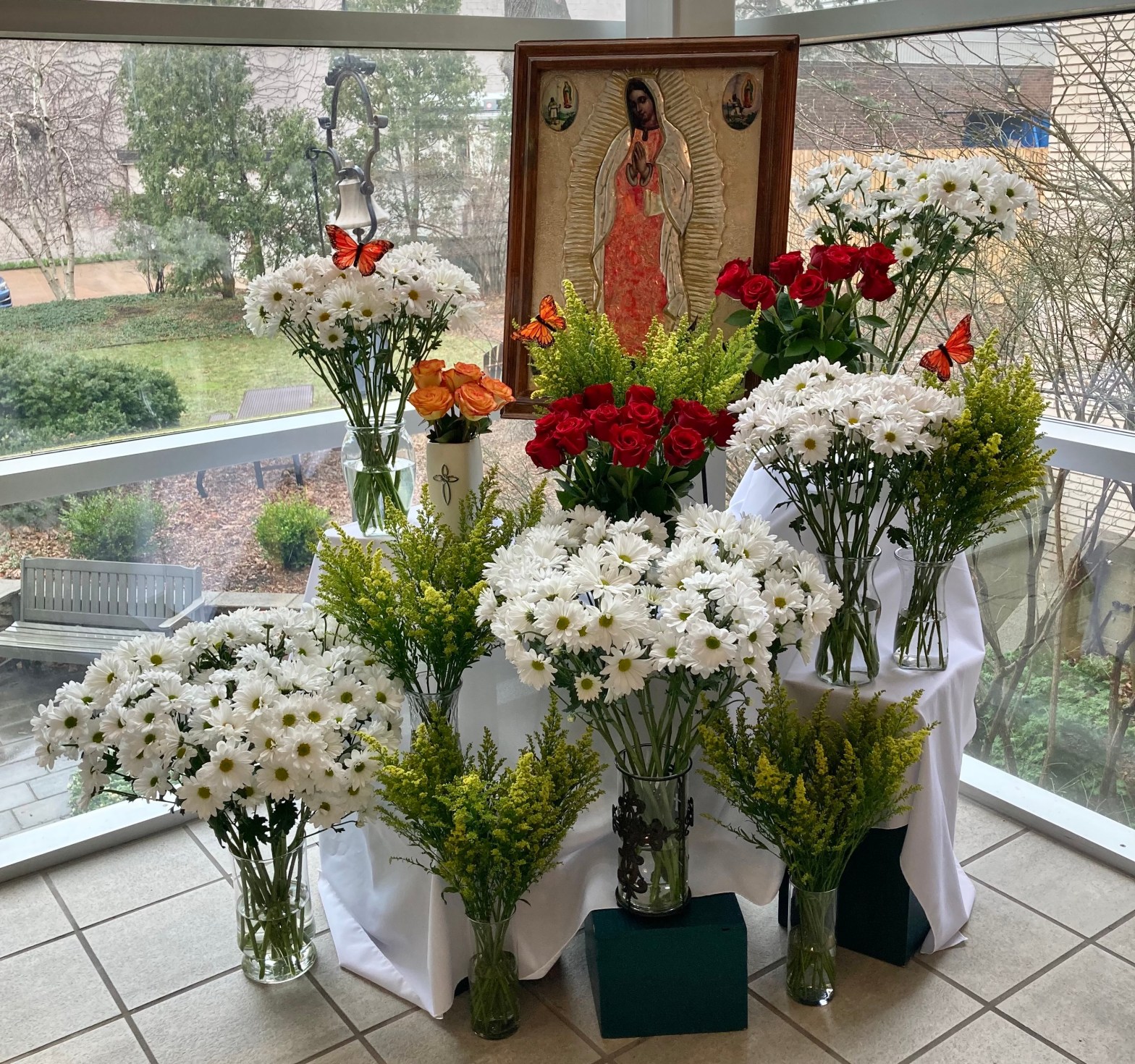
The Sunday readings were particularly meaningful for me this year.  I made my bucket list trip to visit the overwintering monarch butterflies in the central mountains of Mexico, about 3-ish hours west of CDMX (Ciudad de Mexico aka Mexico City).  I stayed closer to the southern edge of the monarch sanctuaries / reserves at Cerro Pelón Butterfly B&B (triple thumbs up!!), and they could take us out the back door to the Cerro Pelón Reserve or drive us in their comfy van to the other main reserves (El Rosario and Sierra Chincua) or any other place the monarch colonies were (literally) hanging out.  These monarchs born last August through October in the United States and Canada made the (up to) 3500 mile journey back to these areas in Mexico, form colonies to conserve body energy and protect each other, and are just now mating, and they will begin the northward migration laying the eggs for the first generation in northern Mexico or the southern United States.  It is the third or even fifth generation, never having seen or been to the mountain reserves in Mexico, who will overwinter there arriving between late October and mid-November.

When we visited the monarch colony in Sierra Chincua, it was very quiet being early in the season (late November) and during the work week.  I went with the 1/2 hour-ish ride being led on horseback up and up towards 10,000 feet, followed by a 20-ish minute hike to the colony.  I prayed a bit in this peaceful, quietly joyful place.  Grateful to be here, so very grateful for the Moreño familia whose business model for their B&B made this possible for me.  We had 30 minutes with the colony, and then went around the corner of the trail and sat down for our delicious packed lunch — a Meal as Communion if there ever was one!  As the clouds lifted a bit, the butterflies became more active — a “gentle explosion” of 100s rather than the 1000s you sometimes see images of.  Still — in the silence of no traffic, no human voices, no other noises whatsoever, all we could hear was the flapping whirr of monarch butterfly wings.  Unbelievable!  And then the rainbow came out.

My prayer had been that God not let us mess up and destroy these butterflies and their migration (the latter of which is headed towards extinction because of the decrease in number of butterflies).  I wiped away tears at the renewal of the covenant “between me [God] and you and every living creature with you” that we will not be destroyed (Gen 9:8-15).  So that is today’s image …

As one friend quipped — the only thing missing is the unicorn!  But deep mysticism in a cynical world does feel magical.  No unicorn needed.  🙂

The covenant is a good reminder that we never enter our journeys alone — God is with us, angels minister us, and the Trinity in our friends and communities shine brightly if we let them (sometimes the vulnerability that invites the shining is the hardest choice for us).

Sixth Sunday in Ordinary Time, Cycle B

Our readings for Sunday are here

These are the poem, my notes, and interpretations of Fr Dennis’ homily from a Mass of

  • February 15, 2015

_______

The poem Fr Dennis references this year is:

In 2015, we reflected on —

  • Lepers were segregated because of the fear of transmission of the illness.  [We now know that Hansen’s Disease (a.k.a leprosy) is not transmitted by contact.]
  • In curing this person, Jesus moves from being in town to being out in the country (apart), as the leper moves from being outcast to being back in town, in community.
  • This exchange is a curious result in this world, but by taking someone else’s burden to ease theirs, that’s how we serve:  we take it on; the extraordinary in the ordinary.
  • Jesus heals in words AND touch, with emotional AND physical connection.
  • He is a reluctant Messiah and not what the Jewish people were expecting
    • he leaves for the boonies of the boonies
    • “Don’t tell anyone [that I healed you]”
  • In the Shed by Mary Logue unveils an ordinary event but also a Testament, that there is an element of rest and consolation in the Buck’s dying, i.e., all deer die but not all find rest in their dying.  “Testament” = “covenant”  The buck in this poem witnesses the covenant in its death in the shed.
  • Jesus was not a worldly redeemer / messiah, but He brings hope in what we otherwise find to be hopeless, especially during Lent.  Though dying is hard, there can be peace in it.

One of the images today is from Cleveland.com (https://www.cleveland.com/middleburg-heights/2017/10/devastating_disease_killing_de.html) and captures the flavor of the poem, a buck finding repose in its illness amidst human settings, here at the edge of someone’s lawn abutting a small stream.  The photo is by Laura Takacs, and downloaded from the above October 5, 2017 article on 16 February 2025.

Our post image is Christ Heals the Leper by Vrindaji Clare-Maria Bowman, a U.S. artist.  The image was found on the Fine Art America website, https://fineartamerica.com/featured/christ-heals-the-leper-claremaria-vrindaji-bowman.html.  It is used this once, without permission of the site or the artist (at this point), but in hopes of sharing her work.  Here is her own webpage:  https://www.vrindajiart.com/biography

D2’s homily reminds me of conversations during the pandemic with friends in the medical profession.  The medical staff (nurses, doctors, technicians), administrative, and custodial staff met us on that boundary of life and death — as we were removed from society, the medical personnel met us there.  But the devotion to service and the grace it gives was wound tightly with the anxiety of bringing this deadly virus home to the ones they loved, those who shared the ones they loved with all of us who were sick and dying.

The extraordinary in the ordinary during an extraordinary time.

Fourth Sunday of Advent, Cycle B

Our readings for Sunday are here

These are the poem, my notes, and interpretations of Fr Dennis Dillon SJ’s homily from the Mass of

  • December 21, 2014 10AM

The poem Fr Dennis references this cycle are:

In 2014, we reflected that —

  • There is so much in these readings!!
  • In the first reading, from the second Book of Samuel —
    • in Nathan’s response, as the prophet of God, to King David, there is all kinds of word play going on with the Hebrew word for “house” and some pretty ironic humor from God’s perspective
      • House as palace
      • House as temple
      • House as dynasty
    • It is this passage that the gospel captures when Gabriel tells Mary that God will her son / His Son “the throne of David his father, and he will rule over the house of Jacob forever, …” (Luke 1:32-33) and makes real God’s words through Nathan that Jesus is (2 Sam 7:16)
      • of the line of David (both Joseph [Mt 1, Luke 3] and Mary [Lk 1, Elizabeth’s cousin, spouse of Zechariah, a priest of the Temple])
      • sprung from his loins
      • Messiah of all the ages
      • God’s promise fulfilled through Jesus.
    • The humor of the passage is David’s saying (paraphrased): I’m good; I gots the house of cedar, but … wait!! God in the Ark is in a tent!!  I need to do something!! … and Nathan, on behalf of God replies (paraphrased): YOU!?!  You’re going to build me a house when I’ve done all these things for you and the Jewish people?!?
    • rl note — thank you for pitching your tent with us, God.  🙂  the humor of this vignette reminds me of the Billy Collins’ poem, D2 shared, The Lanyard, in which a young child haphazardly creates a summer camp trinket and reflects back as an adult how implicitly the child version of himself thought it returned in measure his mother’s love.
  • In the gospel, it’s striking how important the names are: Gabriel, David, Joseph, Galilee, Nazareth, Mary, Elizabeth.
    • This feels in contrast to God’s encounters with us without recognition or name
      • Example #1, the Samson story of this week in the daily readings, a man of God appears, terrible to behold, but knows not to ask his name or where he came from.  (Note: at the time, it was thought that knowing a person’s name and place gave you more control … and more relationship.)
      • Example #2, in the burning bush story with Moses, God gives a name that’s not a name: I AM WHO I AM.
    • And so … Luke gives us a very close / near placement / pitching of the tent of God with us / in us / among us / as the least of us of Jesus, our brother and Savior with the passage’s detailed lineage, names, and places. It is a reminder that Jesus is like us humans — with a genealogy, with parents, grandparents, and more.
  • Tom Hennen’s poem, From a Country Overlooked (and unnamed, D2 added) offers an ordinary but grace-filled moment, like Mary’s encounter with Gabriel amidst her daily life:
    • “A frog calling at God”
    • a spot “so full of grace and being”
  • This week’s image is The Annunciation (public domain) by Henry Ossawa Tanner, and held by the Philadelphia Museum of Art. By Henry Ossawa Tanner – Philadelphia Museum of Arthttps://philamuseum.org/collection/object/104384, Public Domain, https://commons.wikimedia.org/w/index.php?curid=133819364
    • Mary’s visage is one of my favorites — wonder, engagement, humility but no fear, no shrinking from One who Loves us, Gabriel, the angel of God.
    • If Gabriel seems as brilliant as the tungsten of a light bulb; you’re right! Tanner painted this image after witnessing one of many Tesla’s public programs demonstrating this new light. He had also returned from trips to Egypt and Palestine. 
    • Henry Ossawa Tanner (1859-1937) was one of the first African-American painters in the European tradition to gain international acclaim. He spent much of his adult life in Paris.

Third Sunday of Advent, Cycle B

Our readings for Sunday are here

These are the poem, my notes, and interpretations of Fr Dennis Dillon, SJ’s homilies from the Masses of

  • December 17, 2017 Noon
  • December 14, 2014 Noon

The poems Fr Dennis references this cycle are:

  • Minnesota Thanksgiving by John Berryman on December 17, 2017 Noon
  • The Place by Paul Zimmer on December 17, 2017 Noon
  • December by Gary Johnson on December 14, 2014 Noon
  • Wait by Galway Kinnell on December 14, 2014 Noon

In 2017, we reflected that —

  • In the gospel, John the Baptist won’t say who he is!  It is almost like a legal language game:
    • “Are you ….?”  Nope
    • It feels like this familiar and frequent first question in a courtroom
    • It is happening with scribes and pharisees
    • He doesn’t deny or admit anything
    • And, on repeated listenings, it takes on the rhythm of a comedy sketch
  • In Jewish rituals
    • lotsa water is used (ritual purity, drawing of water, blessing on water ….) but no baptisms
    • so the innovation of the baptism with water by John the Baptist may be why the Jewish leaders think he is the Messiah
  • One reason the Jewish leaders may be unable to recognize Jesus as the Messiah
    • John the Baptist testifies to the Light, rather than the power and crampedness of scripture interpretation of the time, the heuristic of many Jewish religious leaders of the time, some Roman appointed
    • John the Baptist says, “I am not worthy to untie his sandal strap” —
      • The pharisees and the scribes (those of power) think John the Baptist must be beneath this unrecognized and thus earthly poor “Messiah” Jesus, whom they do not see as holy
      • But, we now know that John the Baptist is really saying that he cannot lower himself in heavenly humility as much as the one who will wash our feet and be hung on the cross.
  • In Minnesota Thanksgiving by John Berryman, captures the sense of how gratitude opens the door to our perceiving God’s grace and sanctification in us … even in secular circumstances, even with Thanksgiving is a civic holiday.
    • “Dusk comes as perfect ripeness.”
    • “This is where you will go / At last when coldness comes.”
    • “At the end of your life / You remember and dwell in / Its faultless light forever.”
    • rl reflection: The Pope Francis Center in Detroit, serving central Detroit’s community of people who are unsheltered and/or food insecure, for some time shared a quote of one of their guests: I’m not grateful because I’m joyful; I’m joyful because I’m grateful. If there was a hallmark of D2, it was his contentedness — with a couple dozen at daily Mass, with near 600 lined up the aisles at Ash Wednesday (he quipped with his cheery smile, “We should do this more often” joking about the annual celebration.) And so I find myself turning to gratitude, not to avoid my life but to live it fully, not allow myself to be inured in any dark room that circumstances may have me in — but remember I am housed in a mansion of which most rooms have been filled with light and joy, even as the current one may not feel that way. Sometimes they are so in the very moment I live them, sometimes after the fact. When I feel gratitude, I am humble like John the Baptist (love this icon image for praying; Thanks!, Fr Peter Fennessy, SJ, for your icon class). A Friendly Reminder: icons are sacred objects — they are to be displayed in churches or in your home’s designated and attended prayer space. They are not art to be displayed in museums or printed out from a computer and left on a table. We revere or let them be. :-)

In 2014, we reflected that —

  • We accidentally sang the Gloria at the Gaudete Sunday Noon Mass in 2014.  As he and we realized it, Fr Dennis cheerily noted, “Oops!  Ah, but we’re told in the second reading not to quench the Spirit!”
  • The first reading focuses on Joy and Justice.  On reflection (by rl) it seems that qualities of God — justice, gratitude, peace create joy in us.  That resonance of our soul in God creates that Joy that shines from us.
  • In the second reading, the line “Do not quench the Spirit.” stuck with Fr Dennis, even before our unanticipated Gloria!
  • Several things came to him as he reflected on the nature of Advent —
    • When D2 was doing his studies at NYU, he was assigned to and living in the Nativity Parish on the Lower East Side of NYC.
    • On occasion he would visit the Catholic Worker House.  He noticed that Dorothy Day seemed completely present to whomever she was with; no sense of rushing off or other things to do — even when she must surely have had such demands on her time, as she had already become a national and international figure.  When a staff member approached her as she was engaged with a guest; her simple response — “Do you need to speak with one of us?” struck D2 as this John the Baptist humility.
    • His recollection from T.S. Eliot’s play “Cocktail Party” — a one character cocktail party in which one “waits and does nothing.”
    • And, so is Advent — being present, waiting, and, need be — do nothing, in this time of remembering.
  • And so the poems are Wait by Galway Kinnell and December (a poem in English sonnet form!) by Gary Johnson.  The poems focus on what sustains us in the waiting — people, kids, hope.  They are how we hear “the voice of the angels.”

Second Sunday of Advent, Cycle B

Our readings for Sunday are here

These are the poem, my notes, and interpretations of Fr Dennis Dillon SJ’s homilies from the Masses of

  • December 10, 2017 Noon
  • December 7, 2014 8:30

The poems Fr Dennis references this cycle are:

  • December by Gary Johnson on December 10, 2017 Noon
  • Winter Grace by Patricia Fargnoli on December 10, 2017 Noon
  • A Prayer At a Baptism by John Shea on December 7, 2014 8:30 (Sorry, I can no longer find a version on the web; I only have it in hard copy in my notes.)

In 2017, we reflected that —

  • In the first reading (Isaiah 40:1-5, 9-11)
    • the text is the libretto for Handel’s Messiah (“Comfort, give comfort ye my people”), i.e., don’t worry.  “Com” “fort” is with-strength from Latin derivations
    • just being with one another, with God, is a comfort and strength
    • presence is not about changing things, necessarily, but about being.  When we wait upon the Lord, when God comes, the very presence of God changes things.  The ground is leveled and we can then walk on the level –> 🙂  so preach the Good News, shout it out!  🙂 
    • Mark is the first gospel written and the first to use the term “Good News,” i.e., I’m writing Good News, Good News that Jesus proclaimed.
  • In Gary Johnson’s poem December
    • we pass time with singing or humming, e.g., Handel’s “Messiah,” perhaps 🙂
    • a poem is a form of hymn
    • the everyday-ness of Jesus and Christmas, his coming, now, into our untriumphant lives
    • going forward into the dark, we don’t understand — it’s our going forward without head knowledge or certainty is what marks our faithfulness of heart to walk with Jesus.
  • In Patricia Fargnoli’s poem Winter Grace
    • it is about asking for comfort without asking (“truth is found in silence”)
    • the passage of time, preparing for God, and how if we go out & turn to God, God is right there
    • bread — “piled up like a white beaver hat”
    • feast — “on the picnic table”
    • wine — “to be swallowed by water”
    • The Presence — “then you have seen beauty”
    • Transubstantiation — “and know it for its transience”

In 2014, we reflected that —

  • In the Gospel according to Mark
    • there are no infant stories
    • it is the shortest gospel
    • the most used word in this gospel is “suddenly.”  It gives this gospel a very edgy feel relative to the other gospels. “Suddenly” Jesus went here; “suddenly” Jesus went there …
    • in Mark, John the Baptist points the way to Jesus
  • The Isaiah reading
    • has excerpts used as the libretto for Handel’s Messiah, which happened to be being performed at Hill Auditorium that same weekend.
    • and, it is always a good reminder that Handel’s Messiah was originally composed and at first performed at Easter time.
  • John Shea wrote a very long poem about John the Baptist, “The Man Who Was a Lamb,” (which rl couldn’t rummage up on the web at this point) and plays with almost every gospel passage about John 🙂 but, since it’s so long, D2 shared a shorter John Shea poem about baptism, “A Prayer At a Baptism” (which rl also can no longer find on the web, only hard copy in her notes).
    • We recognize and respond to the prayer to be God’s people and recognize each other as our own in the verses “We made you [wee baptized Johnny] our own // by making you God’s [through the Sacrament of baptism]”

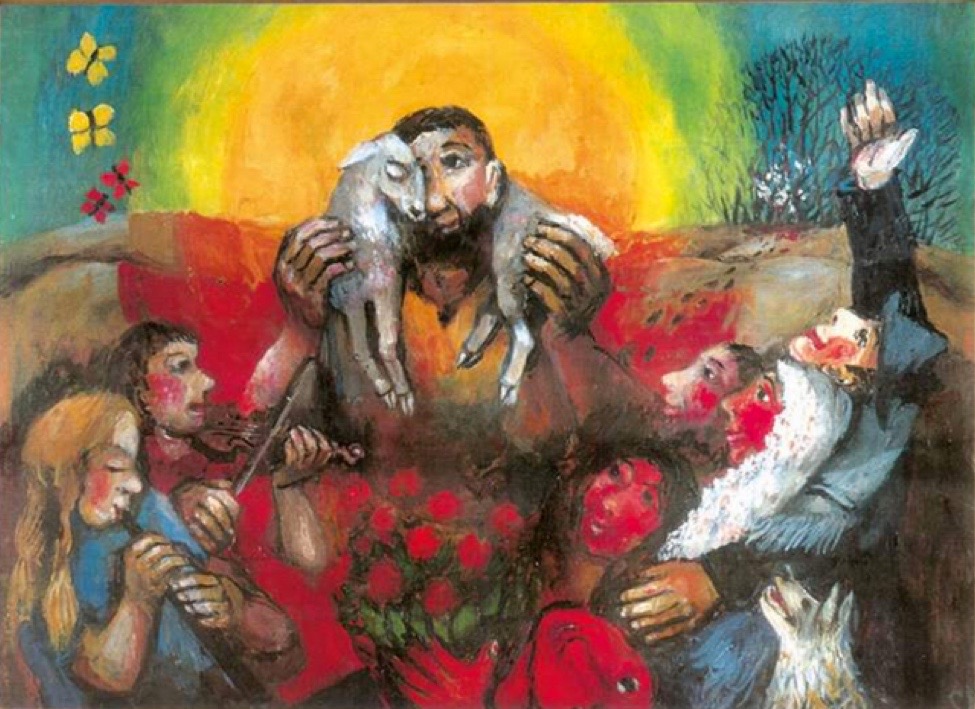
Our featured image is one of the works of Professor Bill Burgard‘s. It is the lamb of Isaiah and the Messiah, and the image for one year’s production of Handel’s Messiah by the University Musical Society. Hill Auditorium (acoustically perfect) usually sells out all 3300 or so seats; the stage is filled with orchestra, the UMS Choral Union, and more.

Bill Burgard is on the faculty of The University of Michigan Stamps School of Art & Design. I always loved this design and am realizing he also did one of a holy king for the production in another year. I use both as part of my nativity scene at home, a Peruvian ceramic set (Mary, Joseph, the three wise guys, a couple llamas, no shepherds, and one baby Jesus — not added until Christmas morning, of course!). I use a Tibetan silk fabric of the richest blue as background and set all in one of my book shelves (I guess that makes me go with the theological option of Jesus born in a cave rather than a stable). I add stars (lights) and angels, but the two Burgard images add the lamb, king, and prophecy of sacrifice and divinity.

I use this image of Bill Burgard’s with his written permission; do not copy or otherwise use or separate it from this site, please. Here is the link to Bill Burgard’s personal website in which you can peruse more of his (secular) art, if you wish!

First Sunday of Advent, Cycle B

Our readings for Sunday are here

These are the poems, my notes, and interpretations of Fr Dennis Dillon SJ’s homilies from the Masses of

  • December 3, 2017 Noon
  • November 30, 2014

The poems Fr Dennis references this cycle are:

In 2017, we reflected that —

  • In this liturgical season, we celebrate three comings, the three “Advents” of Christ:
    • The second coming
    • his birth
    • right now, in this very moment today
  • We are beginning the Gospel of Mark, called Cycle B, of
    • Cycle A focusing on the Gospel according to Matthew,
    • Cycle B focusing on the Gospel according to Mark
    • Cycle C focusing on the Gospel according to Luke

with the Gospel of John scattered throughout the three Cycles, but predominating during the Triduum gospel readings for all three cycles.

  • The Gospel of Mark is
    • the earliest recorded, canonical gospel with a ~70 CE date
    • the approximate date is determined in large part because it references the destruction of the Temple in Jerusalem by the Romans in ~70 CE (and was never re-built)
    • the final loss of the Temple was a major blow to Jewish identity and a major event in their history, as Yahweh (God) was in the Temple and was defeated.  Of course, this was exactly what Jesus was offering, is that God abides in us, too, and indestructible.
  • The event inevitably created what we would call PTSD in individuals and in cultural identity.
  • So, in that context, the “Watch!  Be on the lookout!!” (Mark 13:33-37) is about the “how” of the second coming and reflects this contemporary cultural trauma for 70 CE listeners: Where is that God (with the Temple now destroyed)? How can we be more alert?
  • The Dan Gerber poem Only This Morning reflects on the end of all time, being orphaned, a filly (indicating a relatively new birth) on the only day that matters — now.
    • We go ahead with our lives knowing all things will die
    • And, yet, the gesture of helping, support leading us in the right way is the “Advent” of thanksgiving, and ultimately the Eucharist.

In 2014, we reflected that —

  • the themes of light and dark, watchful waiting
  • In the Mark Strand poem For Jessica, My Daughter
    • He writes austerely, a bit darkly about that mystery of making connection when we aren’t certain when and how it will occur.

And, of course, we’re starting the season with Celeste’s beautiful design — which should actually be for the second week of Advent (Peace), but here we are!

Thirty-Fourth Sunday of Ordinary Time, Cycle A

The Solemnity of Our Lord Jesus Christ, King of the Universe

Our readings for Sunday are here

These are the poems, my notes, and interpretations of Fr Dennis’ homily from the Mass of

  • November 26, 2017 10AM
  • November 23, 2014 10:10AM

_______

The poem Fr Dennis references this year is:

In 2017, we reflected on —

  • how part of the first reading (Ezekiel 34:15-17) and the gospel (Matthew 25:32-34) focused on the different judgments for sheep and goats.  He suggested a good website of sheepandgoats101.  I’m not sure this is it, but this is what I found: https://backyardgoats.iamcountryside.com/feed-housing/feeding-goats-and-sheep-101/
  • the gospel describes the attributes of the sheep, people, and nations on the king’s right in the remainder of the passage.  “I was hungry, and you gave me food; I was thirsty and you gave me drink, …”
  • how there are people who live the works of mercy (feed the hungry, clothe the naked, …) and then find out Christ was in the poor, the hungry …
    • they have a natural sympathy with those in need
    • almost a religion, in that they don’t even really know they’re “living the gospel”
  • our Collect prayer from the Sacramentary (Roman Missal), “Almighty Ever-Living God, whose will is to restore all things in your beloved Son, King of the Universe” addresses another aspect of the end time: God will make things right — justice to and throughout the entire world.

In 2014, we reflected that —

  • it’s important to note what is not said in the gospel: the Judgment isn’t a vindication of Jesus’ teaching because his teaching isn’t about doctrinal matters.
  • the important message (and main point) of the gospel is that
    • we help one another; that we simply be good human beings, and
    • how important service is to the community and ourselves; concern for the poor is mentioned 1 time per 10 verses in the Christian Scriptures (New Testament), 1 time per 4 verses in the gospel according to Luke, and a staggering 1 time per 3 verses in the Epistle of James.
  • Barbara Crooker’s poem engages with what is gold?  what is important? — olive oil, the miracle of many meals from one … from the fat that looks like molten gold.
  • the judgment and The Judgment are about the every day — to be kind, to be good, to be human, to be thoughtful.

Thirty-Third Sunday of Ordinary Time, Cycle A

Our readings for Sunday are here

These are the poems, my notes, and interpretations of Fr Dennis Dillon SJ’s homily from the Mass of

  • November 16, 2014 Noon

_______

The poem Fr Dennis references this year is:

In 2014, we reflected on —

  • Fr Dennis regularly went up north to help catalogue a collection by “The Doctor,” a medical doctor who collected seemingly the largest number of unrelated items imaginable — until the institute had D2 and others begin cataloguing the items.  A treasure trove – the Harrisville Cultural Institute (or sometimes Institute of Cultural Learning)!  When he visited Harrisville, D2 stayed with the diocesan priest, 80 years old, who served four parishes.  (Difficult but not uncommon nowadays, it seems — a distant Lamey cousin priest does a circuit of 240 miles between several parishes over the weekend in northeast Montana.)
  • The Anne Bingham poem offers what is enough to give meaning at the end of our lives, at the end of the world (as we approach the celebration of Christ the King next week). We belong, and we all belong to God.

My (rl) personal reflection on this gospel was that the master, God, offers Mercy or Love, and the only thing to do with this gift is to offer it to others or to praise God.  The servant who received one talent didn’t know or understand God’s Love, didn’t understand the talent itself was a gift. At the time one of my favorite motivational pop songs was Jewel’s Christmas rendition of “Hands.” I think of it as sung more to the forces of the world that would have us feel we can’t do anything, that small things don’t matter or change the world.

The Christian spirituality I learned from Dennis was kind and the exact opposite to the bullying of the world (including the Church) — small kindnesses do matter.

Or, if you’re a STAR WARS fan, remember … there are more of us who believe in Love and Light than those consumed by darkness, we simply have to offer our hands and share the Light of Christ, given to us in the Spirit of Love and Mercy by our Loving God. Northern hemisphere is growing dark, let your light through Christ illuminate these days!

A cameo by Dan Reim, SJ at the 9PM Mass (yes, 9PM! — a beautiful split liturgy in which the Liturgy of the Word was at one end of a consecrated basement hall, and we processed as a congregation — around 200 of us — to the other end of the hall with the altar, to celebrate the Liturgy of the Body; as Communion ended we returned to our original seats) offered that through God and abiding in God’s presence, ordinary acts are sanctified to help build the City of God with God’s hands, the very hands God gave us.

In a world at war (but, God be praised, not World War yet) — the peace and vision of the heavens that the astronomers are creating for us through the James Webb Space Telescope and now the European Space Agency’s Euclid Space Telescope is a wonderful contrast, and reminds me of the promise of the star who started three spiritual seekers on a caravan, in faith, to find a King, and adored the babe nonetheless. And so, two heavenly images of the Crab Nebula for us this post!

Sixteenth Sunday of Ordinary Time, Cycle A

Our readings for Sunday are here

These are the poems, my notes, and interpretations of Fr Dennis’ homily from the Mass of

  • July 20, 2014 Sun 8:30AM

_______

The poem Fr Dennis references this year is:

In 2014, we reflected on —

  • It’s parable time in the reading cycle — lots and lots of parables, last week the seeds and soil, this week the mustard seed and faith, and more weeds.
  • In general for parables
    • when asked a question, Jesus tells a story or parable which essentially prompts the questioner to consider a different view or answer
    • parables are poem-like in that they make larger statements about life in general and have multiple meanings, e.g., “Let those who have ears to hear, here.”  There is the literal meaning of the statement and that meaning which denotes “ear [of faith].”
    • they are an unusual style of story intended to teach and hide
  • He chose the poem by Wilfred Owen.
    • Wilfred Owen was born in 1893 and died during WWI. A lot of his poetry arises out of his experience in war.  This poem is 16 lines but only the last two rhyme, the two lines that express his opinion/point of view.
    • In this poem we hear the human choice surround WWI rather than Abram’s choice to obey God, ultimately saving his son.  Instead, “the old man … slew his son, / And half the seed of Europe, one by one.”

And some fun facts about the mustard tree (the big plant with branches!) that is thought to have originated in Persia and spread throughout the region.

Easter Week 5 Cycle A

Our readings for this Sunday, the Fifth Sunday of Easter, the Resurrection of the Lord, are here

These are the poem, my notes, and interpretations of Fr Dennis’ homilies from the Sunday Mass of: 

  • May 18, 2014 Cycle A, Noon

______

The poem Fr Dennis references is:

In 2014, we reflected on —

  • In the gospel, Jesus knows he is leaving again relatively soon but offers some confusing statements when considered in tandem:
    • Jesus and the Father are one
    • Jesus is going to the Father (which implies distinctness or separation).
  • A note of exasperation at Phillip can be detected in Jesus’ words (“Have I been with you for so long a time …?”), but also Phillip’ and Thomas’ expectations for an understanding they perhaps ought to have internalized by now.  (That being said — their puzzlement is also a balm to us as we are enamored and struggle with the mystery of the Resurrection nearly 2000 years later!)
  • This dialogue and conversation captures the sacred tension between religious structure and the spiritual realm.
Catechism / Structure  <— Sacred Tension —>Spiritual Realm / Mysticism
What am I supposed to do? Where are we going?Who am I supposed to be? Who do I follow?
  • Jesus is teaching that by staying with Jesus, the Jesus inside each one of us, we stay close to God and this means that it matters who we’re traveling with (not as a matter of feet and maps) but our intention and focus (Matthew 6:21, also comes to mind)
    • with Jesus in our heartswith eyes and ears for Jesus in others
    • in prayer and Mass (the actual Presence being given to us anew, each time, for taking into ourselves and taking out into the world).
  • The Lincoln prose-poem of David Shumate is set in 1865, describing the man himself and what he had lived through the prior four years (recalling President Lincoln was assassinated on 14 April 1865 at 10:15PM, the country’s first presidential assassination, just five days after the Union received the words of surrender from the Confederacy on 9 April 1865, and several days before the Civil War’s official end).  It was not just Lincoln’s words that built community out of great division, but the man himself.

Some rl musings —

  • Our image of the post is The Boyhood of Abraham Lincoln by Eastman Johnson (1868). I first learned of it at the University of Michigan Museum of Art (UMMA) (It rocks! Check it out!). Young Abraham Lincoln is leaning into the only light available to capture the light of the words from one of the only books available to him.  His act of hope in the future, a better future for many, is an echo to me of how Jesus himself brought Light into the world, and we need to have that Light inside us and share it and Jesus, as best we can.
  • rl – I have vague memories of the folk song, sung by any number of artists, title “Abraham, Martin, and John.”  I remember Dad growing quiet, or Mom quietly crying to it or having a social sadness that I wouldn’t understand at the time, but feels all too familiar these days.  My horizon of hopes ahead for me personally is, understandably diminishing as I age — both because of my limitations and because I’ve been blessed with so many hopes realized.  But it is the thought of what we need to do for our younglings generally, my grandnephew and grandniece or any child to have a full horizon of hope that shakes any melancholy, renews my faith in Christ “who called [us] out of darkness into his wonderful light,” and sets my sail accordingly to the hope the Resurrection encompasses.