Our readings for Sunday are here.
The following are my notes, the poems, and reflections from Fr Dennis Dillon, SJ’s homilies from the Masses of
• 1 January 2017, 10AM
• 1 January 2016, 10AM
The poems Fr Dennis referenced are:
• Diagnosis by Sharon Olds (2016 homily)
• Going to Bed by George Bilgere (2016 homily)
• New Year Resolve by May Sarton (2016 & 2017 homilies)
In 2017, we reflected:
• How the New Year is also a new hope, a starting over again.
• D2 mentioned Ann Lamott’s new novel All New People in which failure and
forgiveness are prominent themes among its characters.
• And, today’s baptism (at Mass) is a reminder of yet more life and hope going on
amid daily challenges that might make us think otherwise.
• The May Sarton poem, New Year Resolve, offers “come back to still water” in
our minds, and the key to finding clarity is silence.
• Jesus, as an act of salvation, finds the clear water in our everyday
experience, as if to say “everything’s okay.”
In 2016, we reflected that
• Historically, a number of celebrations are wrapped up in this day — Mary, the
historical titular Feast of the Society of Jesus (aka the Jesuits), the Feast of the
Circumcision, New Year’s Day, and more.
• The Feast of the Circumcision was observed because only humans bleed, and
Jesus’ circumcision would have marked the Lord Jesus as truly human. In The
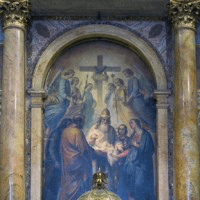
Church of the Gesù in Rome in the rear of its sanctuary/apse, there is the image
(below) of the circumcision, and during and around its June-ish observance, an
image of The Sacred Heart. In part the display of the circumcision is done, as
theoretically, any bloodletting would have satisfied the letter of sacrifice law,
but the crucifixion marks the entirety of his sacrifice and our resurrection (fully
divine, he also fully suffered and died and resurrected completely).
• Today’s Mary, Mother of God celebration is one of the major Marian
observances, as the reading is clear how she was reflecting on all this — the
shepherds, the temple and circumcision, the magi, and later Jesus getting lost in
the temple. Just as Jesus had to grow in wisdom and grace before God and his
community, so, too, did Mary. “What’s going to happen to this child?” “How is he
going to save?” These were normal and expected questions because, for all
appearances, Jesus was just one infant like any human infant.
• So Mary (and all of us) learn how to understand from the experience of a child.
Sharon Olds poem Diagnosis is evocative, perhaps, of the challenge Mary might
have had to interpret and understand Jesus.
• The Bilgere poem evokes this time of year, the winter solstice, the Christmas
season, and the sense of reverence and extraordinariness in the ordinary, like
how the Lord of the Universe erupts into our world as a human infant!
Some rl notes: today’s readings are beautiful — blessings, loving salvation, and shepherds — all in celebration of Mary, the Mother of God. For those who aren’t Catholic, the Marian devotion ranges from proxy mother to mother watching over the community to Jesus’ first and best disciple. Spiritually and emotionally the range of devotions create a flowing, mystical, and rich person.
The first reading, Aaron’s blessing (the Aaronic blessing), is when God instructs Moses to teach his brother, Aaron:
The LORD bless you and keep you!
The LORD let his face shine upon you, and be gracious to you!
The LORD look upon you kindly and give you peace!
I really enjoyed the Irish Blessing, an all-Ireland video released during the pandemic, and one that contains the Aaronic blessing at the end.
I had the gift of reading the Aaronic blessing passage at Mass in 2017. I love reading (or lectoring, if you wish) as when I am prayerful, what is spoken is beyond me. It is one of the joys of the mystical tradition of the Catholic Church. As I was reading: Whoosh! All the errant ways in which I (and many of us) use God’s name or claim to be God’s people or “righteous” flooded in simultaneously with the true voice of God (like in 1 Kings 19:11-13 — a whisper, not a roar; gentleness, not dictatorship), and I found myself emphasizing in the reading the words “my name.” I realized God was not just marking the Jewish people, but God was creating and explaining God’s identity to us humans who worship idols or create false proxies of Love Loving.
But the peace of understanding who God is and how we share God was a rich consolation, making the inheritance of the second reading even closer. It’s easy to imagine the desire to be close to Abba, Father, especially if you feel close to your human father; but experiencing God’s voice of loving call directly draws us each and all to our best self.
The Circumcision by Alessandro Capalti in the apse/sanctuary of the Church of the Gesù in Rome shows this moment,
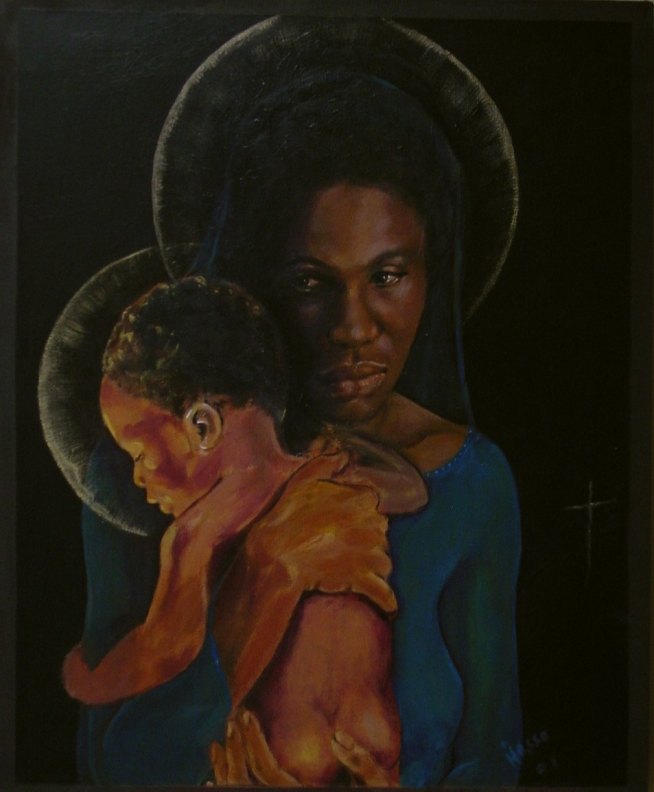
but then Jim Hasse, SJ catches the thoughtfulness, concern, and puzzlement Mary might have carried in his Sorrowful Madonna, our featured image.

