Our readings for Sunday are here for the 32nd Sunday OT and here for Feast of the Dedication of the (St John’s) Lateran Basilica in Rome.
Sooooo, why is the Roman Catholic Church celebrating a building dedicated in 342 C.E.? The abridged version, based on this excellent article in America Magazine is … home. In John Shea’s wonderful poem, the “A Prayer to the God Who Fell From Heaven” he ends with, “for by now / the secret is out. / You are home.” We are celebrating that we have a home in God, really, the only true home we have, but it can be symbolized and present in a magnificent building yet most importantly in our hearts, wherever we go, whenever we turn to God.
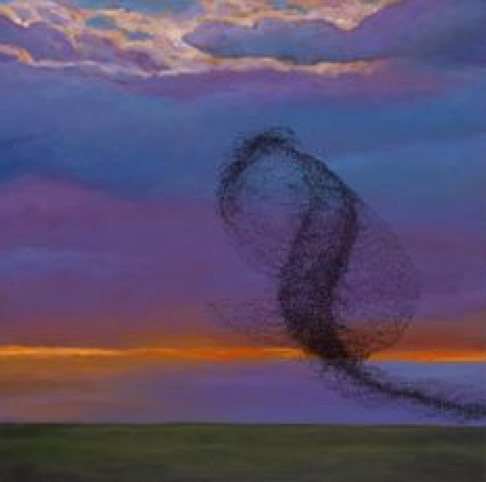
Kind of like the starlings of our featured image today somehow know to turn and remain with each other in the dynamic movement of their bird lives.
These are the poem, my notes, and interpretations of Fr Dennis’ homily from the Mass for the Thirty-Second Sunday of Ordinary Time which we would otherwise be celebrating …
- November 10, 2013 9PM
_______
The poem Fr Dennis references this year is:
- 2013 homily — Starlings in Winter by Mary Oliver
In 2013, we reflected with Fr Dennis that —
- At the time of the Maccabees , the Jewish people began to believe in resurrection (~200 to 100 B.C.E.). But, of course, humans being human — not all Jewish people did:
- the Pharisees became the branch of Judaism that did believe in the Resurrection, and so this is the tradition Jesus was a part of.
- the Sadduccees did not believe in the Resurrection and stuck tight to the first 5 books (the Pentateuch), which is why they begin their conversation with Jesus with “Teacher, Moses wrote for us …”
- In a book D2 recommended to me the year before he passed, The History of the Primitive Church by Jules Lebreton, SJ and Jacques Zeiller (1949), pp 60-65, Lebreton offered a helpful description of Pharisees and Sadducees.
- The Sadducees structure to Jewish society was more like a caste system of lay priestly and aristocratic people with an almost exclusionary focus on written law (and near neglect of oral tradition). So the written law was supreme, especially for those who were not of the ruling caste. We can easily imagine this structure opened the path to cruelty by the Sadduccees to the every day Jewish people. Without the consideration of oral tradition, the Sadducees and their followers did not have a belief in resurrection or angels.
- The Pharisees sit on “the chair of Moses,” i.e., and serve as magistrates of sorts. In contrast to the Sadducees, all classes of people are Pharisees, e.g., priests, scribes, and the simple folk. The Pharisaic tradition is rabbinical, i.e., a master-disciple transmission of the law and faith in the tradition of the elders, more so than a current scrupulous reading of the law in Scripture (i.e., the wisdom of the elders prevailed in interpretative disputes). They also believed in angels and the resurrection of the body AND scrupulous conformity to the law, e.g., observing the Sabbath and legal purity.
- The Jewish people were not unique in this regard. The Greeks of the time continued to press an engraved coin under the corpse’s tongue (only one side of the coin was engraved — cheaper production cost that way!) to pay the ferryman Charon for passage across the River Styx. This is just one cultural example, among many, indicating how the Spirit or soul lies beyond corporeal death.
- This sense of disintegration, flying away in spirit, and re-configuring in hope of new life is captured in Mary Oliver’s “Starlings in Winter.” It reminds us of our hope in the life in the Resurrection.
- This action of the starlings is called murmuration.
 The Surest Sign