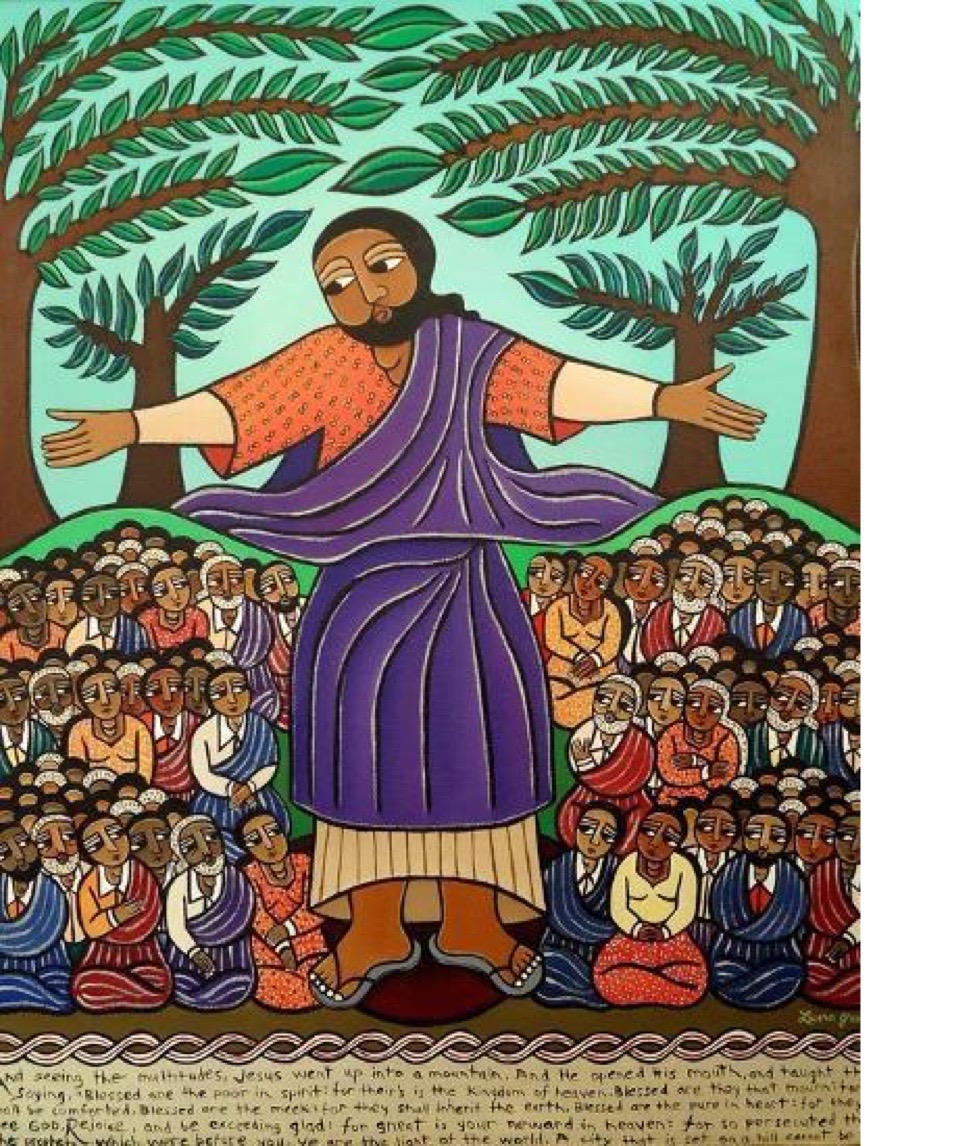
Sermon on the Mount© Laura James, 2010 Used with permission
Our readings for Sunday are here.
These are the poem, my notes, and interpretations of Fr Dennis’ homilies from the Masses of
- Feb 2, 2020 Noon, Feast of the Presentation of the Lord (no homily notes)
- January 30, 2011 (no poem)
_______
The poem Fr Dennis references is:
- 2020 homily — A Marriage Song by Wendell Berry
An introductory comment that these two entries (the Fourth and Fifth Sundays of Ordinary Time) are brief. These are my early note-taking efforts back in 2011 — as I was coming ’round the corner of one year returned to the Church. And, I was beginning to realize how precious — like salt! — Dennis’ homilies were, and all the more so set in a Mass of loving fellowship. Most of the Masses he celebrated left me square in the experience of God’s Love, and these two entries reflect the first stirrings (fifteen years ago) of my desire to leave trail markers in notes should I ever need guideposts to help me find my way to kind love through scripture and prayer.
In 2020, I listened this Sunday but did not capture any homily notes. Likewise, the poem is in Wendell Berry’s New Collected Poems (2012) and is well-worth finding, though I had no luck getting a link from the web. In recollection and without notes, my thought is that the repetition of “Our Mary in her day of days” in the poem is like a refrain in a hymn and would have struck D2 akin to the repetition of the “Blessed are …” introduction of each beatitude. However, I went back to the original spreadsheet and saw this Sunday was the Feast of the Presentation of the Lord.
In 2011, we reflected from D2’s homily that —
- The Beatitudes
- are beyond commandments
- they are affirmative qualities rather than probabilities or conditionals
- They are God-like qualities.
- How can we do this or be these qualities, so extraordinary in sum total or individually?
- It’s a cliffhanger! 🙂 Tune in to the Fifth Sunday in Ordinary Time, Cycle A!
Our featured image today, Sermon on the Mount© Laura James, 2010 Used with permission, is by the renowned artist, Laura James. I found her work embodies that sense of deep connection and Love in the understanding of the preciousness of salt, of ourselves to God, that D2 was conveying in his homilies of the Fourth and Fifth Sundays of Ordinary Time.
Here also is a link to a terrific article on her work.
I hadn’t realized the Book of Gospels we used at St Mary’s when I first returned to the Church in 2010 was the one of her design and art! It was long and lovingly used before it was retired, but this fortuitous connection with her work this morning is just in time for me to return it to use tomorrow for our Black and Blessed Celebratory Mass (and also discover that a new edition was published in 2020!).
May we be the Light of the World today, particularly for those experiencing darkness and oppression … and for those parts of ourselves needing that Light. Pass the salt! 🙂
 The Surest Sign
Maybe the Wendell Berry poem was The Country of marriage.
This is a summary of it and the poem itself — https://lyricstranslate.com/en/wendell-berry-country-marriage-lyrics.html
The poem “The Country of Marriage” by Wendell Berry explores themes of enduring love and commitment, likening the marital bond to a farmer’s intimate and continuous relationship with the land. The central message is that true fulfillment and belonging are found in deep, unwavering connections to both one’s spouse and one’s place in the natural world. Key Themes
Interconnectedness of Life and Nature: Berry uses rich pastoral imagery, such as streams, forests, orchards, and planting seeds, to parallel the cycles of nature with the growth and renewal found within a lasting relationship. Tending to the land requires the same patience, care, and dedication as nurturing a marriage. * Commitment and Fidelity: The poem emphasizes the importance of steadfast devotion, trust, and surrendering oneself to the relationship. The bond is portrayed not as a transactional or “little economy” based on equal exchange, but as a boundless, mysterious force that survives beyond individual needs and thirsts. * Security in Belonging: The speaker contrasts the previous state of loneliness and being “a man lost in the woods in the dark” with the solace and security found in the marital union. The spouse becomes the “known way” and “known place” to which the speaker can always return. * Transcendence and Spirituality: The love described in the poem goes beyond mere human emotion, suggesting a parallel with divine love and participation in all of creation. The abundance of love is an unearned gift, to be accepted humbly, much like a plant accepts light and dark from the bounty of the world.
LikeLike
Hey, Kevin! Thank you! So good to hear from you. This is a different poem on marriage by Wendell Berry; the one Fr Dennis used, “A Marriage Song,” is one to his daughter on her wedding day. Dennis must have read it from one of his Wendell Berry collection books (photocopied for easy reach during his homily). The one you found is the one readily available on the web.
With a hopefully acceptable short excerpt, the poem “A Marriage Song” starts:
In January cold, the year’s short light,
We make new marriage here;
The day is clear, the ground is bridal white,
Songless the brittled air
As we come through the snow to praise
Our Mary in her day of days. … (that’s about a quarter of the poem)
and it continues with that refrain-like repetition.
Thanks again for saying “howdy” and offerings on the poem people are more likely to find!
LikeLike