Our readings for Sunday are here.
These are the poems, my notes, and interpretations of Fr Dennis’ homilies from the Masses of
- October 15, 2017 10AM
- October 19, 2014 8:30AM
_______
The poems Fr Dennis references these years are:
- Sabbath Poem: “1986, I” by Wendell Berry (15 Oct 2017)
- Joe’s Tax by Diana Goetsch (19 Oct 2014)
In 2017, we reflected on
The first reading
- God has anointed (and “set apart”) Cyrus, a non-Jew and given him a task: conquer and later allow the Jews to return out of exile.
- God is using Cyrus for God’s purpose. Have you ever experienced someone — maybe not a friend — striking you or your circumstances and changing your life?
In the gospel …
- The Jewish temple does not have any image of any living things, which means there shouldn’t have been any Roman coins with their engraved image of a leader inside or on the grounds.
- This is a familiar more in the Middle East, i.e., to have no images of living things than in, say, western Europe. As a result, the art of the Middle East tends to use geometry, letters, and things.
- But we humans are created in God’s image. God imbues us with God’s divinity. In Genesis, we are created in God’s image, thus we belong to God.
- So … give Caesar / earthly things to Caesar.
In the Wendell Berry poem, there is a sense of temple, a sense of people waiting to return (like the Jewish people in captivity) —
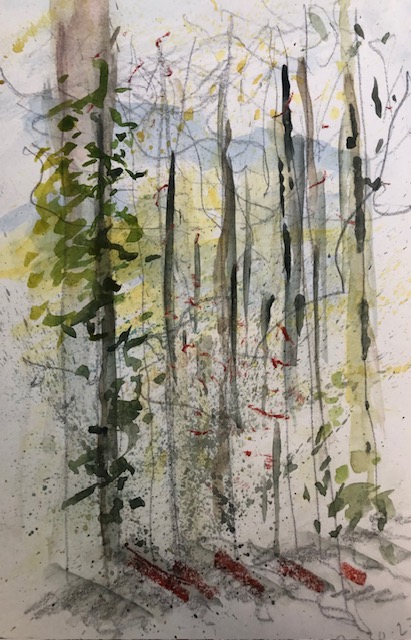
- Trees are changing, colored, and creation. They are “Apostles of the living light.”
- Living light — chlorophyll is alive.
In 2014, we reflected on —
In the first reading, King Cyrus conquers the people of Israel. God, through Isaiah, tells Cyrus that he is God’s chosen instrument (“whose right hand I grasp”). Really?!? God uses a foreign king to conquer God’s people? God is at work; God is in charge — and lest we forget, God’s Way is not our way.
In the gospel reading from Matthew – we have the wit and wisdom of Jesus looking at something from a different point of view. The question is a trap for Jesus to choose against Caesar or against the Jewish leaders (who shouldn’t have had the Caesar coin!!). The crowd would recognize the hypocrisy (and hilarity).
“Whose image”? Name and image in those days indicated control over identity. The Jewish people didn’t directly use the sacred name, and God is never directly represented. Eikón (ikon) is the word used in Greek … the same language as in the Book of Genesis.
Joe’s Tax is a poem with a humorous bent on taxes — a something that can be devoid of humor, but not in this case. 🙂
Year Unknown — I do have a memory of a D2 homily on this gospel in which, in part, he said in his imagining which tended toward cinematic sensibilities, Jesus — knowing the trap being laid — looked at one of the coins, fingered it a bit, and then began walking away, perhaps even flipping the coin a bit casually back to the Pharisees and offering his final line re giving Ceasar Ceasar’s due and to God what God asks of us. 🙂
Our image today is one by friend, Into the Light peep, and artist, Celeste Novak, and for now we have an interim title of Timbered Choir 1. Used with her permission for this entry. You can visit more of her work at CelesteNovakStudio.com. Enjoy!

