Fifteenth Sunday of Ordinary Time, Cycle C

Our readings for Sunday are here

These are the poems, my notes, and interpretations of Fr Dennis’ homilies from the

  • July 10, 2016 5PM Mass
  • July 14, 2013

_______

The poems Fr Dennis references in these years are:

In 2016, we reflected on such wonderful readings and good insights.  Thanks, D2!  🙂 —

  • In the first reading,
    • Moses is letting the people know that these are not obscure sets of law; they are close and within in us and in our hearts.  The early lines (Dt 30:10) state the law as the Will of God, and the remainder (Dt 30:11-14) capture the mystical, personal relationship with God.
    • rl is reminded of Jeremiah’s prophecy from God in J 31:33, that the Love of God will be written in our hearts and Saint Gregory of Nazianzus’ Oration 14 Love of the Poor (~370 C.E., in which he exhorts that we are made in the image of God (Imago Dei) when we love human beings, preferentially the poor).
    • All this returns to D2’s point:  We know what to do, God has placed it there inside us.  It’s the doing that is before us.
  • In the second reading of Colossians,
    • It reads almost like a hymn to Jesus.  He is both the inspiration for the Creation, and he sums it all up.
    • But the apostles and disciples know him as a human being — the humanity behind the divinity of which this “hymn” sings.
    • So few words are used compared to the impact of them.
  • In the gospel of Luke,
    • How we interpret the parable of the Good Samaritan how it has grown from its early interpretations, instead
      • Jesus = Good Samaritan
      • Adam = wounded/sick man, victim of the devil himself
    • In this understanding, then, the priest (law) and the Levite (prophets) pass by because only Jesus is compassion AND human’s death and resurrection.
    • In the parable, wine and oil are used to heal the wounded traveler, like Jesus comes to us in the wine and oil of the sacraments.
    • It all hinges on Mercy, “neighbor” is the one who shows Mercy.  We receive it and give it because we have been saved.  We do so (we mercify, or however you make “mercy” a verb!) out of gratitude, but also only because of having received the grace of Mercy from God.
    • In the text, the scholar of the law correctly captures that we need both love of God one-on-one and love in community (that’s why we pray the “Our Father,” not the “my Father”).
    • The parable makes one thing clear about God’s Mercy, the mercy that we are to live and are graced with:  exclude no one.
  • The poem by Marie Reynolds is
    • set in the context of her cancer treatments,
    • focuses on joy as the insatiable appetite for life and gratitude (“Thanks for my feet, my fingers, …”), hopes (“I want to see my mother again,” “I want my doctor to use the word ‘cure’ just once”), for others (“for the hands that position me, their measurements and marking pens”)
    • Early in the poem she gives “thanks for the scrub jay’s audacious cries …” and at the end she “close[s] my eyes and think[s] of the jay.”
  • Fr Dennis found
    • Jesus (“J” “jay”) in the lines “We wear the same raiment: blood, bone, muscle.”  This is akin to how Jesus shares our blood, bone, and muscle.
    • And this invisible bird — “invisible feathers, invisible wings” that give “a quickening, felt deep within the body, vigorous and fleeting” offer how in our soul, the sense of hope, wanting to live is the Spirit abiding in us.
  • Fr Eric Sundrup, SJ in the 10AM Mass gets a cameo with one of his insights from the parable that walking to help is (often) walking into danger, and we are to “go and do likewise.” <gulp>  However, when we do so out of the gratitude for the gifts we’ve received and the grace of mercy, we are made “safe” from the inside by the Eucharist.  In other words, we can be in consolation that we are in the right place at the right time, regardless of earthly outcome.

In 2013, we reflected on —

  • The readings offer the wonderful tension between God’s Will, as manifested in the law, and the mystical personal relationship, as manifested in the person of Jesus Christ.
  • Fr Dennis offered a Dorothy Day poem/note/quote indicating how grateful she was to know Jesus in prayer and in the poor.  Please take it as the art of Fr Dennis’ homilies that this was seamless in oration, and now clunky being resurrected in my deficient notes!  But Dorothy Day attended daily mass and had her own repeated presences in prayer with Jesus throughout the day.  The point being the same as made in the first reading — God and God’s Will, Love, and Mercy are not “out there,” they are in “here” (she wrote gesturing to her heart).
  • He then suggested Ignatian contemplation of the Good Samaritan parable, becoming alive in the scene and invoking your senses to see what God might have stand out for you at this time and place in your life.  (rl thinks that’s one of the great beauties of Ignatian contemplation:  God can reach you through scripture and connect it with your daily life, but do so uniquely across the experiences and days of your life without changing the words of the scripture passage you read.)

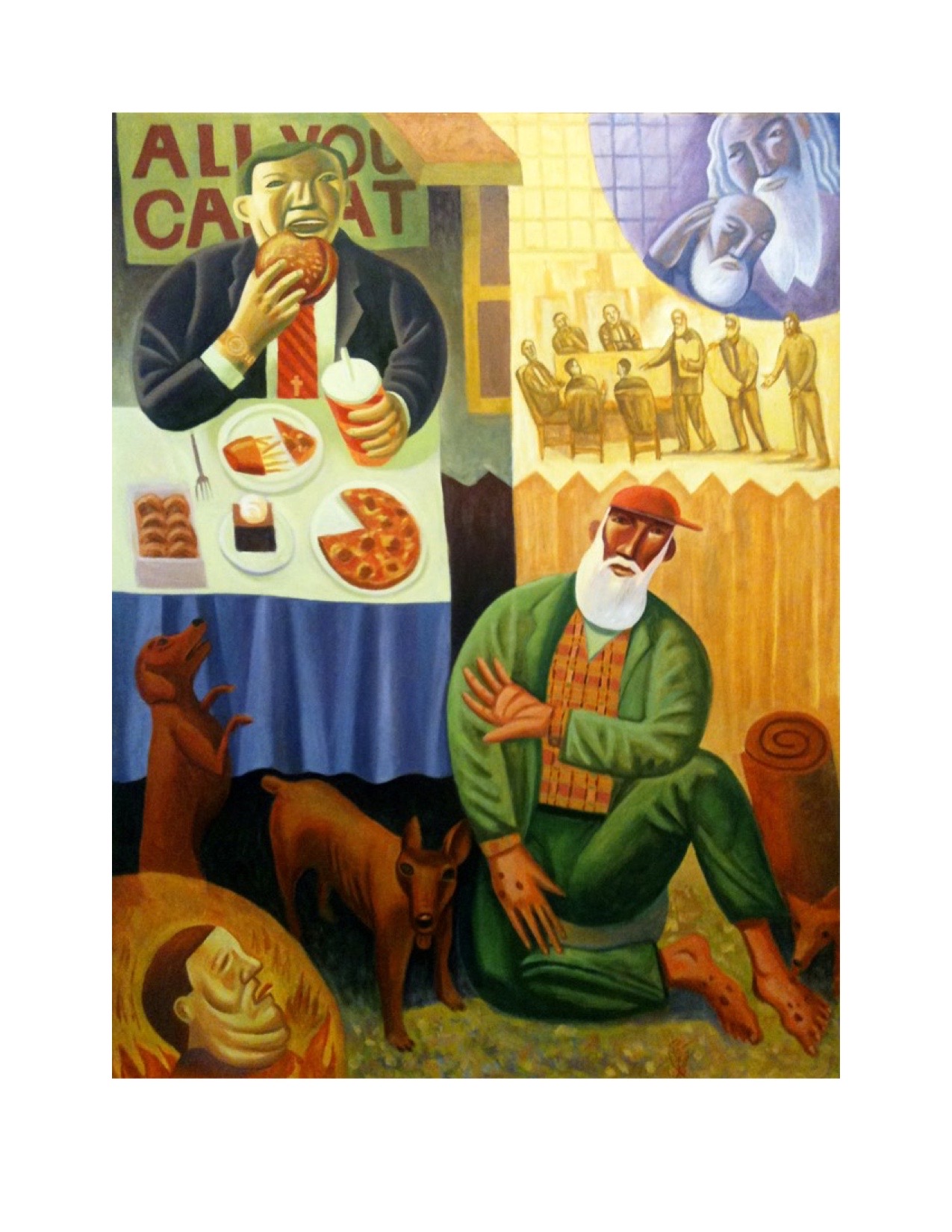
I chose a simple image of the Good Samaritan parable by James Tissot.  Most of his originals are tiny!  But the detail and sense of richness is large. He only used settings and human models of the region of scripture.

Fourteenth Sunday of Ordinary Time, Cycle C

Our readings for Sunday are here

These are the poems, my notes, and interpretations of Fr Dennis’ homilies from the

  • July 4, 2016 8:30 Mass
  • July 7, 2013

_______

The poems Fr Dennis references in these years are:

In 2016, we reflected on —

  • In the first reading,
    • Rejoice!  Rejoice! The first reading and the gospel are of joy.
    • They are nice readings to have during summer with its green and verdancy, vivid reminders to rejoice because our names are written in heaven.
  • In the Gospel of Luke, the author is the only one to mention the 72 disciples.  This number doesn’t come up often, and we don’t know who they are.  It’s possible they represent a literary parallel to Moses’ 72, to create the sense of Jesus as the new Moses, to assure the Jews that Jesus is in the line of prophets. See 2013 note on same topic, below.
  • In the poem, Margrave captures how to live love, a Christian love that always falls short, is always active, and always growing.  How love is lived rather than romanticized.
  • Also in the stumblings Margrave captures, we are called to keep reaching for the crazy love of Christ with and to each other.  Anything less?  We’re settling.
  • This poem was shared shortly after I had finally submitted my application for Pastoral Studies program at Loyola Chicago — and that’s what it felt like.  How could I ever explain to myself, let alone to admissions, why I wanted to continue.  Words never describe how God touches, creates, and recreates our lives.  But we can try, and live in the gratitude of the experience of being Beloved and trying to Love.
  • A brief Fr Eric Sundrup, SJ cameo — a reminder that the circumcision / no circumcision was a hot topic in its day, and the “no circumcision” point of view would have been received like bashing the United States on the Fourth of July, but the point of the readings is don’t settle, keep reaching for the glory of the cross —

In 2013, we reflected on —

  • In last week’s reading, Jesus seemingly set the bar pretty high — leave everything and everyone, etc… but even so …
  • This week, with that standard 70 disciples went out!  (It’s unclear in the original text whether it is 70 or 72 disciples), but in the Hebrew Scriptures Moses receives 70 helpers (Genesis 10), and there were 70 nations in the world at that time
  • Wendell Berry writes so pointedly about the strange search for rest and faith and peace in his poem The Lilies.  D2 offered
    • Isaiah and the Psalms are treasures of the heart, like lilies.
    • Letting the peace of Christ control our hearts in the seeking and not seeking; in the finding and not finding, particularly Isaiah, Psalms, Galatians, and Gospel of Luke.

No special message with the Van Gogh, other than that it is summer. We have much to be grateful for, even amidst all the work of the Kin-dom before us. 🙂

Thirteenth Sunday of Ordinary Time, Cycle C / Observance of the Solemnity of Sts Peter and Paul, Apostles

Our readings for the Sunday of this blog are here

The ones used for this Sunday, June 29, 2025, with the observance of the Solemnity of Sts Peter and Paul, Apostles, are these ones.

And at least one of our Jesuit reads the “Feed my sheep” passage from John 21:1-19. So. I am making an editorial choice this year to keep it simple and continue to share the notes of the Thirteenth Sunday and Fr Dennis’ homily from prior years. His Third Sunday of Easter (Good Shepherd Sunday Cycle X) has some, as usual, thoughtful insights into the passage from John.

These are the poems, my notes, and interpretations of Fr Dennis’ homilies from the

  • June 30, 2013

_______

The poems Fr Dennis references in these years are:

In 2013, we reflected on —

  • In the first reading of the standard Cycle C,
    • the mantle is a sign of a successor — in this case, Elisha being the successor of Elijah the prophet.
    • Elijah is being kind of cranky with God in the context of this vignette.
    • Elisha is responding in an all out “Yes!” and making sure he can’t turn back by breaking the plow and burning it.
  • In the Gospel, when Jesus refers to the looking back while using one of the light plows of the time, he is likely alluding that looking back while using the plows of his day would likely create a crooked furrow.
  • In D2’s and our youth, his mom (and likely our parents) often rolled out platitudes such as “anything worth doing is worth doing well.”  In his case, because often he was lazy and could do reasonably well without much effort, and now being older, and for whatever reason for each of us — we simply cannot do everything well … but there are still some things worth doing, even if we must do so poorly.
  • Another maxim, fitting to Elisha, is nothing succeeds like success (or excess)!  There is the success and excess of this world; and the excess that is the just right response to the overflowingness of Christ’s call and God’s Love that fits in our freedom of choice; i.e., it is no slavery on part. 
  • But our response is often mixed, tinged with regret and constraint in letting go, like the varied examples in today’s gospel reading.
  • “At North Farm” evokes the “and yet” quality that captures our desire to
    • to match God’s excess toward us and “do well.”  This something, this relationship with God is very much worth doing well.
    • and yet not letting that desire interfere with the reality of our limitations and still do this meaningful something, even when we must do so “poorly.”  Because, through Christ’s unrestrained and obedient offering of excess, we are “all in” by way of the Eucharist.

So … I’m not sure I have a good fox image handy for the “Foxes have dens” quote. But I found one with a fox outside its den! I hadn’t thought about this with the passage of foxes having dens and birds having nests; but, both have dens and nests only when they are incubating or raising their young. The kits are inside the den for one or two months while the dog and vixen hunt for food and protect them, and then foxes sleep outside. The same goes for birds. I’m not sure where reflection will lead with the idea that Jesus has nowhere to rest his head, in this context.

Solemnity of the Most Holy Body and Blood of Christ, Cycle C

Our readings for Corpus Christi Sunday are here.

Following are the poem, my notes, and interpretations of Fr Dennis’ homily from the

  • June 2, 2013, 10AM Mass

_______

The poem Fr Dennis referenced was:

In 2013, D2 shared —

  • In the reading from Genesis, Melchizadek prefigures Jesus, and this is his only mention in Hebrew Scripture.  The prefigurement arises in three notable ways:
    • Both offer bread and wine
    • Melchisadek blesses Abram in doing so; Jesus offers his blessing in doing so
    • Melchisadek is a king and priest of the Most High; Jesus is son/descendant of David, king and priest
  • Our Corinthians reading of today is the (historically) oldest written reference of the Eucharist, as the Letter of St Paul to the Corinthians (53 – 54 C.E.) predates any of the written Gospel accounts (~70 C.E. –> 120 C.E.).
  • In our gospel reading (Luke 9:11b-17, the Feeding o’ the 5,000), it shares how we have the Sacraments, and they comprise sacred moments of our lives … but, also, how they also reverberate through them.  E.g., Baptism denotes new life in Christ, yet every birth is thought to be a blessing of new life as a result of the Sacrament consecrating some births.
  • And so, Jesus is God all the time through all the events of a human life, and by his becoming human, he made all these everyday events sacred.
  • Alden Nowlan’s poem captures this sense of everyday events sacred for three friends in Great Things Have Happened

This blog week feels full, so here we go!

I don’t have many memories, if any, of Corpus Christi Sunday from when I was a wee lassie.  Having left the Church in spirit by the time I was 13, that’s not surprising.  However, on my trip to Rome in 2017, as part of an intensive field trip for my Church and Mission course in pastoral studies with Loyola Chicago, a bunch of our class went to the Corpus Christi Mass and Procession (which also happened to be my birthday) with Pope Francis presiding (what a gift!!).

We arrived about one hour early at St John Lateran Church for the papal Corpus Christi Mass.  We were in the second row standing on the grass with a clear view of the outdoor altar, albeit across the road and steps, etc.  It was amazing to have such a large Mass feel so personal spiritually, though being with my Loyola peeps helped lots!  A wonderful liturgy guide was provided and a beautiful choir, shared through an incredible sound system.  There seemed like a bazillion communion ministers (and even then not everyone could receive), but being so close, we did receive.  In my notes, I had written how I can still go to that communion space. 

But, interestingly, what I remember even more now was the procession of all of us, filling the street like blood fills an artery — purposed and full of life, and following the Eucharist to the plaza of Maria Maggiore on the Via Merulana. 

I still have my candle wrapped in wax paper and wax catcher. Almost all of us had one and had it lit, as we walked the street with music from speakers along the way.  It felt like there were more people in the procession than there were at the Mass!  Christ literally walking the streets with us and in us, all in so much Love.  We all end up squishing together in the plaza of Maria Maggiore where Papá met us again.

 “We are one body, one body in Christ, and we do not stand alone.”  🙂

And that’s what it felt like, and Christ’s sacrifice on the cross made more sense for receiving that every day and mystical experience of the Body in motion.

This Friday night our parish is offering prayer in the Stations of the Cross: Through the Lens of Racism.  The Stations and the Solemnity of the Most Holy Body and Blood of Christ feel all the more resonant in such proximity with each other.

Also, Dad’s birthday would have been on the 11th, and this past weekend (feeling a little early with the 2025 calendar), of course, Father’s Day.  The following had been a stanza in a poem I wrote in the early 2010s.  Now … this excerpt is a tighter and better-fitting poem and match to my Dad’s dadditude and an “everyday sacred” moment.

Evening Mass, When All the Others Were Asleep

by Lorraine Lamey

In tribute to Seamus Heaney’s When All the Others Were Away at Mass and my Dad

My bedroom door was closest to the kitchen.

He rarely woke me in his late night sojourns —

            the shufflings of a legal brief or scrapings of sandwich-making.

But, oh! the milk jug sliding off the refrigerator shelf and

            the tink-ings of the extra-large cookie tin

            filled to the brim with Mom’s holiday sables —

            Jackie Kennedy’s recipe, you know! —

            woke me in overeager joy.

Feigning sleepiness, I fake shuffled to the kitchen table.

Why do I always remember a place already set for me?  I know there wasn’t.

We ate, crunched, dunked, and slurped cookies with cold milk

            in a companionable duet for a half-century or better.

I have not one memory of what we said or didn’t say,

            except that once we downed a half gallon of milk

            and a half gallon of cookies to match,

consuming and consumed by the sugary host and milky cup.

Solemnity of Most Holy Trinity, Cycle C

Our readings for Trinity Sunday are here

These are the poems, my notes, and interpretations of Fr Dennis’ homilies from the

  • June 16, 2019 10AM Mass / Father’s Day, and
  • May 22, 2016, 8:30AM Mass, and

_______

The poems Fr Dennis references in these years are:

Across all years … and many celebrants, the constant acknowledgment is that the Trinity is a wondrous theology but doesn’t package up into a homily very well!

One of the reasons for this homiletic challenge is that we have the Mass which celebrates the Trinity, but “the Trinity” is not mentioned directly in the Bible.  There are a couple “Father, Son, and Holy Ghost” references in the Christian Scriptures and the Jewish ruadh occasionally referenced in the Hebrew Scriptures, but no author of any of the books writes “the Trinity.”  So the Trinity, our Triune God, is a theological understanding derived from personal and general revelation about and through God, that became captured in tradition of the Church.  It is one of our few conversations with God that isn’t centered in the Bible.

In 2019, we reflected on —

Alas, I do not have my notes but I recall the poem was offered for Father’s Day, Robyn Sarah’s Fatherhood hits a man, unsurprisingly, but in keeping with the mystery of Love present in the Trinity.

In 2016, we reflected on —

  • In Psalm 8,
    • the focus is on God at the beginning (8:2-4) but then the rest is about us humans (8:5-9) and returns to praise of God (8:10).
    • Fr Dennis used it as a gentle reminder that glorifying God in our daily lives (praise) is one way into the Trinity; the Glory of God is a human being fully alive.
    • Also, too, owning that our individual extraordinariness is somehow an expression of God is a path into the mystery of the Trinity.
  • The second, the Shakespeare excerpt, is a poem that’s not a poem.  From Hamlet, like most of Shakespeare’s plays is written in meter.  BUT, this passage is text/prose and sounds like Psalm 8 — starts with praise of creation (including humans) and then focuses on human misery (Hamlet’s to be exact).
  • We can rejoice to be one of God’s creations, and because of God’s Love we can also rejoice in the world and Glory of God.

With this, I’ll offer a brief homily cameo from Fr Michael Rozier, SJ, PhD, who was then completing his PhD from the University of Michigan’s School of Public Health.  He spoke that relationship is fundamental to understanding God, beyond knowing or believing.  The heart of the Trinity is relational, being Three in One, One in Three.  He also offered the reminder, taken from the Proverbs reading, that part of our relationship is “taking delight” in one another.

This idea of being a community of unity, a dynamic relationship … a dance, if you will captures the sense of the Trinity, of Love Loving.  And, as I enrich my relationship, the love of the mystery and abiding in it is more and more attractive than the study or the explanation of it.  Taking delight in the Trinity as much as the Trinity takes delight in us seems a most marvelous way to pass an eternity together.

Solemnity of Pentecost, Cycle C

Come, Holy Spirit!  Allelujah!! Allelujah!!

Our readings for this Pentecost Sunday are here

These are the poems, my notes, and interpretations of Fr Dennis’ homilies from the

  • June 9, 2019 Noon Mass
  • May 15, 2016, 10AM Mass, and
  • May 19, 2013, 10AM Mass

_______

The poems Fr Dennis references in these years are:

In 2019 and 2016, I didn’t collect any notes, mistakenly thinking since 2013 was a “complete” capture of homily and poem the latter years notes wouldn’t be missed or topped.  I’ve included a few snippets that I recall regarding the poems, or are at the least consistent with what Fr Dennis offered.

In 2019, we reflected on —

Fr Dennis re-used Laura Grace Weldon’s How to Soothe poem from Divine Mercy Sunday as an example of the Spirit as comforter.  The second poem, Portrait in Nightshade and Delayed Translation by C. Dale Young, shared a more complex aspect of the Spirit and Jesus of moving us in and beyond our own understandings — often without knowing the path, just our humanity.  And, as we are wont to forget our humanity and the humanity of others in a blur of accomplishments, goal-settings, and self-focus, this unbidden reminder of our humanity is a precious gift of the Spirit.

In 2013, we reflected on —

  • How Wilbur Rees’ poem captures that feeling of when Spirit asks too much, or when we have fallen asleep. 
  • Fr Dennis had altered the poem, originally written in ~1971 and using solidarity with people of color and immigrants as signs of our “not-so-challenging-or-close-to-you-o-God” limits and conditions on God’s Love, and switched it to “homeless.”  In a brief reading of a poem during the homily it would be difficult to explain the original language and context.  Our parish hosts a Daytime Warming Center for a month in January and supports a variety of local ministries of homelessness, so the example of a “homeless” person as God stretching us was a better fit for the brief moment of a homily.  Also, our parish has a strong accompanying and advocacy with immigrants, particularly those of Latinx identity.
  • As usual to his kindness mode, Fr Dennis did not make any mention of this.  After the fact, when I found the original version of the poem, I noted the original text and the spoken change he had made.  I did not ask him about it.  D2 pastored in a predominantly African-American parish in Columbus, was known for his kindness and easy goingness, and had clearly and seamlessly incorporated Black theology and culture within his practice of Catholicism.  I didn’t ask him because all my experience of him already told me he had found the word change to be the appropriate edit to walk closely with his best friend, Jesus, and call us to reflect on how to do the same in our relationship with Christ. Too many words for how he handles Christ’s Love simply.
  • The second poem, String Quartet, captures the sense of tongues and how the Spirit made a unity of them, in contrast to the babble of the Tower of Babel.  We know we are in concert with the Holy Spirit when we are called and act in One Love, One Voice, and One Listening.  This is a Spirit in community of body and hearts, and on our lips and tongues.

On a popular culture note (RL chimes in), in the current Obi-Wan Kenobi series, young Leia asks “Old Ben” “What does the Force feel like?” 

He replies with an analogy — “Have you ever been afraid of the dark?”  This was no small question as Leia had just been abducted across the galaxy as a 10-year-old and placed in a dark room and/or had her head covered. 

“How does it feel when you turn on the lights?” 

She says, “Safe.” 

“Yes, it feels like that,” Obi-Wan replies.

In Ignatian spirituality, the sense he describes is called consolation.  That in abiding in the Love of God, even in challenge, we have the peace … the “safety” if you will, of knowing we are in and with Christ, in Spirit.  Consolation has been thought to explain the stories of Christian martyrs whose countenance was filled with radiance and peace at their deaths (St. Stephen, Acts 6:15, Ste. Jeanne d’Arc).  I also think of US Rep. John Lewis (RIP), when asked why he was smiling in one of his civil rights arrests booking photos: Because I knew I was on the right side of history.

Unlike the STAR WARS universe, Christian Spirit is not a body measurement (no midi-Chlorian counts, sorry), nor is it a light switch, nor a wizardly incantation (no matter how much I like the consolation-type explanation of the Expecto Patronum charm that Lupin offers). 

It is the silent deep joy of being in Communion with Love Loving, a communion which may bubble out of us humans in all kinds of wonderful and unique ways.  Come, Holy Spirit!

The images for this weekend are one wondrous peony from my garden and the Peony Garden at the University of Michigan Ann Arbor Nichols Arboretum.  It is celebrating 100 years with ~200 plants and 10,000 blooms at peak season.  Watching the peony and the people blooms intermingle with the buzzy flying things, four-footed friends, and each other — peacefully (albeit some of us need masks) was one of the most Spirit-filled and treasured “normal” moments in quite a while.  Beauty rang out in all directions, filling us all.  And, in that, not unlike the wonder of Pentecost for all those present.

Funeral for a Friend

The day that had to happen, that I didn’t want to happen (all love of our theology and the Resurrection aside) … has happened.  Father Dennis Dillon, SJ, died at peace on Monday, April 21, 2025.  Yes, Easter Monday, and the same day as Pope Francis. His are the homilies and poem selections that form the main content for the liturgical entries in this blog.

I’ve delayed posting this for all kinds of reasons, but it seemed fitting to do so as we begin the 13th season (in-person) of the parish film series he began at St Mary’s (St Mary Student Parish in Ann Arbor, Michigan) in 2012.

His obituary from the Midwest Jesuits and the funeral home are similar but a bit different in purpose.

I’ve included the various notes and materials below of his Vigil and Funeral Mass at Colombiere Chapel in Clarkston, Michigan.  It was a one-time Jesuit college and in its hey-day filled with budding Jesuits.  Now — the Colombiere Conference and Retreat Center runs side-by-side with the Colombiere Jesuit Community — a retirement and healthcare facility.  We should all be so graced to receive such love and care in our final days.

Vigil, Thursday, April 24, 2025

Wake/Vigil Service

In the Vigil, you hear wonderful testimonies of friendship & family and the overwhelming memory of relationship with him — kindness.  And, as his adult nephew said, somehow, no matter what was going on, if Dennis was around, it just felt like everything would be alright.  Not because of any particular acumen on his part (though he was accomplished as priest, prophet, and magician!), but because of his faith and how he walked with Jesus.

Prelude to Funeral Mass

Prior to the beginning of the funeral Mass, Fr Mark Luedtke, SJ, superior of the Colombiere Jesuit Community, queued up Odetta’s version of “Ain’t No Grave Gonna Hold This Body Down.”  This was one of D2’s requests, as his final two full-time assignments prior to semi-retirement at St Mary’s had been to predominantly African-American parishes in Ohio.  Unfortunately, the prelude was not captured on the livestream.

The link to Odetta’s version and her lyrics follow.

“Ain’t No Grave (Gonna Hold This Body Down)” (originally by Claude Ely)

There ain’t no grave
can hold my body down.
Ain’t no grave
can hold my body down, my body down.
When the blues trumpet sound,
I’ll be gettin’ up walkin’ round.
Ain’t no grave
can hold my body down.
Well, I heard, beautiful sinner,
well its Jesus’ words takin’ me home.
Been I headin’ out, headin’ a-headin’
O lord, I been told
when I call this Throne of Grace
it’s gonna coin my soul in place.
Ain’t no grave
can hold my body down.
When Jesus hangin’ on the cross
well it made poor Mary [??].
Then he look down on his disciples
and take my brother home
Ain’t that a pity, dark shame
How they crucified his name
Ain’t no grave
can hold my body down.
Ain’t no grave
can hold my body down.
Ain’t no grave
can hold my body down, my body down.
When the blues trumpet sound,
I’ll be gettin’ up walkin’ round
ain’t no grave can hold my body down.

Funeral Mass

Funeral Mass Livestream

Entrance Hymn:  I Want to Be a Child of Jesus

First Reading:  Job 19:23-25, 27

Psalm 23

Second Reading: 1 John 3:1-2

Luke 24:13-35 (The Road to Emmaus)

(read in alternation with Fathers Gary Wright and Bob Scullin, SJ)

A Poetry & Prose Homily by both:

Poems read by Fr. Bob Scullin, SJ:

Jane Kenyon: Let Evening Come

Thomas Lynch: Father Andrews

Laurence Raab: Request

Prose — an excellent homily (part 2!)

Fr. Gary Wright, SJ Homily:

Alas, it falls to me to carry the lowly prose section of this.  I hesitate to even say anything following those beautiful words.  I’ll begin with a story of my third to last visit with Dennis.  He was still in the hospital in the throes of co-vid.  He was not lucid and couldn’t really speak at all.  But, part way through the visit he suddenly snapped to alertness and looked me right in the eyes.  I thought, “Ah! A moment of clarity!” And I said, “You know who I am!” “Yes, of course! You are the Pope!”  And to this day, I don’t know if he was hallucinating or just being his usual playful self with me. 

But I can assure you, he was not being playful in choosing these readings today.  These selections from scripture give a wonderful window into the soul of Dennis, a wonderful way into his spirituality. 

Last night at the Vigil Service many of us spoke about how gentle a soul Dennis was, how kindly, how compassionate.  But, I found the first reading from the Book of Job today to be almost defiant in tone, not like Dennis at all.  “O that my words were chiseled into the rock forever.  I know that my Redeemer will live and stand upon the dust of the earth.  And from my flesh I will see God.”  He’s almost like a defiant proclamation to us, of Dennis’ own belief in God and a life beyond this one and in the Resurrection.  But I think it’s more than a belief in the Resurrection.  He’s also saying something about our destiny, our purpose in this life as human beings, which is to see God.  “From my flesh I shall see God” that we might see something of the divine mystery that gives birth to all of us, that is our life, that is our destiny, and our calling.

In the second reading today, from the Letter of St John, I think Dennis is making clear that that seeing God is a lifelong process of transformation in us.  That every time we get some glimpse of the divine mystery, some glimpse of the depth dimension of our lives, we are transformed, and we become more like God ourselves.  The reading says that we know we are God’s children now but we don’t know what we will be then, bespeaks of that process of transformation.  But we do know that when it is revealed we shall be like him … we shall be like him for we shall see him as he is.

Now those are wonderful thoughts and we know Dennis would never leave us there with some lovely theological truths that are somewhat abstract.  And, so the gospel today, I think, brings out the human dimension, brings out the human story, and a narrative how we do see God and find God in our very human, our everyday experience.  If this gospel were a movie, as Dennis might look at it, I see in it three scenes that are critical for our reflection.

Scene 1:  there, the disciples are walking along the road on the way to this village, and it is said they were conversing about everything that had happened.  And this stranger comes up, and it says he walks with them, he walks with them.  And, it seems to me, this captures a great deal of the life and even the ministry of Dennis Dillon:  conversing about everything that’s happened. 

I know I first met Dennis when we were assigned to live together in a Jesuit community in 1972.  And over 53 years, we conversed a lot.  Many of you knew him as a priest, as a pastor, as a spiritual guide, I just knew him as a friend.  And we talked and talked and talked and talked.  It was a lot of conversation. And I’m sure you enjoyed conversation with him.  And I think  he had a deep trust that in that conversation Jesus would come up and walk with us.  Maybe we didn’t recognize him but Jesus was there in the conversation.

Scene 2:  Jesus begins to reveal himself to them, and he begins to explain the scriptures to them.  And I think this was an essential part of who Dennis was, he explained the scriptures to us, but NOT by talking about the Bible.  <chuckle>  He explained the scriptures through poetry, through film, through the arts.  He gave us a way in to words and to thoughts that helped us articulate what our lives are really about in this world, with one other, with our God.  And, I think in this, Dennis was really exercising a prophetic ministry.  I think we all know today religious language is lost on most people.  It’s just not heard any more.  And I think Dennis very deliberately developed, as it were, a second language, an alternative language, other words to give us a way into the sacred, into the sacred words, into some understanding of our faith and of the life that we live.

Scene 3:  They arrive at the inn, they go in, and they sit down to eat.  And there, Jesus takes the bread, says the blessing, blesses it, and breaks it, and gives it to them.  This was another dimension of the ministry of Dennis, of his life — sharing meals with his friends.  But above all sharing the sacred liturgy.  I think of all the years of Dennis’ life as a Jesuit and all the many different assignments that he had; he was never far from the altar.  He was never far from the altar.  And I’m sure many of you sitting here from his various parishes may remember him primarily as one who celebrated the Eucharist.  Who called us together at this table, and Dennis was the one who took the bread, and said the blessing and broke it and shared it with us.  And, I think in that, we could recognize who Dennis really was, just like those disciples finally recognized Jesus who he was. 

In the Eucharist, I think we see, really, the deepest part of Dennis, his most real self, what he believed and lived most.  It was a world of symbols, signs, sacrament, that went beyond words, in which we are called to experience the presence of God with us, in his Christ, and experience that call to be broken and shared ourselves to give our lives to one another.

This came together for me in an image, a memory that came back to me recently.  One week ago yesterday it was Holy Thursday, and at the time I didn’t realize how close Dennis was to passing.  At the HT service, my mind was just filled with the memory of Dennis presiding at a HT service many years ago when he was the pastor at Gesu parish, and I was sitting in the congregation. At the end of that service, the priest takes the communion, the Sacrament the blessed Sacrament, and makes a solemn procession through the church preceded by candles and incense.  This memory came back to me and just filled my mind and my heart because that day many years ago when I watched Dennis come down the aisle toward me somehow time stood still for a minute.  And as it were I saw into another dimension of Dennis, and in that moment he became for me an icon, of the human being bearing the presence of Christ as he walks through the world. That was Dennis, an image of Christ walking through the world.

And if it is true that we are all called to be other Christs,  and, if it is true that we believe that Dennis now is moving more deeply into union with Christ, then, it isn’t a scandal for us to say of Dennis what we might say of Christ.  And so I want to end by quoting an Easter hymn that is addressed to Christ that we sang at that Holy Thursday liturgy so many years ago.

Dennis, we remember how you loved us to your death, and still we celebrate for you are with us here.  And we believe that we will see you once again in your glory.  We remember.  We celebrate.  We believe. —***—

Offertory: Jesus, Let All Creation Bend a Knee to the Lord

Closing:  Jesus, We Remember

Take and Receive (Old Melody)

Song at Final Commendation of our funeral Masses (Song of Farewell, Dennis Smolarski, SJ)

A Jesuit Post reflection by a young Jesuit who had happened upon Dennis’ grave a few days later, as he was reflecting on the passing of Pope Francis.

Thank you, Dennis, for your many, many gifts of kindness to so many; for a spirituality of humbleness and gratitude as a way to learn to walk with Christ; and for all the shared and sharing love of poetry, film, and the arts.

The Solemnity of the Ascension of the Lord, Cycle C

Our readings for this Sunday, the Ascension of the Lord are here

Ascension on Thursday, May 29, would mark forty days from Easter.  However, many dioceses in the United States (and elsewhere) moved the observance to the following Sunday (this year, June 1) to increase participation in its observance. In the 1990s, the dioceses of Australia, Canada, and the United States moved their observances to Sunday, as did England and Wales later.  However, England and Wales have since reverted to a Thursday observance.

These are my notes from Fr Dennis’ homily from the

  • May 12, 2013 Mass

_______

Fr Dennis did not reference a poem in 2013!  However …

in 2013, we reflected that —

  • The Ascension is all about Jesus.  Easter is our resurrection.  Pentecost is the Spirit in us.  But the Ascension?  Jesus!  Be happy for Jesus — He made it!  His work is over.
  • His power & Spirit now convert all things in this world to His Kindom.
  • St Ignatius has one meditation, bridging the First Week and the Second Week of the Spiritual Exercises, called The Two Standards in which one presented two kings and their standards and the choice of whom you would follow.  He ends the Spiritual Exercises with a meditation on the Ascension of Jesus in Week 4. (Spoiler Alert: Jesus is represented in the Two Standards by the king in the muck with us, whose love calls out our very best giving and being selves.)
  • RL confession — somehow and definitely NOT captured in my notes, Fr Dennis lucidly took us to the following story and insight, which I assure you made perfect heart and soul sense during my experience of the homily.  I can remember the feeling of God’s Love and consolation, but not the homiletic transition.  Sorry!
  • St Ignatius’ conversion and his sharing of his story with his brother Jesuits (eventually, after a long time and much prompting by his companions) has much charming quirkiness.  For example, when he finally succeeded in making his pilgrimage to the Holy Land, the Franciscans who held the authority position in Christendom there, for the Church, essentially booted St Ignatius out.  However, St. Ignatius then bribed his way back in, first trading a penknife and then a pair of scissors(!),  to the place on Mount Olivet near Bethphage that was marked as the place from where Jesus ascended.  Apparently, even back then (in 1523) there was some plaque marking the “footprints” of Jesus Christ. Ignatius wanted to return a second time to see “the direction in which the right foot was pointing and which way the left” (Tylenda transl., 2001, A Pilgrim’s Journey
  • Dennis thought that these kinds of unique quirkinesses in us are just the sort of thing our parents and our Loving God love in us, tenderly.

In that spirit … or Spirit, I found a replica of the Ascension footprints and used it as the blog image. 🙂

Sunday’s gospel passage has one of my all time favorite phrases: μετὰ χαρᾶς μεγάλης with great joy (in some translations — “with exceeding great joy”). While, of course, it made sense on one level — “Jesus Ascended and we saw it!,” there are some additional layers.

With apologies to the variety of uncited theologians and historians who have helped me form this understanding: 40 days after utterly and completing abandoning Jesus in Jerusalem and running for their lives, all of the apostles and disciples went back into Jerusalem to praise Him and share the Word of Love.

At that time, there had been all kinds of “messiahs” running around. The disappearance or death of one more was not a big deal. But one historian, perhaps Josephus, noted that it was this act — the return of the disciples to the scene of the crime if you will, joyfully, filled with presence and consolation, and a scenario in which they could reasonably believe THEY would also be put to death — this is the act that convinced many of the Resurrection and Jesus as the Son of God, the promised Messiah. It is a humble reminder and compass setting across the millennia.

A Merry Ascension to you, Jesus!

Easter Week 6, Sixth Sunday of Easter, Cycle C

Allelujah!! He is Risen!!

Our readings for this Sunday, the Sixth Sunday of Easter, the Resurrection of the Lord are here

These are the poems, my notes, and interpretations of Fr Dennis’ homilies from the

  • May 1, 2016, 10AM Mass, and
  • May 5, 2013, 10AM Mass

_______

The poems Fr Dennis references in 2016 and 2013 are:

In 2016, we reflected on —

  • The readings are meant to encourage the participation in Christian life of the new members of our community.
  • The gospel and second reading offer a sense of fullness; we should be delighted that Jesus is gone because this is the restoration of Jesus, to where he came from.
  • In the second reading from the Book of Revelation, Jerusalem is coming from the heavens because God’s very self is the fullness of the city, the very light of which is never extinguished.
  • In the first reading from Acts, “because there arose no little dissension and debate among them,” as to whether Gentiles can be in the church — Yes!, they can!  However, if the Gentiles are no longer separate from the Jewish-Christians, are the Jewish-Christians still a segment of Jewish religion? What is the common ground, particularly with regard to the many Jewish rules?  This is all about the nascent community and its members trying to find their place in their world as it is and also as Christ calls us to live.
  • The NY Times obituary for Fr Daniel Berrigan, SJ included the basis for his persistent radicalism, paraphrased If I don’t have faith, then I couldn’t give myself knowing that probably nothing is going to change.
  • Ultimately, these readings are about what does it means to be “our family” in this world of the Resurrected Christ?
  • In Thomas Lynch’s poem, West Highland, he includes his sense of envy of people who seem to have it all together, but it is also a good reminder that Jesus offers Peace, not a solution.  Our focus on outcome can be a distraction from a focus on being, being in Christ — however that may manifest.  Thomas Lynch is a Michigan poet and part of a family providing undertaker and funeral services for generations now.

In 2013, we reflected on —

  • D2 used the Gospel reading from Cycle B (John 15:9-17).  That we remain in God’s Love so that our joy and God’s joy in us may be complete.
  • In the poem Transportation by Kristen Lindquist, Fr Dennis found that it captures the shining from within of the Gospel Cycle B and Book of Revelation readings, how the Love of Christ will illuminate the shining from within —
    • Everyone in O’Hare is happy today / The sun shines benevolently …

RL’s musing and reflection: With different relationship but same enthusiasm at Lindquist’s verse: I like the way [he] moves! What immediately leapt into my mind (so to speak) at the thought of illumination and transportation from within was North American hoop dance (history within link).  I had seen one particular video captured at a school, but instead, I’ve used a video link of the same young man, Nakotah LaRance, dancing at the 2016 World Championships.  In the link I share, he uses five hoops in a more rapid and creative fashion than during his dance at the elementary school, in which he used eighteen hoops (and, yes, at one point, is engaged with all at once.)  At the 2016 World Championship, he dances sage grouse, alligator, eagle, and even some moon-stepping.  🙂  The life and joy shine out of him and his dance, it resurrects and is kept alive at the same time. I like the way [he] moves!

Interestingly, very early on (more detail in the history link above), the Hoop Dance Championships decided on age divisions but no gender divisions.  In 2000, Lisa Odgig (Seneca) became the first female dancer to earn the World Championship; she repeated in 2003.  She continues to dance in the open and senior divisions, but I couldn’t find a video from those early years.

And I suppose this theme of dancing — of all kinds, captures the dynamic peace in the Resurrection for me, the one created by the Lord of the Dance.

The Salvador Dali image featured in this week’s entry is one of two in his New Jerusalem suite; this is image 1, entitled The Messiah; The Harbinger. You can see Golgotha and Jerusalem in the background. I chose a human community representation this time, though I am one of those who steps into nature and meets God immediately. However, Brian Matz in his book on St Gregory of Nazianzus (2016) had an insight that profoundly impacted me:

Nature is excellent for meditating on God’s invisible attributes but engagement with other people reveals God’s visible image.  Church communities help us witness the power of God’s grace to bring order out of the chaos of our lives; the church of nature cannot do that (Matz, 113).

St Gregory the Theologian taught that humans are most made in the image of God when we love other humans, especially the poor (Oration 14, Love of the Poor, c. 370 C.E./A.D.).

Easter Week 5, Fifth Sunday of Easter Cycle C

Allelujah!! He is (still) Risen!!

Our readings for this Sunday, the Fifth Sunday of Easter, the Resurrection of the Lord are here

These are the poem, my notes, and interpretations of Fr Dennis’ homily on April 28, 2013, unknown which Sunday Mass time at St Mary’s (St. Mary Student Parish in Ann Arbor). 

_______

The poem Fr Dennis references in 2013 is:

In 2013, we reflected on —

  • The Cycle C gospel reading is again brief.
  • From the second reading taken from the Book of Revelation, D2 found engaging the declaration from the throne “‘Behold, God’s dwelling is with the human race.'”  I (Rainey) find this simple statement powerfully resonant in St Gregory of Naziansus’ oratory in which he declared humans are most made in God’s image when we love humans, particularly when we love the poor.
  • D2 (aka Fr Dennis Dillon, SJ) paired Revelation’s “‘Behold, God’s dwelling is with the human race'” with the Gospel’s “As I have loved you” to create the understanding that we are created/made to give, and we know this when we are giving.  But we can become locked or marooned into a “not-giving” state of doing … or being.
  • In a quote from Alice Waters, one of the prime forces of the farm-to-table food movement in the United States and noted chef, author, and restaurateur, D2 shared a simple and ordinary practice of this love, when Ms. Waters wrote:
    • Our full humanity is contingent on our hospitality: we can be complete only when we are giving something away; when we sit at the table and pass the peas to the person next to us we see that person in a whole new way.
  • The poem by Richard Wilbur is written in commemoration of what would have been Robert Frost’s 100th birthday and in a Frost-like style.  Wilbur uses a rhyming couplet with iambic meter, mostly octameter.  D2 found that the final four lines of the poem capture that gentle sense of God’s call, of when we really listen and are released from those places of “not-giving” …
    • So that the freeze was coming out,
    • As when a set mind, blessed by doubt,
    • Relaxes into mother-wit.
    • Flowers, I said, will come of it.