Twentienth Sunday of Ordinary Time, Cycle C

Our readings for Sunday are here. 

These are the poems, my notes, and interpretations of Fr Dennis’ homilies from the

  • August 18, 2019 Noon Mass
  • August 18, 2013 Noon Mass

_______

The poems Fr Dennis references in these years are:

In 2019, we reflected on the juxtaposition of great desire and great suffering in the gospel passage.  We likely reflected on much more, but I have not the notes!  🙂  Sorry!

In 2013, we reflected on

  • St Ignatius used “hearts on fire” and “set the world on fire” to describe the charism of the Jesuits. 
  • (rl notes the Jesuit sense of humor, as Fr James Martin, S.J. in his book The Jesuit Guide to (Almost) Everything, pointed out that in the Jesuit Curiae in Rome, a statue of St Ignatius with the slogan of “Set the world on fire” on its pedestal is located right next to the fire extinguisher.)
  • D2 continued — Our readings capture some of the deep desires of our faith, desires that help lead us on and through severe challenges:
    • In the 1st Reading, Jeremiah is subject to much suffering and trials
    • In the 2nd Reading, St Paul exhorts that Jesus endures the cross in obedience for the joy to come (not causal, but in faith)
    • In the gospel reading from Luke, “set against” could also be translated as “set apart” in Greek.  We’re unsure.  But Christ’s great desire to bring us to the Kin-dom, even though he had to pass through great suffering and death is our model of longing and desire for God’s Will, God’s Love.
  • In the Cleveland Art Museum, there is a face of Jesus displaying … actually, there are lots of faces of Jesus in the Cleveland Art Museum!  So, rl found this one … In the Very Disk of the Sun Shines the Face of Jesus Christ, 1888.  But, I am wondering if this homily is one of the times that Fr Dennis mentioned St Peter Repentant (the blog image), one that shows Peter looking up to Christ in the Judgment Hall after his third denial of knowing him and meeting Mercy.  It looks like a face that has met and is meeting love and the realization that we are always already forgiven.
  • Also, the painting of The Burning of the Houses of Lords and Commons, 16 October 1834 captures how people are drawn to / compelled to gather around fire.
  • In the poem For a Dying Tomcat,
    • Our offerings to Christ at the peak of our inner fire (the neighbor’s koi). Our offerings to Christ as our means to act in return to Christ’s offerings begins to fade until we begin …
    • Learning to rest in Christ’s arms (like a reverse pieta), as the fire now seeks to still me.
  • Christ separating us from earthly family / communities to return us to God the family.

Nineteenth Sunday of Ordinary Time, Cycle C

Our readings for Sunday are here. 

These are the poem, my notes, and interpretations of Fr Dennis’ homily from the

  • August 7, 2016 10AM Mass

_______

The poem Fr Dennis references this year is:

  • 2016 homily — Fetch by Tony Hoagland

In 2016, we reflected on —

  • This is one of those gospel readings in which we very quickly say “We got it!” to avoid listening to all the beatings.
  • In the 1st Reading, the Book of Wisdom, there are proverbs offered as a series of couplets, loosely, but generally linked.  However, they don’t have a clear sense of connection.
  • In the 2nd Reading, Abraham is known as and worked as a man of faith, someone who knows God will be faithful but not how that faithfulness will manifest in his life.
  • The Jewish people began as nomads without any property of their own so they had to move their flocks.  Their experience gave them a strong sense of wandering and trusting in God to provide food and shelter along the way.
  • This experience is somewhat akin to modern era people who are homeless, who have to trust God or others to help us / to provide for us.
  • Today’s gospel shares that
    • Our heart is where our treasure is, and the need to be faithful serves us; and
    • We don’t take everything with us, just what is essential (the video, about 1minute, is an rl addition).  🙂
  • We take all of these to re-focus on and in the Eucharist
    • Sundays are a re-focusing day and also contain our lifelong questions: What is my life about?  What am I trying to do and need God’s help? The poem, Fetch, captures how we long for love with people, animals, and God and that’s what focuses our lives.  How are we loving? Within those things that happen again and again, there is still the possibility of hope and love.
  • And our image today is a fun video. Navi the Basset Hound running in slow motion. Perhaps fetching, but I doubt it. She is a Basset Hound after all! No deep meaning … just a little lightheartedness.

Eighteenth Sunday of Ordinary Time, Cycle C

Our readings for Sunday are here.  In 2016, Fr Dennis discussed St Ignatius of Loyola, as a Jesuit parish, we may observe his Memorial.

These are the poems, my notes, and interpretations of Fr Dennis’ homilies from the Masses of

  • July 31, 2016 8:30AM, and
  • August 4, 2013

_______

The poems Fr Dennis references in these years are:

In 2016, we reflected on —

  • In the readings, Deuteronomy is death and doom; Corinthians is about the glory of God; and the Gospel of John selection is “Come and see!”
  • D2 referred back to a late 1990s NYTimes Magazine that had a series on the Me Millenium (us).
  • From 0 to 1000 CE humans built large organizations and communities, 1000-2000 CE became much more about individual identity, particularly in western civilizations.
  • This NYTimes May series explored archetypal personalities, e.g., Heloise, Faust, Jane Austen, and also … Ignatius of Loyola: The Saintly Boss.
  • He was an admirable leader who regularly danced for the younger Jesuits.
  • He was a saintly boss for his flexibility, concern for inner and outer lives of organizational members, and his heartfelt connection with people from all walks of life. (rl notes St Ignatius was one of the first religious leaders to acknowledge that women did not engage in prostitution for moral reasons but for economic reasons, and act and serve from that faith foundation.)
  • As a leader he embraced diversity, teaching, and the Spiritual Exercises (based on the insight that God is present in our imaginations.
  • He gave up the incredible joy of celebrating Mass when it began to interfere with his ability to respond and be in communion with the Eucharist. 
  • (rl took this as when our emotions of an activity undermine the very purpose of the activity, e.g., I might get so excited about toasty flannel sheets and a down comforter on a cold, snowing night, the giddiness of it all made sleep impossible.  St Ignatius’ tears and emotions took him out of the prayer space a priest needs to celebrate Mass; perhaps too much of a good thing.)

In 2013, we reflected on —

  • Fr Dennis read Fr General Arturo Sosa S.J.’s Letter to the Jesuits — humble in tone, as we would hope, and grateful for Pope Francis celebrating a humble yet engaged Eucharist, in the mystery of the Sacrament at the Jesuit mothership, Gesu Church in downtown Rome.  Pope Francis then offered a votive candle to St Ignatius; prayed at the altar of Saint Francis Xavier across the way.  He ended with visiting the remains of Father General Pedro Arrupe, S.J.  In essence, he prayed his way through the history of the Society of Jesus since its founding.
  • D2 ended with W.H. Auden’s First Things First poem.  A poem about being grateful for what we have and abiding in that gratitude.
  • He also included a David Brooks op-ed column on THE SEARCHERS, a John Ford 1956 film which we had watched in the St Mary’s Summer Film series of that year (created and shepherded by guess who! That’s right — D2!)  The gist was that the film captured one generation’s story “about men who are caught on the wrong side of a historical transition” and used that as context for 1/5 of 25 to 54-year-old men are out of the work force (compared to 4% around 50 years ago). 
  • rl notes that Mr. Brooks engaged with the impact of gender and race on these numbers in passing, if at all.  Still, a thoughtful piece of writing.

In the summers of 2017 and 2018 I took a class through Loyola University Chicago Institute of Pastoral Studies that had an intensive field study portion in Rome and environs for about ten days.  Both times I spent much of my free time with the masses and side chapels in the Church of Gesù, as well as the rooms of St Ignatius.  With the former, which also included a side chapel for Oscar Romero, including the Missal he was using when he was martyred, you feel and see the lived experience of the Jesuits through history attempting to walk with Jesus.  The regular display in the apse is the circumcision of Jesus, that “bloodletting” would have satisfied the sacrificial requirement … however, it is the Passion in which he shows how greatly God loves and humbles God’s self to witness Love.  Hence, a large statue of the Sacred Heart of Jesus is presented in the apse (replacing the circumcision).   While most of us will not be called to that sort of sacrifice and even fewer to answer it, we can all turn to the Sacred Heart to live more fully in God’s Love.  And that is the Ad Majorem Dei Gloriam the Society of Jesus kinship is formed of and to.

Our image today is a mural in El Paisnal, El Salvador, seen in this Jan. 29 photo by Rhina Guidos, that features Blessed Oscar Romero and town native Fr. Rutilio Grande, S.J. surrounded by rural men, women and children, the community the Jesuit Father Grande served from 1972 until his March 12, 1977, assassination. Fr. Grande spoke of his dream of a communal table where everyone, including the poor, had a place to eat and a right to have a say in matters that affected them. Catholic News Service photo by Rhina Guidos.

Seventeenth Sunday of Ordinary Time, Cycle C

Our readings for Sunday are here. 

These are the poem, my notes, and interpretations of Fr Dennis’ homily from the

  • July 28, 2019 Mass

_______

The poem Fr Dennis references in this year is:

  • 2019 homily — Pied Beauty by Gerard Manley Hopkins, on his 175th birthday

In 2019, we reflected simply on —

  • God’s goodness
  • God’s gifts
  • and God’s good gifts

which D2 thought expressed particularly well in Gerard Manley Hopkins, SJ’s poem, Pied Beauty on this the 175th birthday of GMH!

For those who may be unfamiliar with GMH, he was a Jesuit priest, a convert to Catholicism.  In this case, wiki pegs our attraction to his poetry:

His prosody – notably his concept of sprung rhythm – established him as an innovator, as did his praise of God through vivid use of imagery and nature.

The Poetry Foundation‘s description is really thorough.

And Natalie Merchant captures the mystery and enchantment of his Spring and Fall poem by setting it to music, in her album of children’s music.

This blog is brief, but the readings and the poem capture it all. 

In today’s (Monday’s) excerpt from Psalm 50, “[You who] offers praise as a sacrifice glorifies me; …”  Indeed, how absolutely wonderful, isn’t it?!? —

we can serve God with praise; praise of all that God gives, all that makes us alive, keeps us alive, and resurrects.  Whatta God!  🙂

Playing fox kits seems ample praise today!

Sixteenth Sunday in Ordinary Time, Cycle C

Our readings for Sunday are here. 

These are the book referral, my notes, and interpretations of Fr Dennis’ homily from

  • July 21, 2013

_______

The book Fr Dennis references in 2013 (rather than a poem):

This must have been one of my early or lighter note-taking Sundays, perhaps one of my first.

In 2013, we reflected on such wonderful readings and good insights.  Thanks, D2!  —

  • In the first reading,
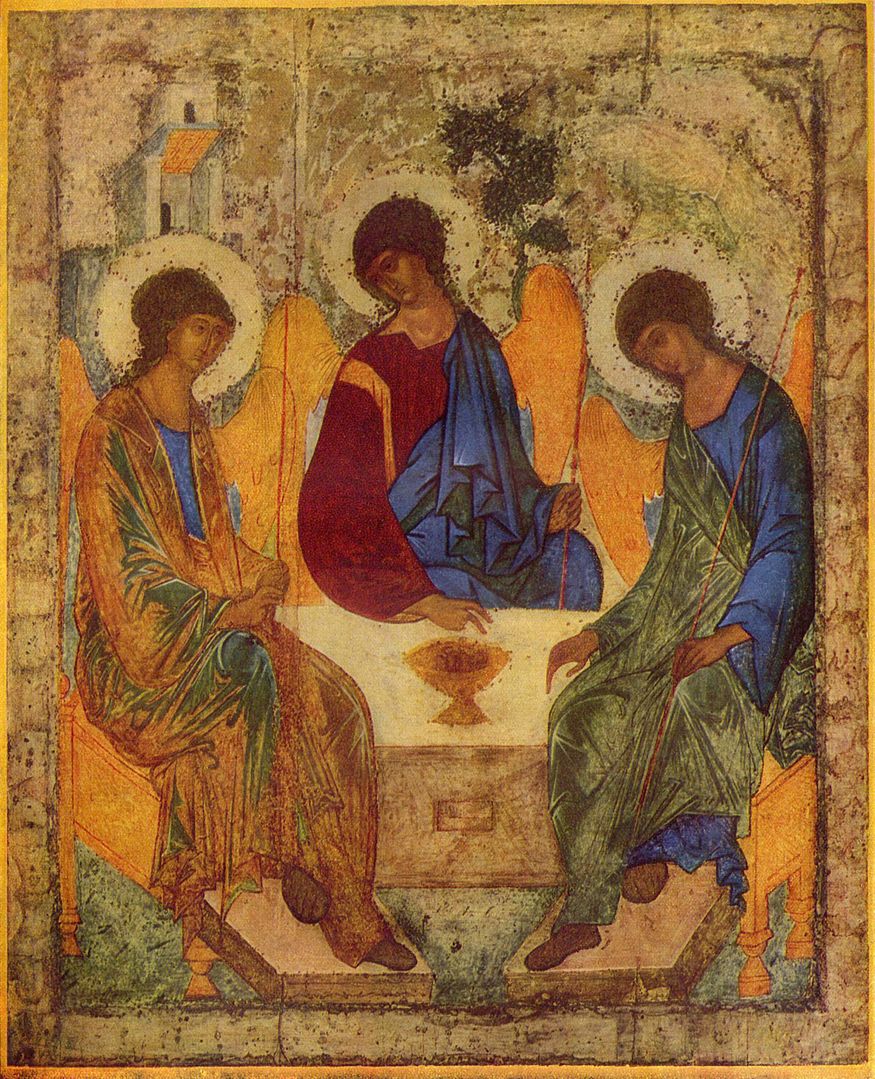
    • Abraham and Sarah are hosting a trio of Angels, some think the Trinity.  (A quick biblical note, “the Trinity” is not mentioned in the Christian or Hebrew Scriptures; the Trinity is a theological understanding of God that developed over time and from the scriptures — including this one and the multiple “Trinitarian formulations” in Christian scripture, e.g., invocations of the Father, Son, and Holy Spirit.)
    • In Gen 18:1, “the Lord appeared to Abraham” and in Gen 18:2, “… Abraham saw three men standing nearby” and then addresses them as the singular “Sir” in 18:3.
    • But the emphasis of the first reading (and the other two) is hospitality and invitation.  Abraham portrays the urgency of presence and welcome, in accordance with custom of the time and echoed later in Christian scripture with “Do not neglect hospitality to strangers, for by this some have entertained angels without knowing it.” (Heb 13:2).
  • In the gospel of Luke,
    • The story also emphasizes hospitality and prayer, with presence being the key to either ministry or engagement.  The acts of hospitality and the motions of prayer do not fulfill hospitality and prayer without our heartfelt or mindful presence in these efforts.
    • Martha is “anxious and worried about many things” (Lk 10:41), while Mary is present with Jesus in breaking open the scripture.
    • Mary could have been worried about violating social norms of women and religion, but she remained present to Love.  Martha could have been present to hospitality as Abraham was, who served his guests, and then “waited on them under the tree while they ate” (Gen 18:8).
  • In Martha Manning’s book, Undercurrents: A Life Beneath the Surface, Fr Dennis thought that Martha Manning’s book captured the sense of balance for each of us in our inner Martha and Mary.
    • This is the memoir of an ordinary woman—a mother, a daughter, a psychologist, a wife—who tells the tale of her spiraling descent into a severe, debilitating depression. Undercurrents pioneers a new literature about women and depression that offers a vision of action instead of victimhood, hope instead of despair.
    • We need faith that nothing is “taken away” when we rest, that is part of the contemplative nature of the Kin-dom.

For myself (rl), in light of Abraham’s and Sarah’s challenges in Jewish culture of the day from wandering, being landless for so long, and childless — I found the enthusiasm of Abraham in offering hospitality captured in Mary Oliver’s poem Why I Wake Early, when she writes a poem of gratitude and ends, “Watch now, how I start the day in happiness, in kindness.”  These choices not only bless and uphold wandering angels, they bless and uphold us.

Similarly, for the gospel, the invitation to and teaching of presence by Jesus, was captured in Mary Oliver’s Freshen the Flowers, She Said, in which she ends a poem about being present to fluffing cut flowers in a vase with “… Fifteen minutes of music // with nothing playing.”  

Andrei Rublev’s Trinity is the image of this post, though I was sorely tempted to find another image of daisies to share. Ann Arbor is hosting its annual Art Fairs (3 large fairs for 3 days), and one of the artists had a beautiful, super high resolution of a firefly sitting on a daisy bloom and back-lighting one of its petals. Extraordinary.

Fifteenth Sunday of Ordinary Time, Cycle C

Our readings for Sunday are here. 

These are the poems, my notes, and interpretations of Fr Dennis’ homilies from the

  • July 10, 2016 5PM Mass
  • July 14, 2013

_______

The poems Fr Dennis references in these years are:

In 2016, we reflected on such wonderful readings and good insights.  Thanks, D2!  🙂 —

  • In the first reading,
    • Moses is letting the people know that these are not obscure sets of law; they are close and within in us and in our hearts.  The early lines (Dt 30:10) state the law as the Will of God, and the remainder (Dt 30:11-14) capture the mystical, personal relationship with God.
    • rl is reminded of Jeremiah’s prophecy from God in J 31:33, that the Love of God will be written in our hearts and Saint Gregory of Nazianzus’ Oration 14 Love of the Poor (~370 C.E., in which he exhorts that we are made in the image of God (Imago Dei) when we love human beings, preferentially the poor).
    • All this returns to D2’s point:  We know what to do, God has placed it there inside us.  It’s the doing that is before us.
  • In the second reading of Colossians,
    • It reads almost like a hymn to Jesus.  He is both the inspiration for the Creation, and he sums it all up.
    • But the apostles and disciples know him as a human being — the humanity behind the divinity of which this “hymn” sings.
    • So few words are used compared to the impact of them.
  • In the gospel of Luke,
    • How we interpret the parable of the Good Samaritan how it has grown from its early interpretations, instead
      • Jesus = Good Samaritan
      • Adam = wounded/sick man, victim of the devil himself
    • In this understanding, then, the priest (law) and the Levite (prophets) pass by because only Jesus is compassion AND human’s death and resurrection.
    • In the parable, wine and oil are used to heal the wounded traveler, like Jesus comes to us in the wine and oil of the sacraments.
    • It all hinges on Mercy, “neighbor” is the one who shows Mercy.  We receive it and give it because we have been saved.  We do so (we mercify, or however you make “mercy” a verb!) out of gratitude, but also only because of having received the grace of Mercy from God.
    • In the text, the scholar of the law correctly captures that we need both love of God one-on-one and love in community (that’s why we pray the “Our Father,” not the “my Father”).
    • The parable makes one thing clear about God’s Mercy, the mercy that we are to live and are graced with:  exclude no one.
  • The poem by Marie Reynolds is
    • set in the context of her cancer treatments,
    • focuses on joy as the insatiable appetite for life and gratitude (“Thanks for my feet, my fingers, …”), hopes (“I want to see my mother again,” “I want my doctor to use the word ‘cure’ just once”), for others (“for the hands that position me, their measurements and marking pens”)
    • Early in the poem she gives “thanks for the scrub jay’s audacious cries …” and at the end she “close[s] my eyes and think[s] of the jay.”
  • Fr Dennis found
    • Jesus (“J” “jay”) in the lines “We wear the same raiment: blood, bone, muscle.”  This is akin to how Jesus shares our blood, bone, and muscle.
    • And this invisible bird — “invisible feathers, invisible wings” that give “a quickening, felt deep within the body, vigorous and fleeting” offer how in our soul, the sense of hope, wanting to live is the Spirit abiding in us.
  • Fr Eric Sundrup, SJ in the 10AM Mass gets a cameo with one of his insights from the parable that walking to help is (often) walking into danger, and we are to “go and do likewise.” <gulp>  However, when we do so out of the gratitude for the gifts we’ve received and the grace of mercy, we are made “safe” from the inside by the Eucharist.  In other words, we can be in consolation that we are in the right place at the right time, regardless of earthly outcome.

In 2013, we reflected on —

  • The readings offer the wonderful tension between God’s Will, as manifested in the law, and the mystical personal relationship, as manifested in the person of Jesus Christ.
  • Fr Dennis offered a Dorothy Day poem/note/quote indicating how grateful she was to know Jesus in prayer and in the poor.  Please take it as the art of Fr Dennis’ homilies that this was seamless in oration, and now clunky being resurrected in my deficient notes!  But Dorothy Day attended daily mass and had her own repeated presences in prayer with Jesus throughout the day.  The point being the same as made in the first reading — God and God’s Will, Love, and Mercy are not “out there,” they are in “here” (she wrote gesturing to her heart).
  • He then suggested Ignatian contemplation of the Good Samaritan parable, becoming alive in the scene and invoking your senses to see what God might have stand out for you at this time and place in your life.  (rl thinks that’s one of the great beauties of Ignatian contemplation:  God can reach you through scripture and connect it with your daily life, but do so uniquely across the experiences and days of your life without changing the words of the scripture passage you read.)

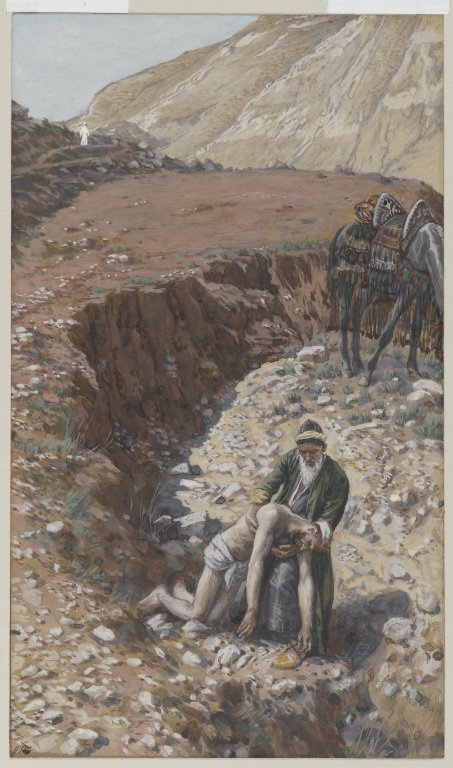
I chose a simple image of the Good Samaritan parable by James Tissot.  Most of his originals are tiny!  But the detail and sense of richness is large. He only used settings and human models of the region of scripture.

Fourteenth Sunday of Ordinary Time, Cycle C

Our readings for Sunday are here. 

These are the poems, my notes, and interpretations of Fr Dennis’ homilies from the

  • July 4, 2016 8:30 Mass
  • July 7, 2013

_______

The poems Fr Dennis references in these years are:

In 2016, we reflected on —

  • In the first reading,
    • Rejoice!  Rejoice! The first reading and the gospel are of joy.
    • They are nice readings to have during summer with its green and verdancy, vivid reminders to rejoice because our names are written in heaven.
  • In the Gospel of Luke, the author is the only one to mention the 72 disciples.  This number doesn’t come up often, and we don’t know who they are.  It’s possible they represent a literary parallel to Moses’ 72, to create the sense of Jesus as the new Moses, to assure the Jews that Jesus is in the line of prophets. See 2013 note on same topic, below.
  • In the poem, Margrave captures how to live love, a Christian love that always falls short, is always active, and always growing.  How love is lived rather than romanticized.
  • Also in the stumblings Margrave captures, we are called to keep reaching for the crazy love of Christ with and to each other.  Anything less?  We’re settling.
  • This poem was shared shortly after I had finally submitted my application for Pastoral Studies program at Loyola Chicago — and that’s what it felt like.  How could I ever explain to myself, let alone to admissions, why I wanted to continue.  Words never describe how God touches, creates, and recreates our lives.  But we can try, and live in the gratitude of the experience of being Beloved and trying to Love.
  • A brief Fr Eric Sundrup, SJ cameo — a reminder that the circumcision / no circumcision was a hot topic in its day, and the “no circumcision” point of view would have been received like bashing the United States on the Fourth of July, but the point of the readings is don’t settle, keep reaching for the glory of the cross —

In 2013, we reflected on —

  • In last week’s reading, Jesus seemingly set the bar pretty high — leave everything and everyone, etc… but even so …
  • This week, with that standard 70 disciples went out!  (It’s unclear in the original text whether it is 70 or 72 disciples), but in the Hebrew Scriptures Moses receives 70 helpers (Genesis 10), and there were 70 nations in the world at that time
  • Wendell Berry writes so pointedly about the strange search for rest and faith and peace in his poem The Lilies.  D2 offered
    • Isaiah and the Psalms are treasures of the heart, like lilies.
    • Letting the peace of Christ control our hearts in the seeking and not seeking; in the finding and not finding, particularly Isaiah, Psalms, Galatians, and Gospel of Luke.

No special message with the Van Gogh, other than that it is summer. We have much to be grateful for, even amidst all the work of the Kin-dom before us. 🙂

Thirteenth Sunday of Ordinary Time, Cycle C / Observance of the Solemnity of Sts Peter and Paul, Apostles

Our readings for the Sunday of this blog are here. 

The ones used for this Sunday, June 29, 2025, with the observance of the Solemnity of Sts Peter and Paul, Apostles, are these ones.

And at least one of our Jesuit reads the “Feed my sheep” passage from John 21:1-19. So. I am making an editorial choice this year to keep it simple and continue to share the notes of the Thirteenth Sunday and Fr Dennis’ homily from prior years. His Third Sunday of Easter (Good Shepherd Sunday Cycle X) has some, as usual, thoughtful insights into the passage from John.

These are the poems, my notes, and interpretations of Fr Dennis’ homilies from the

  • June 30, 2013

_______

The poems Fr Dennis references in these years are:

In 2013, we reflected on —

  • In the first reading of the standard Cycle C,
    • the mantle is a sign of a successor — in this case, Elisha being the successor of Elijah the prophet.
    • Elijah is being kind of cranky with God in the context of this vignette.
    • Elisha is responding in an all out “Yes!” and making sure he can’t turn back by breaking the plow and burning it.
  • In the Gospel, when Jesus refers to the looking back while using one of the light plows of the time, he is likely alluding that looking back while using the plows of his day would likely create a crooked furrow.
  • In D2’s and our youth, his mom (and likely our parents) often rolled out platitudes such as “anything worth doing is worth doing well.”  In his case, because often he was lazy and could do reasonably well without much effort, and now being older, and for whatever reason for each of us — we simply cannot do everything well … but there are still some things worth doing, even if we must do so poorly.
  • Another maxim, fitting to Elisha, is nothing succeeds like success (or excess)!  There is the success and excess of this world; and the excess that is the just right response to the overflowingness of Christ’s call and God’s Love that fits in our freedom of choice; i.e., it is no slavery on part. 
  • But our response is often mixed, tinged with regret and constraint in letting go, like the varied examples in today’s gospel reading.
  • “At North Farm” evokes the “and yet” quality that captures our desire to
    • to match God’s excess toward us and “do well.”  This something, this relationship with God is very much worth doing well.
    • and yet not letting that desire interfere with the reality of our limitations and still do this meaningful something, even when we must do so “poorly.”  Because, through Christ’s unrestrained and obedient offering of excess, we are “all in” by way of the Eucharist.

So … I’m not sure I have a good fox image handy for the “Foxes have dens” quote. But I found one with a fox outside its den! I hadn’t thought about this with the passage of foxes having dens and birds having nests; but, both have dens and nests only when they are incubating or raising their young. The kits are inside the den for one or two months while the dog and vixen hunt for food and protect them, and then foxes sleep outside. The same goes for birds. I’m not sure where reflection will lead with the idea that Jesus has nowhere to rest his head, in this context.

Solemnity of the Most Holy Body and Blood of Christ, Cycle C

Our readings for Corpus Christi Sunday are here.

Following are the poem, my notes, and interpretations of Fr Dennis’ homily from the

  • June 2, 2013, 10AM Mass

_______

The poem Fr Dennis referenced was:

In 2013, D2 shared —

  • In the reading from Genesis, Melchizadek prefigures Jesus, and this is his only mention in Hebrew Scripture.  The prefigurement arises in three notable ways:
    • Both offer bread and wine
    • Melchisadek blesses Abram in doing so; Jesus offers his blessing in doing so
    • Melchisadek is a king and priest of the Most High; Jesus is son/descendant of David, king and priest
  • Our Corinthians reading of today is the (historically) oldest written reference of the Eucharist, as the Letter of St Paul to the Corinthians (53 – 54 C.E.) predates any of the written Gospel accounts (~70 C.E. –> 120 C.E.).
  • In our gospel reading (Luke 9:11b-17, the Feeding o’ the 5,000), it shares how we have the Sacraments, and they comprise sacred moments of our lives … but, also, how they also reverberate through them.  E.g., Baptism denotes new life in Christ, yet every birth is thought to be a blessing of new life as a result of the Sacrament consecrating some births.
  • And so, Jesus is God all the time through all the events of a human life, and by his becoming human, he made all these everyday events sacred.
  • Alden Nowlan’s poem captures this sense of everyday events sacred for three friends in Great Things Have Happened. 

This blog week feels full, so here we go!

I don’t have many memories, if any, of Corpus Christi Sunday from when I was a wee lassie.  Having left the Church in spirit by the time I was 13, that’s not surprising.  However, on my trip to Rome in 2017, as part of an intensive field trip for my Church and Mission course in pastoral studies with Loyola Chicago, a bunch of our class went to the Corpus Christi Mass and Procession (which also happened to be my birthday) with Pope Francis presiding (what a gift!!).

We arrived about one hour early at St John Lateran Church for the papal Corpus Christi Mass.  We were in the second row standing on the grass with a clear view of the outdoor altar, albeit across the road and steps, etc.  It was amazing to have such a large Mass feel so personal spiritually, though being with my Loyola peeps helped lots!  A wonderful liturgy guide was provided and a beautiful choir, shared through an incredible sound system.  There seemed like a bazillion communion ministers (and even then not everyone could receive), but being so close, we did receive.  In my notes, I had written how I can still go to that communion space. 

But, interestingly, what I remember even more now was the procession of all of us, filling the street like blood fills an artery — purposed and full of life, and following the Eucharist to the plaza of Maria Maggiore on the Via Merulana. 

I still have my candle wrapped in wax paper and wax catcher. Almost all of us had one and had it lit, as we walked the street with music from speakers along the way.  It felt like there were more people in the procession than there were at the Mass!  Christ literally walking the streets with us and in us, all in so much Love.  We all end up squishing together in the plaza of Maria Maggiore where Papá met us again.

 “We are one body, one body in Christ, and we do not stand alone.”  🙂

And that’s what it felt like, and Christ’s sacrifice on the cross made more sense for receiving that every day and mystical experience of the Body in motion.

This Friday night our parish is offering prayer in the Stations of the Cross: Through the Lens of Racism.  The Stations and the Solemnity of the Most Holy Body and Blood of Christ feel all the more resonant in such proximity with each other.

Also, Dad’s birthday would have been on the 11th, and this past weekend (feeling a little early with the 2025 calendar), of course, Father’s Day.  The following had been a stanza in a poem I wrote in the early 2010s.  Now … this excerpt is a tighter and better-fitting poem and match to my Dad’s dadditude and an “everyday sacred” moment.

Evening Mass, When All the Others Were Asleep

by Lorraine Lamey

In tribute to Seamus Heaney’s When All the Others Were Away at Mass and my Dad

My bedroom door was closest to the kitchen.

He rarely woke me in his late night sojourns —

            the shufflings of a legal brief or scrapings of sandwich-making.

But, oh! the milk jug sliding off the refrigerator shelf and

            the tink-ings of the extra-large cookie tin

            filled to the brim with Mom’s holiday sables —

            Jackie Kennedy’s recipe, you know! —

            woke me in overeager joy.

Feigning sleepiness, I fake shuffled to the kitchen table.

Why do I always remember a place already set for me?  I know there wasn’t.

We ate, crunched, dunked, and slurped cookies with cold milk

            in a companionable duet for a half-century or better.

I have not one memory of what we said or didn’t say,

            except that once we downed a half gallon of milk

            and a half gallon of cookies to match,

consuming and consumed by the sugary host and milky cup.

Solemnity of Most Holy Trinity, Cycle C

Our readings for Trinity Sunday are here. 

These are the poems, my notes, and interpretations of Fr Dennis’ homilies from the

  • June 16, 2019 10AM Mass / Father’s Day, and
  • May 22, 2016, 8:30AM Mass, and

_______

The poems Fr Dennis references in these years are:

Across all years … and many celebrants, the constant acknowledgment is that the Trinity is a wondrous theology but doesn’t package up into a homily very well!

One of the reasons for this homiletic challenge is that we have the Mass which celebrates the Trinity, but “the Trinity” is not mentioned directly in the Bible.  There are a couple “Father, Son, and Holy Ghost” references in the Christian Scriptures and the Jewish ruadh occasionally referenced in the Hebrew Scriptures, but no author of any of the books writes “the Trinity.”  So the Trinity, our Triune God, is a theological understanding derived from personal and general revelation about and through God, that became captured in tradition of the Church.  It is one of our few conversations with God that isn’t centered in the Bible.

In 2019, we reflected on —

Alas, I do not have my notes but I recall the poem was offered for Father’s Day, Robyn Sarah’s Fatherhood hits a man, unsurprisingly, but in keeping with the mystery of Love present in the Trinity.

In 2016, we reflected on —

  • In Psalm 8,
    • the focus is on God at the beginning (8:2-4) but then the rest is about us humans (8:5-9) and returns to praise of God (8:10).
    • Fr Dennis used it as a gentle reminder that glorifying God in our daily lives (praise) is one way into the Trinity; the Glory of God is a human being fully alive.
    • Also, too, owning that our individual extraordinariness is somehow an expression of God is a path into the mystery of the Trinity.
  • The second, the Shakespeare excerpt, is a poem that’s not a poem.  From Hamlet, like most of Shakespeare’s plays is written in meter.  BUT, this passage is text/prose and sounds like Psalm 8 — starts with praise of creation (including humans) and then focuses on human misery (Hamlet’s to be exact).
  • We can rejoice to be one of God’s creations, and because of God’s Love we can also rejoice in the world and Glory of God.

With this, I’ll offer a brief homily cameo from Fr Michael Rozier, SJ, PhD, who was then completing his PhD from the University of Michigan’s School of Public Health.  He spoke that relationship is fundamental to understanding God, beyond knowing or believing.  The heart of the Trinity is relational, being Three in One, One in Three.  He also offered the reminder, taken from the Proverbs reading, that part of our relationship is “taking delight” in one another.

This idea of being a community of unity, a dynamic relationship … a dance, if you will captures the sense of the Trinity, of Love Loving.  And, as I enrich my relationship, the love of the mystery and abiding in it is more and more attractive than the study or the explanation of it.  Taking delight in the Trinity as much as the Trinity takes delight in us seems a most marvelous way to pass an eternity together.