Third Sunday of Easter Sunday Cycle B

Our readings for this Third Sunday of Easter are here. (https://bible.usccb.org/bible/readings/041424.cfm).  The Third Sunday of Easter we are visiting the Mass of: 

  • April 5, 2018 Noon

______

The poems Fr Dennis referenced are:

In 2018, we reflected on —

Easter is a time to delve into what the Resurrection means.

Jesus seems a bit different

 Before the ResurrectionAfter the Resurrection
Offering a greeting of Peace / Shalom, as recorded in any of the gospel accountsRare, if it is ever mentioned at all, even though this, accompanied by outstretched or extended arms, was a standard greeting of the dayIn almost every appearance mentioned, Jesus offers this greeting, as if to say “It’s okay.  Calm down” to a group of friends who had utterly abandoned him.

Jesus needs help proving that he is not just a ghost — eating fish is a good counterpoint!

Jesus is more like a friend now than “teacher”

  • He does not review / prove / or re-prove anything re the crucifixion and resurrection.
  • He is more like a friend, and “we know this together.”
  • Much of his time is spent hanging out with friends and having meals (no big miracles or healings akin to prior to the Crucifixion).

What are other ways you experience Jesus differently in the gospels pre- and post-Resurrection?

[rl — while it was just last week on the spiritual blog that we discussed the following poem; it was three years between uses by Fr Dennis!]

Today’s poems are April 5, 1974 by Richard Wilbur and Room Service English Muffins by Kim Dower.

  • Easter was April 5, 1974 in 2015, and this was also the date that Hank Aaron set the homerun record.  (The latter doesn’t particularly fit the poem, but people have puzzled whether April 5, 1974 was a particular date of importance or simply the day the poem was written, making it important enough.)  ‘Tis a good poem, one of an older style of poetry with rhymes in couplets.
  • The poem reminds D2 of the Resurrection with
    • the couplets of rocks twitching and blurring — “Was matter getting out of hand // And making free with natural law” 
    • a dreamy quality with, like the Resurrection, the unexpected ghostly appearances
    • the juxtaposition of the content of the poem is ordinary — flowers spring up in spring, the departure of winter” and the inherent extraordinariness of the happenings

In Room Service English Muffins by Kim Dower find the comfort in the disrupted routine and preferences during travel and movement.  That comfort and reassurance is like Jesus in the Resurrection — always with us.

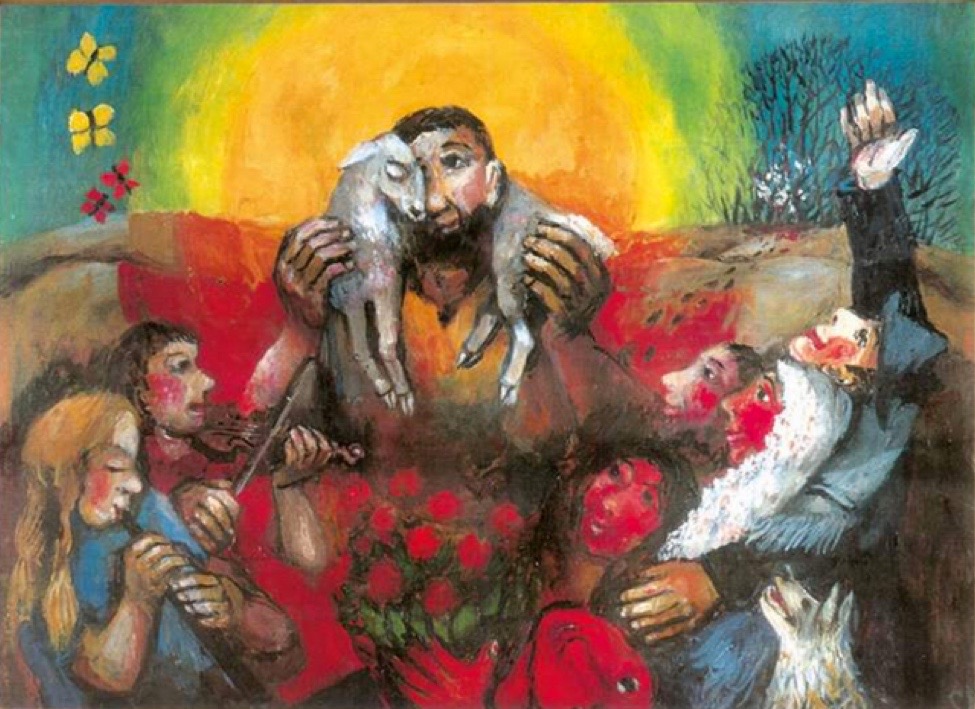
Our image today was created by the late Fr Sieger Koder (1925-2015), a German priest, WWII veteran, smith, and artist.  He retired from active priestly pastoral duties in 1995, but continued his artistry until he passed in 2015.  A gift of another 20 years to us all.  The Europeans have created a number of books offering retreat-like meditations using his work.

The featured image today is his “The Meal,” from the Lenten veil Hope for the Excluded, 1996.

Second Sunday of Easter Sunday Cycle B

Allelujah!! Allelujah!! He is Risen!!  (Enjoy! — it’s the last one as we end the Octave of Easter — back to regular “Thanks be to God!” and no “Allelujah!”s at the dismissal next Sunday.)

Our readings for this Second Sunday of Easter, also known as the Sunday of Divine Mercy, are here. (https://bible.usccb.org/bible/readings/040724.cfm).  So for most of Eastertide (through Pentecost), the first reading will be from the Acts of the Apostles, and the gospel reading mostly from St John’s account.

Again, these are the poems, my notes, and interpretations of Fr Dennis’ homilies from two different Cycle B years.  The Second Sunday of Easters we are visiting are the Masses of: 

  • April 8, 2018 Noon
  • April 12, 2015 5PM

______

The poems Fr Dennis referenced are:

In 2018, we reflected on —

Easter is about

  • what Resurrection means for Jesus
  • what Resurrection means for us
  • in other words, how do we hold Resurrection and death together?

Consider that during the Holy Week liturgies

  • in the Paschal sacrifice and creed we avow that Jesus “died and rose.”
  • the silences at the end of the Palm Sunday and Good Friday (and eventually, Holy Thursday, after the Sacrament is transferred to the Altar of Repose) liturgies are to show that none of the Holy Week masses are finished, are complete UNTIL our Easter Vigil in which from the darkness of the world in the beginning before God through the Light of the Sacrament and new people joining the church …
  • death and resurrection occur
    • the suffering of death, and
    • the suffering fulfilled in his Resurrection
  • we know this (that the suffering is fulfilled in his Resurrection) because God’s Mercy fulfills all this, because of the blood and water of Jesus poured out for us and creating the Church

As a reflection, we may want to think about some of God’s Mercies to me / us when we sing out God’s glory in the Gloria or psalm or hymns.  We might reflect on our close calls, when we were spared by God’s Mercy, as children of a God who is constantly saving us in Mercy, and in so doing, asks us to offer the same … or at least offer mercy.

Jeff Comer’s poem is a wonderful witness of how we have all been spared by very close margins.  Mercy comes close even (and most especially) in real serious danger.  Consider the parable of the Good Samaritan, when perhaps another 1/2 hour the traveler would be dead … or one of the blows had landed inches closer resulting in a fatal blow … or the innkeeper wouldn’t do business with a Samaritan or a near death traveler.

In 2015, we reflected on —

This is the day that the Lord has made (15:30 to 18:00 in the video),” as we just sung in the psalm … and so is all of Easter!

The reading from Acts is clear that, when we are of one heart and mind, we share our physical belongings and needs, too.

  • People are selling everything they own and pooling their money so they can live in community and in common to pray and serve together.
  • The passage helps show that people can be blown open in Love and faith to live in a new way, like the gospel and Thomas’ exclamation from his soul — “My Lord and My God!!”

The gospel offers the grace of being able to identify with Thomas, as we struggle with our doubts and resentments and more.  However, … the most important actor in the gospel isn’t Thomas, …  it’s Jesus!  🙂  Jesus is the heart and soul of the gospel.

  • Jesus is speaking to all of us 2,000 years later when he offers that “Blessed are those who have not seen and have believed.”
  • We believe and see Jesus in the events of our lives, the people around us, in the world around us, and, in those most blessed and rare of moments, inside ourselves.
  • (rl — interjecting a brief cameo from Bob Scullin, SJ’s homily at the Spanish Mass) that with the greeting of “Shalom [Peace]” the hands of the greeter are lifted wide in greeting, not unlike a partial extension on a cross.  This means that Jesus’ wounds are visible to his friends when the sleeves of his garment drop, and they identify him.  More importantly, with the visible wounds and Jesus’ physical presence and greeting, they can, Allelujah!  Allegria!, see he isn’t angry with them, see he is real.  In fact, Jesus is the face of God’s Divine Mercy / Miserecordia.
  • Again, Jesus is the focus.  Not Thomas, not us, not me.

Today’s poem is April 5, 1974 by Richard Wilbur.

  • Easter was April 5, 1974 this year.
  • The line in which Wilbur writes “a set mind, blessed by doubt, // Relaxes into mother-wit.”  “Mother-wit” meaning “good sense.”
  • “Flowers, I said, will come of it.”  The passage offers the grace of being at ease in a sudden confirmation of common sense — yes, I do know what is happening … and hope (flowers) follow this kind of awakening.

Doubts can lead to new insights and new life; we just need to keep growing in and through our doubts in confidence in the presence of the Spirit in our lives.

[Hoping for permission for what I think is a wonderful image by an amazing artist.]

Don’t think it’s happening — but I loved “Thinking of Ewe” by David Zinn, an Ann Arborean and international street / chalk artist of inimitable creativity.

Not ba-a-a-ad for all us sheep hoping to get Home, don’t you think? 🙂 Creation concreted over, and the white alyssum still find their way through … and flowers have come of it. And a sheep.

Easter Sunday Cycle B

Allelujah!!  Allelujah!! He is Risen!!

This is a re-publish with edits for the 2015 and 2018 Cycle B with a new image and a little new text, but here is the link sharing all of the ABC readings and poems and my notes from the Fr Dennis’ Easter homilies of yesteryear. It seems more Easterly to provide a bounty of poems!

Our readings for this Sunday, Easter, the Resurrection of the Lord are here. (https://bible.usccb.org/bible/readings/033124.cfm).  The readings are ABC, meaning they are used every Easter Sunday when the Mass of the Day is celebrated (cf. the usual Sunday readings which tend to use one of the synoptic gospels (Saints Mark, Matt, and Luke throughout each of the liturgical years Cycle A, B, and C). 

Again, these are the poems, my notes, and interpretations of Fr Dennis’ homilies from a couple years.  The Easters we are visiting are: 

  • April 1, 2018 Cycle B
  • 8:30 Mass on April 5, 2015 Cycle B

______

The poems Fr Dennis referenced are:

The following are notes from the earlier Easter celebrations — in 2018 I was often serving at other St Mary’s liturgies during the day and didn’t always get to hear the homilies associated with the poems and notes!

The 2018 essay by Margaret Renkl is her journey of faith in and out and in of the Catholic Church, but she practically begs for us to read Wendell Berry’s Manifesto: The Mad Farmer Liberation Front.

In 2015, we reflected on —

That Easter Sunday Mass is a bit of a letdown from the Vigil and other Triduum masses, a bit quieter and less detailed exaltation. But, in some ways, more easily joyful.

  • It’s interesting to note that compared to his public ministry of healings and miracles prior to the Passion, Jesus “doesn’t do much” after the Resurrection.  He could have done fantastic things.  But other than the fish catch of 153 fish after a night of empty nets, there are no miracles.  Even that is not on a par with those miracles before the crucifixion or the resurrection itself.
  • It seems that all he wants to do is eat with his friends.  He seems quite content to be ordinary.
  • So … we’re going to rise, but we want to cherish what is happening all around us — food, eating, breathing, living.
  • Breathing — the miracle and depth of it in any given moment.  The Hoarfrost and Fog poem by Barton Sutter captures this beautifully.  Perhaps imagine that first breath again for Jesus once Resurrected.
  • We are all born again when we realize we have a God who became human so God could see things from our point of view; and he died and rose so that we could learn God’s point of view, i.e., God’s Love for us.

The image today is of the atrium in our parish in which we honor Our Lady of Guadalupe.  Though we are officially Saint Mary of the Immaculate Conception, we have a strong devotion to Nuestra Señora, the Mother of the Americas — as we are a multi-generational and international parish.  We are also ministered by Jesuits.  Over the years we have grown in our understanding of Ignatian Spirituality, the spiritual practices and techniques witnessed and recorded by Saint Ignatius of Loyola.

In the Spiritual Exercises of Saint Ignatius of Loyola, there are roughly four “Weeks” of spiritual journey, not seven day weeks literally, but four main periods of interior, spiritual movement.  The “Fourth Week” is the section of spiritual journey in which someone walks with Jesus during the Resurrection.  He offers a reflection, acknowledging that Scripture does not say this, but surely the first person Jesus must have visited once resurrected was his mother.

From Joseph Tetlow, SJ’s guide to the Exercises, he prompts the retreatant, the person reflecting on this exercise, to consider how

  • he came to her
  • what they said to each other, what did they do, and imagine them sharing with you their respective experiences of the moment
  • how did Jesus console his mother, who surely must have been heartbroken and traumatized by what she saw happen to her son?  how do we nowadays console surviving family members lost to state violence and terrorism?
  • how did Jesus, Lord Savior of the Universe, manifest his divinity to his Mom, who knew him from his first moment as fully human.
  • rl only — did they celebrate? how so?

Palm Sunday Cycle B

Our readings for Palm Sunday are here. (https://bible.usccb.org/bible/readings/032424.cfm).

These are my notes and interpretations of Fr Dennis Dillon SJ’s homilies from the March 25, 2018 Mass at Noon and March 29, 2015 at St Mary Student Parish, Ann Arbor, MI.

______

The poem and reading Fr Dennis references are:

On Turning Ten by Billy Collins (25 Mar 2018 Noon)

Excerpt from I Know Why the Caged Bird Sings by Maya Angelou, pp 29 (“When I was around ten years old, …”) – 34 “… and hummed ‘ Glory, glory, hallelujah, when I lay my burden down.'”) (29 Mar 2015)

In 2018, D2 reflected —

While it is Palm Sunday and the entrance starts so promising, it feels Good Friday-ish because of the reading of the Passion.  We hear this reading of the Passion again on Good Friday. But it seems a short time of celebration, even as we must admit Jesus probably knew the entrance was not an enduring celebration of his ministry or himself.

In the Spiritual Exercises of St Ignatius of Loyola, the spiritual movements of our soul towards God are captured by “Weeks.”

  • The First Week is God’s Love for us and only then do we consider the sinful quality of ourselves and the world, the system of sin.  These reflections inevitably, at some point, lead us to the conclusion:   We need a Savior! 
  • The Second Week is when our spiritual reflection focuses on the Savior, and we walk with Jesus in his public ministry.
  • The Third Week of the Spiritual Exercises is the Passion and Death of our Savior.  We don’t focus so much on our guilt and shame (or even our own grief) because then we are not focused on Jesus.  We do so because the details of his death and ongoing throes leading up to the Passion demonstrate he is human and we feel emotional attachment to him. 

He seems mostly human in his Passion despite being able to have done something about it as God, but he consciously and conscientiously goes through this for Love.

He is bloody, he is human.  There are two times we read of Jesus bleeding.

  • The first is his ritual circumcision, and the bleeding is implied.  This blood alone would have been enough for the sacrifice.
  • The second is the Crucifixion, in which he pours out his blood.  He suffers emotionally, socially, and physically in such a way that individuals suffering in all ways might know they are not alone.  We are never alone in our sorrows or our joys.

Billy Collins’ poem touches on, perhaps, what Jesus as human might have had to face (as his time neared), and we certainly do.  It seems only yesterday I used to believe there was nothing under my skin but light. //  If you cut me I could shine. // But now … I bleed.

In the Jesuit mother ship in Rome, The Church of the Gesù, the apse generally has a painting of the Circumcision, and then a statue of the Sacred Heart is rolled out around that day’s observance.  And, of course, the Altar Crucifix is present.

In 2015, D2 read and reflected on the excerpt from Maya Angelou’s I Know Why the Caged Bird Sings autobiography.  The excerpt is when Maya Angelou’s Momma endures in Christ the mockery and attempted dehumanization of some poor white children of the area through violations of basic decency, manners to our elders, and more — all unbound from morality because of the children’s concept of race and God.

It remains one of my favorite Palm Sunday observances to this day — to have such a vivid reminder that the Passion and Crucifixion is all too alive in this time, still, for some of us.  Our parish does a shared reading of the Passion — the Celebrant and two lay readers.  The two lay readers that 2015 Palm Sunday happened to be student-parishioners, vibrant young women, and richly graced in their African-American identities.  I can’t remember the particulars anymore, but my heart is singing, “Glory, glory, hallelujah, when I laid my burden down …”

Our image is a repeat, The Last Supper by Sieger Koder. Which face are you drawn to?

Fifth Sunday of Lent Cycle B

Our readings for this Sunday, the First Sunday of Lent are here. (https://bible.usccb.org/bible/readings/031724.cfm).

These are my notes and interpretations of Fr Dennis Dillon SJ’s homily from the 8:30AM Mass on March 22, 2015 at St Mary Student Parish, Ann Arbor, MI.

______

The poem Fr Dennis references in 2015 is:

Quarantine by Eavan Boland (22 Mar 2015 8:30AM)

In 2015, D2 reflected —

  • At this point, the Fifth Sunday of Lent, the season is becoming a bit more somber as we’re moving to Jesus’ passion and death, which prompts the questions:
    • What is most important to us / for us?
    • What are our decisions about?
  • This time of Lent and these questions call us to think about how central God’s Love for us and for each other is.

The poem, Quarantine by Eavan Boland (now deceased), from the 2015 homily generated several reflections in Dennis, SJ —

  • a somber tone to the poem
  • describes the action of love rather than the words of love
  • the husband / man offered an action of love (holding the woman’s feet to the last source of his body heat, his heart) in a time of what could only have been a dark abyss (see more below). 
  • This is the sort of love we take into Holy Week, a love that recalls another’s humanity out of our own act of humanity when circumstances want to force despair and inhumanity, and then commingling our shared sense of humanity into the sacredness of Jesus Christ.  Giving ourselves totally in Love and to Love to say “Yes.”

For those unfamiliar with An Gorta Mor / The Great Famine of Eavan Boland’s poem, it and the echo famine of 1879, following two centuries of penal (anti-Gaelic, anti-Catholic) laws enacted by the British in Ireland, caused the massive decline of the Irish population from 8 million to 4 million in roughly 50 years — 2 million lost to starvation, and another 2 million lost to emigration, with families shattered. 

If you listen to “Thousands Are Crossing” on the Winter’s Crossing by James Galway and Phil Coulter, narrated by Liam Neeson, you’ll get a flavor of the sorrow.  An 1847 painting of An Gorta Mor, “The Irish Peasant Family Discovering the Blight of Their Store” by Daniel MacDonald, an Irishman, is one of the only known contemporaneous paintings to capture a family’s moment of despair during the Great Famine.

The Irish were relegated to growing potatoes to feed themselves, while the remaining crops were exported for British profit.  When the blight hit their potatoes, which could be harvested looking fine and then rot some time later, no policy or tax was changed to save the Irish from starvation during An Gorta Mor

Our featured image today is of the sculpture Kindred Spirits by Alex Pentek, composed of nine 20′ high stainless steel eagle feathers forming a bowl; this article further describes the art and surrounding culture of Kindred Spirits installed in Co. Cork.

Why?

This rte.ie article describes the kind of love we hear in Eavan Boland’s poem, except between groups of people.  The Choctaw and Cherokee nations, having recently endured the Trail of Tears and having lost nearly 1/4 of their remaining people, decided to raise money and donate (likely through the Quakers) towards the relief of the 1847 Irish Famine as one of their earliest acts of self-governance following their forced relocation by the United States government and dissolution of their native / original self-governance. 

This sacred giving was remembered by the Irish when the Covid-19 pandemic of this century struck.  While the Choctaw and Cherokee nations faced hardship during the pandemic, the Diné / Navajo people faced a public health disaster and the potential catastrophic loss of their families, elders, faith keepers, and language guides during a quarantine ranging across 140,000 people and 72,000 square miles.  A group of younger Navajo created a GoFundMe account when they realized the federal government would not be acting with the alacrity nor the volume of aid needed.  A simple look at the “remembrances” section of the GoFundMe page reveals the sacred link of Irish gratitude across centuries and thousands of miles.

Fourth Sunday of Lent Cycle B

Our readings for this Sunday, the Fourth Sunday of Lent are here. (https://bible.usccb.org/bible/readings/031024.cfm).

These are my notes and interpretations of Fr Dennis Dillon SJ’s homily from the 10AM Mass on March 15, 2015 at St Mary Student Parish, Ann Arbor, MI.

______

The poem Fr Dennis references in 2015 is:

A Drink of Water by Jeffrey Harrison (15 Mar 2015 10AM)

In 2015, D2 reflected —

  • The Cycle A readings, which we may use any year we have an RCIA class of catechumens (who are now the Elect by this time of Lent), are geared for those to be newly initiated and entering into a renewed church … which means, the readings are to renew us, the people of God as the church, too!  But, in the case of St Mary’s, there has been an RCIA class virtually every year, so we heard the Cycle A readings every year at all the Sunday Masses for a while.  As a result, we were missing out on the Lenten readings of Cycle B and Cycle C.  Now some of the Lenten St Mary’s Masses may use the Cycle A readings, for an RCIA observance of passage closer to Easter Vigil, and, of course, during Cycle A.
  • On the First Sunday of Lent, we were reminded of God’s ways and generosity by God’s setting of the rainbow to remind God’s self not to destroy the humans or other living creatures of the Earth through water again.  And while God may condemn to the 3rd or 4th generation, God blesses to the 1000th!
  • In the Chronicles reading today, the Jewish people are nearing the end of being held captive in Babylon, almost destroyed … near to no hope that they would ever be a nation with their own lands again.  They had almost disappeared after 70 years of captivity … and then, defying any expectation, restored by God acting through King Cyrus of Persia.
  • The history that the Jewish people and we are a part of is one of a God who is not predictable.
  • In the Gospel of John there is a pattern (not a logical construction, but a pattern)
    • In Genesis:  We hear of Eden and the serpent’s cross-talking words having Adam and Eve upend their relationship with God through their choice.
    • In Numbers 21:9, Moses stretches out and lifts the serpent up (so there is the foreshadowing of the Cross), and any who look at it will be cured.
    • Gospel o’ John:  The Son of Man will be lifted up so that those who look upon Him on the cross will be cured.
    • In Aramaic, “heals” = “salvation.”
    • Jesus’ spirituality heals and the physical healing is a sign of it.
    • (rl notes that this healing pattern played out in Greek tradition with the Rod of Asclepius, a  serpent-entwined staff, and even to this day being used as the symbol of the American Medical Association.)
  • back to D2’s homily / reflection — This notion of pattern across the millennia helps raise the question of us now:  How, Who, and Which patterns are we repeating?  What frailties, what darknesses are we repeating?  And, also importantly, what echoes of Jesus are we repeating, bringing forth into the world?

Today’s poem, A Drink of Water, by Jeffrey Harrison, offers this sense of patterns repeating in people.  The poet watches the son repeat the pattern of drinking water straight from the kitchen sink faucet, like the poet’s now deceased brother (“decades before anything went wrong, …”).  This pattern, a “small habit born of a simple need, // which, natural and unprompted, ties them together // across the bounds of death, and across time … //”

****

Our image today is of the Italian artist Gian Paolo Fantoni’s monument entitled The Brazen Serpent. It is on display at Mount Nebo to represent the bronze serpent on Moses’ staff (Numbers 21:9) and as the foreshadowing of Christ on the cross (John 3:14), his salvation / healing of us.  The 20+ foot sculpture is not quite halfway between Madaba (south of Amman, Jordan) and Jericho (roughly due east of Jerusalem) on Mount Nebo (elevation ~ 2300 feet).  The viewer can look across the valley containing the Jordan River and the Dead Sea to Jericho and Jerusalem.

Third Sunday of Lent Cycle B

Our readings for this Sunday, the Third Sunday of Lent are here. (https://bible.usccb.org/bible/readings/030324.cfm).

Again, these are my notes and interpretations of Fr Dennis Dillon SJ’s homily from the 10AM Masses on March 4, 2018 and March 8, 2015. 

______

The poems Fr Dennis references in 2018 & 2015 are:

The Sorrel Filly by Wendell Berry (4 March 2018 10AM Mass)

My Grandmother Washes Her Feet in the Sink of the Bathroom at Sears (8 Mar 2015 10AM)

In 2018, I must have only caught the Wendell Berry poem when I spoke with him later (as I don’t have any homily notes, just the poem) —

  • A farmer who, a week later, catches sight of the filly that he, in his bustle, was going to sell but couldn’t get his asking price … “…Now in the quiet I stand / and look at her a long time, glad / to have recovered what is lost / in the exchange of something for money.
  • And, this may be what underlies Jesus anger and exasperation — of what we lose when something or someone or Someone is reduced to a price.

In 2015, D2 reflected —

  • It is good to remember in the Exodus reading of today that the Ten Commandments are of a long tradition dating back to the Hebrew Scriptures, and the style and content reflects the basics of society from several millennia ago.
  • In the second reading, those who are called to see Jesus as the Ultimate Wisdom; Jesus as the one they want to spend their life with.
  • The gospel is not typical; we have one other account in Luke 19:45-48 of this angry episode of Jesus in John 2:13-25 (and coming directly after the first sign in John, the wedding at Cana — a quiet miracle occurring only on the prompting of Jesus by Mary) … but otherwise, Jesus is very mild.
  • With today’s John 2 gospel showing Jesus being very angry in the Temple, how the apostles must have been puzzled with this peaceful, calm Jesus and the angry, table-tossing Jesus.

In Mohja Kaaf’s poem, “My Grandmother Washes Her Feet in the Sink of the Bathroom at Sears,”

  • And the granddaughter finds a space of silent bridge builder by “hold[ing] the door open for everyone.”
  • In the third stanza, her grandmother’s indignation and anger is an expression of her faith, perhaps ….
  • in the same way Jesus’ anger was an expression of his faith.
  • Jesus is the True Son of God in his anger, maybe especially in his anger.

Our image is by the Indian (Bangalore area) artist Jyoti Sati, who focuses on the intersection of art and spirituality.

Second Sunday of Lent Cycle B

Our readings for this Sunday, the Second Sunday of Lent are here. (https://bible.usccb.org/bible/readings/022524.cfm).

Again, these are my notes and interpretations of Fr Dennis Dillon SJ’s poem from the 10AM Mass on February 25, 2018, an undated daily Mass homily on the Transfiguration, and the 8:30AM Mass on March 1, 2015.  

______

The poems Fr Dennis references in 2018 & 2015 are:

Didn’t My Lord Deliver Daniel as sung by Paul Robeson (25 Feb 2018 10AM Mass)

Adirondack Moosehead by Jeffrey Harrison (1 Mar 2015 8:30AM)

In 2018, we reflected on —

  • I only captured the one poem/lyrics, without notes at the time.  … 🙂 or they are “somewhere.”
  • This spiritual is sung and choreographed in Alvin Ailey’s Revelations, an American classic in the dance repertoire.  I remember one year Transfiguration was observed during the week at a daily Mass (or a Transfiguration gospel reading was the reading of the day), and Dennis happened to be the celebrant. During the homily described his understanding, of course, some theological matters in the long tradition of theology but also how in his Jesuit time in New York City , he had the opportunity to see Alvin Ailey’s Revelations.  (It premiered in 1960 when Alvin Ailey was 29.  !!)
  • What I remember is D2 offering that after seeing these luminous dancers of the soulful, rich music — he left feeling like he could dance like that, even as he knew he couldn’t!  He felt like he floated up the subway stairs and could have danced down the New York City streets back to the Jesuit residence. 
  • That sense of Transfiguration always stuck with me — the feeling of the illumination of our souls which, if even for a moment, outshines the limitations of our bodies.
  • Here’s a link to one of the “Daniel” scene performances in Alvin Ailey’s Revelations. It is at about 3:30 time of the full 1/2 hour-ish choreography — well worth watching!!

In 2015, D2 reflected —

It is good to remember in the Genesis reading of today that

  • in the tribes around Israel at the time of Abraham, child sacrifice was common.
  • it was used as an (extreme by our standards) expression of sacrificing the best or first fruits, animals, or other possessions (recalling that children, like women, have been considered “property” for much of the history of humanity) to gods or God.
  • so, in that context, we can say that God, in this story and example, is very clearly saying “No.  This is what I am NOT calling you to do.”

Likewise, in the Transfiguration,

  • Jesus and God reveal another side of themselves to us (after having long retired the flaming bushes and overwhelming Presence in favor of God-with-us humility) … which raises the issue
    • How do we (each and communally) know God?  And how do we allow for a change in how we know God?

This being surprised by God — can we accept and love a new facet of our Loving God?  In the poem, Adirondack Moosehead by Jeffrey Harrison, he takes on this notion of quiet presence and potential for change … and transfiguration.

  • (rl adds colloquially — Dandelions can be a “weed” or even like a prophecy of nature on planned, manicured lawns.  Most deciduous trees surrender all their leaves as part of an eventual complete regeneration of the tree itself — one tree, completely different and constantly changing manifestation throughout the year.)

So some possible reflections for us are:  Who is God for the author of this poem?  Who and how for each of us?  Who is God to me now and how do I respond?  In what faith will I respond to the next turn in the road?

Lent is the “changing of the heart-mind” season, a metanoia.

Our image this is week is James B Janknegt’s Transfiguration oil painting from 2001.  I love it for this week because of its celebration and the dancing like poses of Moses and Elijah — very fitting for the Alvin Ailey Revelations reflection of Dennis Dillon, SJ!

First Sunday of Lent Cycle B

Our readings for this Sunday, the First Sunday of Lent are here. (https://bible.usccb.org/bible/readings/021824.cfm).

Again, these are my notes and interpretations of Fr Dennis Dillon SJ’s homily from the 10AM Mass on February 18, 2018 and his poem selection from February 22, 2015.  

______

The poems Fr Dennis references in 2018 & 2015 are:

Evening on the Lawn by Gary Soto (18 Feb 2018 10AM Mass)

Small Boy by Norman MacCaig (22 Feb 2015 8:30AM, Noon, or 9PM Mass)

In 2018, we reflected on —

  • How the readings are a review of our basic call to be Christians — our covenants (God with us), our being claimed by God through Baptism, and our responsibility to confront our temptations.
  • 1st Reading (Genesis) Water! is a reference to Baptism (our RCIA / OCIA elect), a long tradition back to Noah, a one-sided covenant, a gracious guarantee as God promises Noah and all his descendants … but note that they don’t have any obligation to God in this covenant.
    • On a summer retreat I (rl) encountered my temptation of cynicism with this passage, as I wiseacred to myself that “Yeah, God didn’t promise we wouldn’t destroy ourselves …”  That is not who God is — not Lawyer God who specifies that burning up was not the part of that covenant; not Cynical God; not Human God (think STAR TREK IV) not any of those human frailties — but Love Loving.  We don’t know God, but I can remember this covenant (between God, humans, and ALL living creatures) and push back against my temptation to give up.
  • Back to D2 — The Sign of the Cross at the start of Mass is a remembrance of God’s promise in our Baptism; God leads us through the floods of our lives — great and small.
  • The Gospel — the first time D2 has thought of this time in the desert more squarely in the context of the vision quests, like the indigenous tribes across the globe.  The time in the desert is a journey to see who we are now and who we are meant to be.
  • Maybe Jesus, particularly in Mark’s version of the Time in the Desert, is a vision quest by Jesus to understand what “you are my Beloved Son” means, to find out what it meant.  The journey and meditation certainly marks a transition in his life and ministry.
  • In essence, that’s what we’re all doing as Christians, ever since our creation and Baptismal grace.  We are in the desert, trying to find out which spirits we are pulled by.
  • College can be a desert!   🙂  Trying to figure out who you are and who you are meant to be.  Jesus finds out that John the Baptist is arrested and to be killed; that’s when he announces his professional life.   (fyi — St Mary’s is officially Saint Mary Student Parish and is a parish dedicated by the bishop to serve the University of Michigan Catholic community and hosts the Newman Center, so there were a fair portion of young people present.)
  • Evening on the Lawn by Gary Soto describes a pivotal moment in a young man’s life when his gifts have him perceive this wondrous image of nature, an isolated roiling cloud seemingly gobbling up stars, and he calls his mother and stepfather to join him.  They don’t share the moment with him, though they come outside and indicate mild puzzlement or irritation that their routine was interrupted.  It is a pivotal moment of individuation for him (and all others) when the “home of our youth [is] struck by lightning.”  This felt like Jesus reconciling his new sense of identity:  devotion to the faith, his authenticity, and the faith traditions.  All of us are called and must do this devotion to the faith and the authenticity created inside us.

In 2015, D2 used (I must have missed the Mass / homily) —

  • Norman MacCaig’s poem, Small Boy, as a simple reflection on the practices and challenges of Lent:  we practice simple things every day but we are really “practicing for the future” and our greatest challenge is to “unclench [our grasp] and let them go.”

The Sunday readings were particularly meaningful for me this year.  I made my bucket list trip to visit the overwintering monarch butterflies in the central mountains of Mexico, about 3-ish hours west of CDMX (Ciudad de Mexico aka Mexico City).  I stayed closer to the southern edge of the monarch sanctuaries / reserves at Cerro Pelón Butterfly B&B (triple thumbs up!!), and they could take us out the back door to the Cerro Pelón Reserve or drive us in their comfy van to the other main reserves (El Rosario and Sierra Chincua) or any other place the monarch colonies were (literally) hanging out.  These monarchs born last August through October in the United States and Canada made the (up to) 3500 mile journey back to these areas in Mexico, form colonies to conserve body energy and protect each other, and are just now mating, and they will begin the northward migration laying the eggs for the first generation in northern Mexico or the southern United States.  It is the third or even fifth generation, never having seen or been to the mountain reserves in Mexico, who will overwinter there arriving between late October and mid-November.

When we visited the monarch colony in Sierra Chincua, it was very quiet being early in the season (late November) and during the work week.  I went with the 1/2 hour-ish ride being led on horseback up and up towards 10,000 feet, followed by a 20-ish minute hike to the colony.  I prayed a bit in this peaceful, quietly joyful place.  Grateful to be here, so very grateful for the Moreño familia whose business model for their B&B made this possible for me.  We had 30 minutes with the colony, and then went around the corner of the trail and sat down for our delicious packed lunch — a Meal as Communion if there ever was one!  As the clouds lifted a bit, the butterflies became more active — a “gentle explosion” of 100s rather than the 1000s you sometimes see images of.  Still — in the silence of no traffic, no human voices, no other noises whatsoever, all we could hear was the flapping whirr of monarch butterfly wings.  Unbelievable!  And then the rainbow came out.

My prayer had been that God not let us mess up and destroy these butterflies and their migration (the latter of which is headed towards extinction because of the decrease in number of butterflies).  I wiped away tears at the renewal of the covenant “between me [God] and you and every living creature with you” that we will not be destroyed (Gen 9:8-15).  So that is today’s image …

As one friend quipped — the only thing missing is the unicorn!  But deep mysticism in a cynical world does feel magical.  No unicorn needed.  🙂

The covenant is a good reminder that we never enter our journeys alone — God is with us, angels minister us, and the Trinity in our friends and communities shine brightly if we let them (sometimes the vulnerability that invites the shining is the hardest choice for us).

Sixth Sunday in Ordinary Time, Cycle B

Our readings for Sunday are here

These are the poem, my notes, and interpretations of Fr Dennis’ homily from a Mass of

  • February 15, 2015

_______

The poem Fr Dennis references this year is:

In 2015, we reflected on —

  • Lepers were segregated because of the fear of transmission of the illness.  [We now know that Hansen’s Disease (a.k.a leprosy) is not transmitted by contact.]
  • In curing this person, Jesus moves from being in town to being out in the country (apart), as the leper moves from being outcast to being back in town, in community.
  • This exchange is a curious result in this world, but by taking someone else’s burden to ease theirs, that’s how we serve:  we take it on; the extraordinary in the ordinary.
  • Jesus heals in words AND touch, with emotional AND physical connection.
  • He is a reluctant Messiah and not what the Jewish people were expecting
    • he leaves for the boonies of the boonies
    • “Don’t tell anyone [that I healed you]”
  • In the Shed by Mary Logue unveils an ordinary event but also a Testament, that there is an element of rest and consolation in the Buck’s dying, i.e., all deer die but not all find rest in their dying.  “Testament” = “covenant”  The buck in this poem witnesses the covenant in its death in the shed.
  • Jesus was not a worldly redeemer / messiah, but He brings hope in what we otherwise find to be hopeless, especially during Lent.  Though dying is hard, there can be peace in it.

One of the images today is from Cleveland.com (https://www.cleveland.com/middleburg-heights/2017/10/devastating_disease_killing_de.html) and captures the flavor of the poem, a buck finding repose in its illness amidst human settings, here at the edge of someone’s lawn abutting a small stream.  The photo is by Laura Takacs, and downloaded from the above October 5, 2017 article on 16 February 2025.

Our post image is Christ Heals the Leper by Vrindaji Clare-Maria Bowman, a U.S. artist.  The image was found on the Fine Art America website, https://fineartamerica.com/featured/christ-heals-the-leper-claremaria-vrindaji-bowman.html.  It is used this once, without permission of the site or the artist (at this point), but in hopes of sharing her work.  Here is her own webpage:  https://www.vrindajiart.com/biography

D2’s homily reminds me of conversations during the pandemic with friends in the medical profession.  The medical staff (nurses, doctors, technicians), administrative, and custodial staff met us on that boundary of life and death — as we were removed from society, the medical personnel met us there.  But the devotion to service and the grace it gives was wound tightly with the anxiety of bringing this deadly virus home to the ones they loved, those who shared the ones they loved with all of us who were sick and dying.

The extraordinary in the ordinary during an extraordinary time.